
Master the SaaS product development process with this practical guide. Learn how to validate, build, launch, and scale your product with real-world advice.
Jan 11, 2026
Building a SaaS product can feel like you're betting the house. I've seen it happen. But the truth is, a solid, structured process can turn that gamble into a calculated investment. It’s a roadmap that takes you from a raw idea all the way to a launched, scalable product. The whole point is to make sure you're building something people will actually pay for.
Your Blueprint for a Successful SaaS Product
Far too many founders jump straight into coding. They burn through cash and countless hours building a beautiful product, only to find out nobody has the problem they're trying to solve. This guide is your blueprint to avoid that fate. We’ll walk through how to systematically de-risk your idea, scope a lean MVP, structure your development work, and launch something that genuinely resonates with your target audience.
Think of this as a practical playbook. It’s for founders and product teams who need to be smart and efficient, focusing on tangible results that directly support business goals.
The Core SaaS Development Flow
At its heart, the process is pretty straightforward: you validate your idea, you build the core product, and then you launch it. Keeping this simple flow in mind helps everyone on the team stay focused on what really matters at each stage.
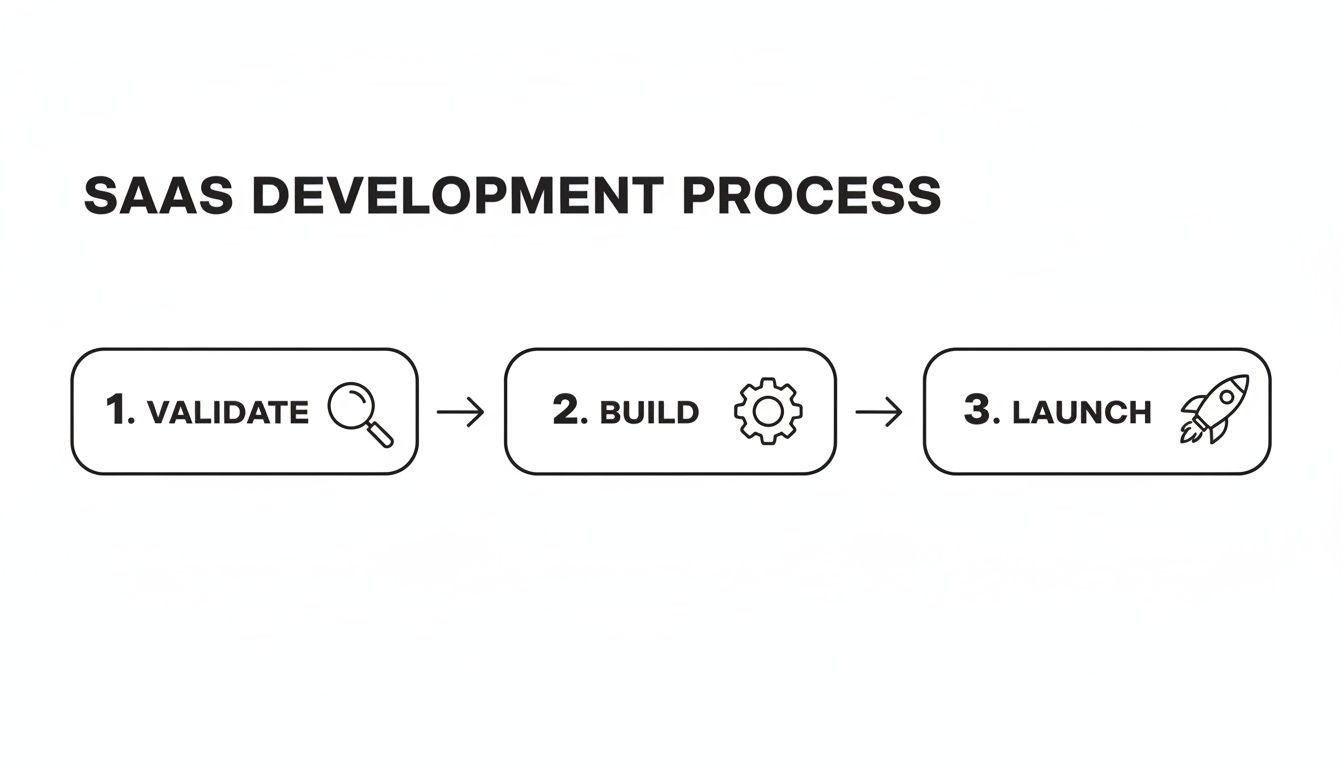
This visual drives home a critical point: building is not the first step. You have to validate the problem first.
Why a Disciplined Process Matters
Without a structured approach, you're just navigating in the dark. The most common pitfall is building in a bubble, completely detached from real market needs. The stats don't lie: a staggering 38% of failed startups go under simply because they built a product the market didn't need. If you want to learn more about avoiding this, check out what some experts in SaaS product development have to say.
That number is a harsh reminder that rushing into development before you've confirmed product-market fit is a one-way ticket to failure. A disciplined process forces you to ask and answer the tough questions before you write a single line of code.
A great SaaS development process isn't about rigid rules. It's about creating a framework that helps you learn and adapt on the fly, turning real user insights into product improvements with every single cycle.
By following a clear roadmap, you can:
Reduce Financial Risk: You’ll pour money into features that have been validated by real users, not just your team's best guesses.
Increase Speed to Market: A tightly defined MVP scope prevents "feature creep," helping you launch faster and start learning from real-world data.
Build Customer-Centric Products: This process naturally keeps your target user at the center of every single decision you make.
Align Your Team: Everyone—from design and engineering to marketing—knows the goals, the priorities, and what "done" looks like. It makes for much smoother collaboration.
To give you a clearer picture of the journey ahead, here’s a high-level overview of the entire lifecycle.
SaaS Product Development Lifecycle Overview
Phase | Primary Goal | Typical Timeline |
|---|---|---|
Discovery & Research | Validate the problem and identify the target audience. | 2-4 weeks |
Validation & Prototyping | Confirm the proposed solution resonates with users. | 2-4 weeks |
UX/UI Design | Create intuitive, user-friendly interfaces. | 3-6 weeks |
MVP Development | Build the core, essential features of the product. | 3-6 months |
Testing & QA | Ensure the product is stable, secure, and bug-free. | Ongoing |
Launch & Marketing | Release the MVP and attract the first users. | 4-8 weeks |
Measure & Iterate | Analyze user data and feedback for future sprints. | Ongoing |
This table serves as a quick reference, setting realistic expectations for how long each major step might take. Of course, these timelines can shift, but it’s a solid starting point for planning.
Validating Your Idea Before You Build
The single most expensive mistake you can make in SaaS development is building a beautiful solution to a problem nobody actually has. This validation phase isn't about writing code—it's about disciplined learning to save you from becoming another statistic. Think of it as your chance to rigorously test your core assumptions before a single dollar is spent on development.
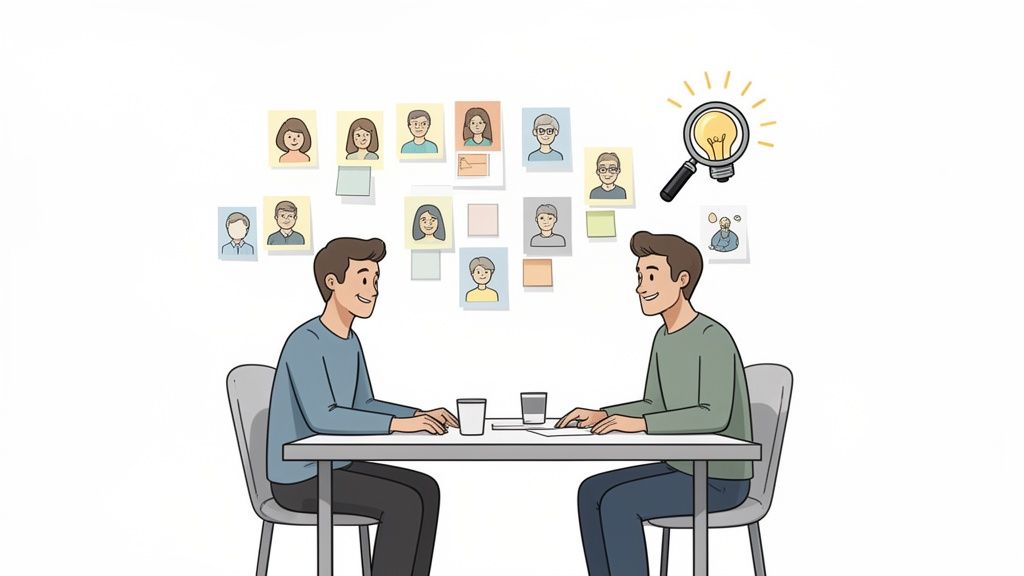
This is where you get out of your own head and into the minds of your potential customers. It’s the critical step that separates a cool idea from a viable business. Before you go any further, knowing how to validate a business idea is non-negotiable.
Uncovering Real Pain Points Through Interviews
Surveys are easy, but interviews are where the gold is. Your first mission is to talk to at least 15-20 people who fit your ideal customer profile. These aren't sales pitches; they are discovery conversations.
You're trying to understand their current workflow, pinpoint their biggest frustrations, and hear about the clunky workarounds they've pieced together. Steer clear of leading questions like, "Wouldn't it be great if you had a tool that did X?"
Instead, ask open-ended questions that get to the heart of their needs:
"Can you walk me through how you currently handle [the process your product addresses]?"
"What's the most frustrating part of that process for you?"
"Have you tried to solve this before? What happened?"
"If you could wave a magic wand and fix one thing about this, what would it be?"
Listen for emotion—frustration, annoyance, or stress. Those feelings signal a real, painful problem that people will gladly pay to make go away.
The deliverable here isn't code or a prototype. It's a validated concept, backed by real-world evidence, that confirms you're building a product people will actually pay for.
After these conversations, you should be able to articulate the problem even better than your customers can. This deep empathy is the foundation of every successful product.
Analyzing Your Competitors' Blind Spots
Chances are, you’re not the first person to tackle this problem. Competitor analysis isn't about just copying features; it’s about finding the gaps they’ve left wide open. Look at both direct competitors (those solving the exact same problem) and indirect ones (those solving it with a different type of solution).
For each one, dig into:
Their Target Audience: Who are they explicitly marketing to? You might find an underserved niche they’re completely ignoring.
Their Core Value Proposition: What's the main benefit they're promising? Is it speed, cost savings, or something else entirely?
Customer Reviews: Scour sites like G2, Capterra, and Reddit. Look for recurring complaints—these are your opportunities. Phrases like "I wish it could..." or "It's great, but..." are absolute treasure troves of insight.
Your goal is to find a unique angle. Maybe the competition is too expensive for small businesses, too complex for non-technical users, or missing a key integration. That weakness is your entry point.
Defining Your Problem and Hypothesis
With all this research in hand, it’s time to get specific. This brings crystal-clear clarity to your entire team and becomes the North Star for the rest of the development process.
First, write a clear problem statement. This is just a concise, one-sentence description of the user's issue. For example: "Early-stage marketing teams struggle to consistently track their content ROI without stitching together multiple, expensive analytics tools."
Next, formulate a testable hypothesis. This is your proposed solution and the outcome you expect. For instance: "By providing a unified dashboard that connects website analytics with social media engagement, we will help marketing teams save 10 hours per month and improve their content strategy decisions."
This hypothesis gives you a specific, measurable goal. From this point forward, every feature you consider building gets weighed against this statement. If it doesn't directly contribute to solving this problem, it doesn't belong in your MVP. This kind of ruthless focus is what separates successful MVPs from bloated, delayed projects.
Defining Your MVP and Designing the User Experience
Alright, you've validated your idea. Now the real fun begins. It's time to shift from learning to building, but this is where so many founders go wrong. The goal isn't to build your entire vision at once; it's to build a Minimum Viable Product (MVP).
An MVP isn't just a buggy, stripped-down version of your final product. Think of it as the smallest, simplest thing you can build that delivers real value to your first set of users. It’s a tightrope walk between getting to market quickly and not shipping something that’s broken.
The whole point is to get your product into the hands of real people, see what they actually do, and start that crucial Build-Measure-Learn feedback loop. Resisting the temptation to add "just one more feature" is probably the hardest discipline in the entire saas product development process, but it’s what separates the projects that launch from those that die in development.
Prioritizing Features with Ruthless Focus
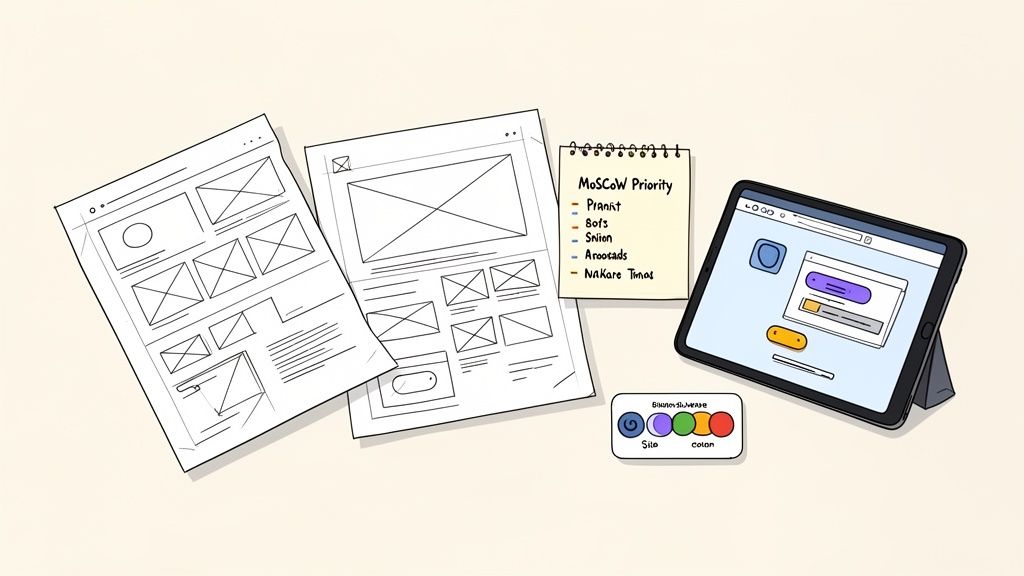
So, how do you decide what gets built and what gets cut? You can't just go with your gut. You need a system. One of the most effective and straightforward frameworks I've used is the MoSCoW method. It’s a simple way to categorize every feature idea you have.
This isn't just a box-ticking exercise; it forces you and your team to have tough, honest conversations about what is truly essential to solving the core problem you uncovered earlier.
Must-Haves: These are the absolute, non-negotiable features. If these aren't in the product, it simply doesn't work. For a project management tool, this would be the ability to create a task and assign it to someone.
Should-Haves: These are important and add a ton of value, but the product can launch without them. Think of these as top contenders for your very next update. In our example, this might be adding comments to a task.
Could-Haves: The "nice-to-have" stuff. These features are polish—they might improve the experience slightly, but they don't solve a core pain point. Think custom color themes or slick animations.
Won't-Haves (for now): This category is just as important as the first. It’s a clear line in the sand. These are features you explicitly decide not to build for the MVP. Advanced reporting or third-party integrations usually land here at the start.
Using a framework like this is your best defense against "feature bloat," the silent killer of MVPs. It keeps everyone on the same page and focused on the real prize: shipping.
From Core Features to Tangible Design
Once you’ve got that tight list of "Must-Haves," it's time to make them real. The design process is about translating abstract features into a concrete user experience (UX) that feels intuitive. You’ll move from big, messy ideas to pixel-perfect screens. The SaaS industry is exploding, and a product's success often comes down to how well its development process fits its stage. For an early-stage company, that means short, fast cycles focused on nailing product-market fit.
The design journey usually unfolds in a couple of key stages:
Low-Fidelity Wireframes: Start with the skeleton. These are simple, black-and-white layouts that focus purely on structure and user flow. Don't worry about colors, fonts, or logos. The only question you should be asking is: "How does a user get from A to B to complete their goal?"
High-Fidelity UI Mockups: Once the blueprint is solid, your UI designer can start painting. This is where the brand comes to life through colors, typography, and icons. These mockups are a preview of exactly what the finished product will look like.
A classic rookie mistake is jumping straight into high-fidelity design. Wireframing first saves you a mountain of time. It's infinitely cheaper and faster to fix a bad user flow on a simple sketch than on a fully designed mockup.
Creating a Clickable Prototype and Design System
The last stop before you hand things over to your developers is the clickable prototype. Using a tool like Figma or Adobe XD, you stitch all those high-fidelity mockups together into an interactive simulation. This is huge. It lets you and a few test users actually click through the app as if it were real, catching any awkward or confusing spots before a single line of code is written.
This prototype becomes the ultimate source of truth for the engineering team. For a deeper dive, our guide on UX design for SaaS covers how to create experiences that keep users coming back.
At the same time, it's smart to create a basic design system. It doesn’t need to be a massive, complex library. Just a simple collection of your reusable UI components (like buttons, forms, and navigation bars) and defined styles (your color palette and fonts). This not only keeps the app looking consistent but also makes development way faster down the line. Engineers can grab a pre-made component instead of building it from scratch every time.
Bringing Your SaaS Product to Life: Engineering and QA
Alright, you’ve got a validated concept and a design prototype that looks fantastic. Now for the exciting part—turning those ideas and mockups into actual, working code. This is where the engineering phase kicks off, and it’s where your SaaS product starts to feel real.
But this stage is also where things can easily go off the rails. Without a solid process, you risk spiraling into a mess of missed deadlines and buggy software. The key is to bring structure and discipline to the creative chaos of coding.
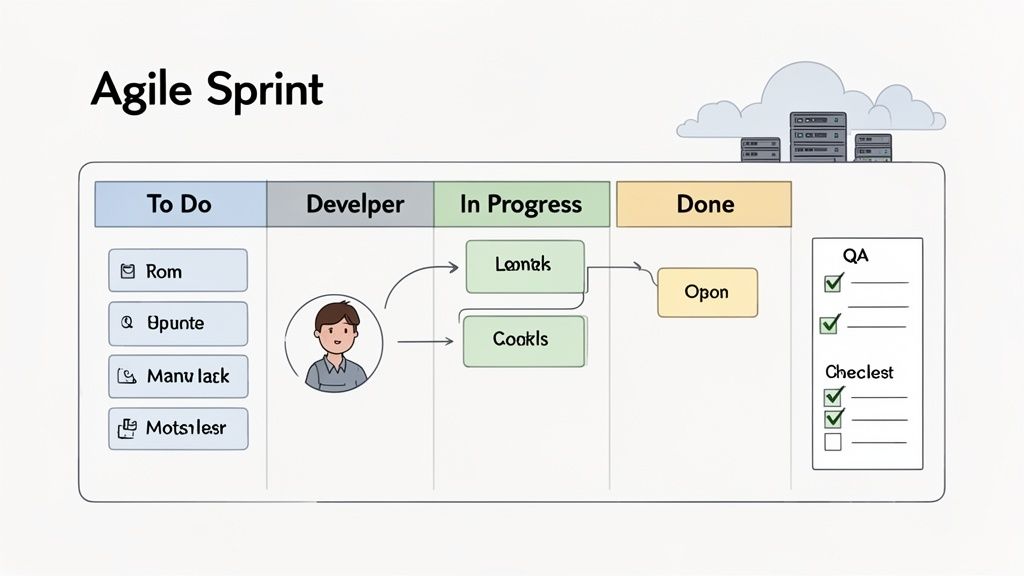
This is where an agile methodology becomes your best friend. Frameworks like Scrum or Kanban are designed to break the massive undertaking of building a product into small, manageable pieces. It keeps the team aligned, productive, and laser-focused on delivering value step-by-step.
The Rhythm of Development: Agile Sprints
Instead of one long, grueling development cycle, agile works in short, time-boxed periods called sprints. Think of them as mini-projects, each with its own clear goal. We typically run them in two-week cycles, which creates a predictable and motivating rhythm for everyone involved.
A standard two-week sprint has a few key meetings, or "ceremonies," that keep things moving:
Sprint Planning: We kick things off here. The product manager outlines the highest-priority items from the backlog, and the engineering team decides what they can realistically build in the next two weeks.
Daily Stand-ups: This is a quick, 15-minute daily huddle. Everyone shares what they did yesterday, what they're doing today, and—most importantly—any roadblocks holding them up.
Sprint Review: At the end of the sprint, the team demos the working software they’ve built. This isn't just a show-and-tell; it’s a critical moment for stakeholders to give feedback.
Retrospective: The final meeting. The team reflects on what went well, what didn't, and how they can do better next time. This commitment to continuous improvement is the real magic of agile.
This cyclical process prevents the team from disappearing down a rabbit hole for months. It guarantees that every two weeks, you have a new, potentially shippable piece of your product.
Laying a Strong Foundation: Critical Tech Decisions
Before a single line of code is written for the first sprint, your tech lead has to make some foundational calls. These early decisions will stick with your project for years, and getting them right can save you from a world of technical debt and expensive rework down the line.
The tech stack is one of the biggest choices. For an MVP, speed is the name of the game. That usually means sticking with proven, well-established frameworks and languages your team already knows inside and out, rather than chasing the latest shiny object.
Just as critical is setting up a scalable cloud infrastructure. Using a provider like AWS, Google Cloud, or Azure from day one lets you start small and seamlessly grow your resources as your user base explodes. It's far easier to build on a scalable foundation from the start than to migrate a live product later.
As more companies use multiple SaaS tools, managing them all is becoming a real challenge. Projections show that by 2026, half of all organizations will use SaaS Management Platforms, pushing the market from $6.55 billion to something much larger. This trend highlights why it's so important to build your product with compliance and easy metering in mind from the get-go.
Quality Assurance Isn't an Afterthought
Let’s be clear: Quality Assurance (QA) is not a final step you tack on at the end. It's a mindset that must be woven into every single part of the development process. Integrating QA early and often is the only way to build a product that’s stable and reliable.
Waiting until the end to test your product is like waiting until you've finished building a house to check the foundation. It’s a recipe for disaster.
We use different types of testing at different stages:
Unit Tests: Developers write these to check that small, individual pieces of code work exactly as intended.
Integration Tests: These ensure that different parts of your application can talk to each other and work together smoothly.
End-to-End Tests: These are automated tests that mimic a real user's journey, making sure entire workflows are functioning from start to finish.
A huge part of this is having a rock-solid process for bug tracking. Understanding and mastering the software bug life cycle is non-negotiable for an efficient team that wants to ship high-quality software.
What Does "Done" Actually Mean?
To keep everyone on the same page, you need to agree on a "Definition of Done." This is a simple, shared checklist that every feature must pass before it can be considered complete. You can get more ideas for this by looking at how other structured projects work, like these website development processes.
Here’s a simple template to get you started:
MVP 'Definition of Done' Checklist
This checklist helps ensure that every piece of work delivered by the engineering team meets a consistent quality standard. No story is "done" until it passes these checks.
Criteria | Description | Status (Template) |
|---|---|---|
Code Complete | All planned coding for the feature is finished. | ☐ Not Started |
Unit Tests Passed | All associated unit tests are written and passing with >80% code coverage. | ☐ Not Started |
Peer Reviewed | At least one other developer has reviewed and approved the code. | ☐ Not Started |
QA Tested | The QA team has tested the feature against all acceptance criteria. | ☐ Not Started |
No Critical Bugs | No open bugs with a "critical" or "blocker" severity exist for this feature. | ☐ Not Started |
Documentation Updated | Any relevant internal or external documentation has been updated. | ☐ Not Started |
Merged to Main | The feature branch has been successfully merged into the main development branch. | ☐ Not Started |
This isn't just about making sure the code works. It's about building a culture of quality that gives everyone—from developers to stakeholders—confidence in every single release.
Planning Your Launch and Driving Iteration
Getting your MVP out the door isn't the finish line—it's the starting gun. This is the moment when all the theory and planning meet the real world. Your focus instantly pivots from building to launching, measuring, and learning from what actual users do inside your product.
A great launch is never an accident. It’s built on a smart go-to-market plan that usually kicks off with a soft, controlled release before you swing the doors wide open. This first step, often a private beta, is your golden opportunity to iron out the wrinkles with a small, forgiving group of early adopters.
The real goal here is to test the entire customer experience, not just the software. I’m talking about everything from the signup flow and welcome emails to the initial SaaS onboarding best practices. You're hunting for any friction points that could cause a new user to bail before they even get to the good stuff.
Setting the Stage for Your First Users
Before that first person logs in, you absolutely need a few key pieces in place. This isn't just marketing fluff; these are the essential tools for turning curious visitors into active users and setting them up for success.
Here’s a barebones go-to-market checklist:
A Compelling Landing Page: Think of this as your digital storefront. It has to nail your value proposition, speak directly to your ideal customer’s pain, and have a can't-miss call-to-action to sign up.
A Simple Onboarding Flow: The first five minutes in your app are everything. Forget the exhaustive feature tour. Your only job is to guide users to that "aha!" moment as quickly and painlessly as possible.
Basic Support Channels: Give people a simple way to ask for help or report bugs. A dedicated email address or a simple chat widget works perfectly. Making it easy for users to give feedback is non-negotiable.
Measuring What Matters Most
Once people are actually using your product, you've officially entered the measurement phase. Gut feelings won't cut it anymore; you need cold, hard data to guide your next moves. The SaaS world is fiercely competitive, and companies are spending more than ever.
In fact, SaaS organizations are projected to spend an average of $55.7 million a year on their software stacks by 2026, which is an 8% jump year-over-year. This spending is directly tied to development priorities. For instance, spend on AI-native apps skyrocketed by 108%, with big enterprises seeing an incredible 393% increase in a single year. You can dig into more of these SaaS spending trends yourself. In this kind of environment, you can't afford to guess.
To start, just focus on a few vital SaaS metrics:
User Activation Rate: What percentage of people who sign up actually complete the one key action that shows they "get it"?
User Retention/Churn Rate: Are people coming back? Or are they leaving?
Customer Lifetime Value (LTV): Over time, how much revenue can you expect from an average customer?
Customer Acquisition Cost (CAC): How much do you have to spend in marketing and sales to get one new customer?
Your main goal with an MVP isn't to hit a home run with massive growth. It's to find a small tribe of users who are absolutely obsessed with your product. Once you find them, you can figure out how to find more people just like them.
The Build-Measure-Learn Feedback Loop
This is the engine that drives all smart product development. The concept, made famous by "The Lean Startup," is beautifully simple: you build a feature, measure how people use it, and use what you learn to decide what to build (or fix) next.
This cycle runs on two kinds of feedback:
Quantitative Data (The "What"): This comes straight from your analytics tools. It tells you what users are doing. For example, "Only 15% of users are clicking the reporting feature."
Qualitative Data (The "Why"): This comes from talking to users, sending surveys, and reading support tickets. It tells you why they're doing what they're doing. For example, "I didn't click on reports because it looks confusing and doesn't show the data I actually need."
When you blend these two insights, you get a roadmap that’s actually based on what your users need, not just what your team thinks they need. This is how you make sure every sprint delivers more value, tightens your product-market fit, and keeps your business moving forward.
Scaling Your SaaS Product for Long-Term Growth
Getting to launch is a huge milestone, but it's really just the starting line. The real marathon of the SaaS product development process begins now: turning that scrappy MVP into a mature, stable product that won’t buckle under the pressure of real growth. This is all about scaling smartly.
As more users sign on, that single, heroic dev team that got you here will quickly become a bottleneck. The logical next move is to split into specialized squads. You might spin up a "Core Experience" team to own the main user journey and an "Integrations" team focused solely on building out third-party connections. This setup lets you work on multiple big things at once, seriously ramping up how fast you can ship new value.
Of course, more teams bring more complexity. That once-tidy backlog can become a monster, fast. This is the point where you have to evolve how you manage the whole development process.
Managing Technical Debt and Architecture
Remember all those shortcuts and "good enough for now" decisions you made to get the MVP out the door? That's your technical debt, and the bill is coming due. You have to start paying it down. Ignoring it is like having a small leak in your roof—it seems fine at first, but leave it long enough, and you risk the whole thing caving in.
One of the biggest architectural decisions you'll face is whether to move from a monolith to microservices. A monolith is just a single, all-in-one application, which is perfect for an MVP. Microservices, on the other hand, break that application down into a collection of smaller, independent services. It's a huge shift that adds a lot of operational overhead, so you don't want to jump into it too early.
When is the right time? You'll know it's time to seriously consider microservices when your development teams start tripping over each other's work and deploying a tiny change requires a full-scale, white-knuckle redeployment of the entire application.
This change lets individual teams truly own their part of the product. They can deploy updates on their own schedule without risking a single point of failure that brings everything down.
Building a Customer-Centric Roadmap
As you grow, your roadmap becomes a balancing act. It's not just about chasing shiny new features anymore. A truly great product is built on a foundation of reliability, speed, and trust.
To achieve sustainable growth, your roadmap needs to dedicate resources to three key areas:
New Feature Requests: This is the exciting stuff, driven by customer feedback and market gaps. It's how you expand your product's core value.
Performance Improvements: This is the less glamorous but critical work—refactoring old code, optimizing slow database queries, and paying down that tech debt. These projects don't add new buttons, but they're essential for keeping your existing users happy.
Security and Compliance: The bigger you get, the bigger a target you become. You have to budget time and money for regular security audits, patching vulnerabilities, and staying compliant with regulations like GDPR. This isn't optional; it’s fundamental to earning and keeping your customers' trust.
Got Questions About SaaS Development? We’ve Got Answers
Even with the best roadmap, building a SaaS product is a journey filled with questions. I get asked these all the time by founders and product managers, so let's clear up some of the most common ones.
How Long Should an MVP Really Take to Build?
You should aim to get a solid Minimum Viable Product built in 3 to 6 months. If your timeline is stretching past six months, that’s a red flag. It almost always means your scope has gotten too big.
What's happening is that "nice-to-have" features are sneaking in, blurring the focus of what an MVP is supposed to be. The whole point is to ship a lean, functional product that solves a core problem. You need to get it into the hands of real users as fast as possible to start getting that critical feedback.
What are the Most Common Pitfalls to Avoid?
I’ve watched too many promising projects stumble over the same few hurdles. If you can sidestep these, you’re already ahead of the game.
Three mistakes pop up again and again:
Skipping Validation: This is the biggest one. Diving into code without first proving people actually need what you're building is the fastest way to create a product no one will pay for.
Letting 'Scope Creep' Take Over: An ever-expanding feature list is a silent killer. It delays your launch, blows your budget, and makes your core value proposition confusing. You have to be ruthless about protecting the MVP scope.
Ignoring Technical Scalability: Building for speed is smart, but taking major architectural shortcuts will bury you in technical debt later. It makes it a nightmare to add features or handle more users down the road.
A disciplined process isn't about killing creativity—it's about focusing it. It gives you the guardrails to steer clear of these common, costly, and completely avoidable mistakes.
What Key Roles Do I Need on My Development Team?
In the early stages, keep your team lean. Hiring too many people too soon just creates communication overhead and burns cash.
You can get a lot done with a small, core group:
Product Manager: This is the visionary, often a founder at the start. They own the strategy and decide what gets built next.
UX/UI Designer: This person is your user's advocate. They design the entire experience, from wireframes to the final polished interface, making sure the product is easy and even enjoyable to use.
Engineers (Frontend & Backend): You'll need at least one of each. The backend engineer handles all the server logic and data, while the frontend engineer builds everything the user sees and interacts with.
QA Specialist: Their job is to find and squash bugs, ensuring the product is stable. On a tiny team, developers might pitch in on testing, but having a dedicated QA role pays off quickly.
As you grow, you'll start adding specialists like a DevOps Engineer to manage your infrastructure.
How Much Does It Cost to Develop a SaaS Product?
This is always the big question, and the honest answer is: it depends. The complexity of your product, its scope, and where your team is located all play a huge role.
That said, you can use some ballpark figures for planning. A focused MVP with a clear feature set will typically land somewhere between $50,000 and $150,000. If you're building a more complex platform with advanced features, lots of integrations, or strict security needs, that number can easily climb past $250,000. The best way to control costs is to keep your MVP scope incredibly tight.
At Shalev Agency, we partner with founders and product leaders to get through every stage of SaaS development, from validating an idea to building an MVP people can't stop talking about. If you want a team to help you ship faster and smarter, let's talk about your project.