
Master the stages of product development for startups. This guide covers MVP creation, UX/UI, engineering, and scaling to turn your idea into a market success.
Jan 11, 2026
Building a product from the ground up is a marathon, not a sprint. For a startup, it's the entire process of taking a bright idea and turning it into something real that people will actually pay for. It’s all about moving fast, listening to your users, and using lean methods to create a product that can stand on its own.
Think of it less as a straight line and more as a continuous loop of learning, building, and adapting.
The Startup Founder’s Roadmap to Product Development
So you've got an idea that you're convinced is a game-changer. What now? Turning that concept into a market-ready product can feel like staring up at a mountain. Startups are always fighting the clock and the budget, which means a smart, efficient development plan isn't just a "nice-to-have"—it's a survival tool. The goal is to follow a clear path that removes as much risk as possible and proves you're building something people genuinely need.
It's a lot like building a house. You wouldn't start picking out curtains before you have the architectural blueprints and a solid foundation poured, right? The same logic applies here. You need a plan before a single line of code gets written. This roadmap walks you through the essential stages, helping you answer the tough questions and check your assumptions before you burn through your cash.
Your Five-Stage Journey
Every startup that makes it follows some version of this journey. It always starts with deeply understanding the problem you want to solve. From there, you confirm that people will actually pay for your solution, and only then do you build the simplest possible version to test that core idea. A full-scale launch and ongoing improvements come much later.
This five-step process maps out the entire journey, from that first spark of an idea to a cycle of continuous improvement.
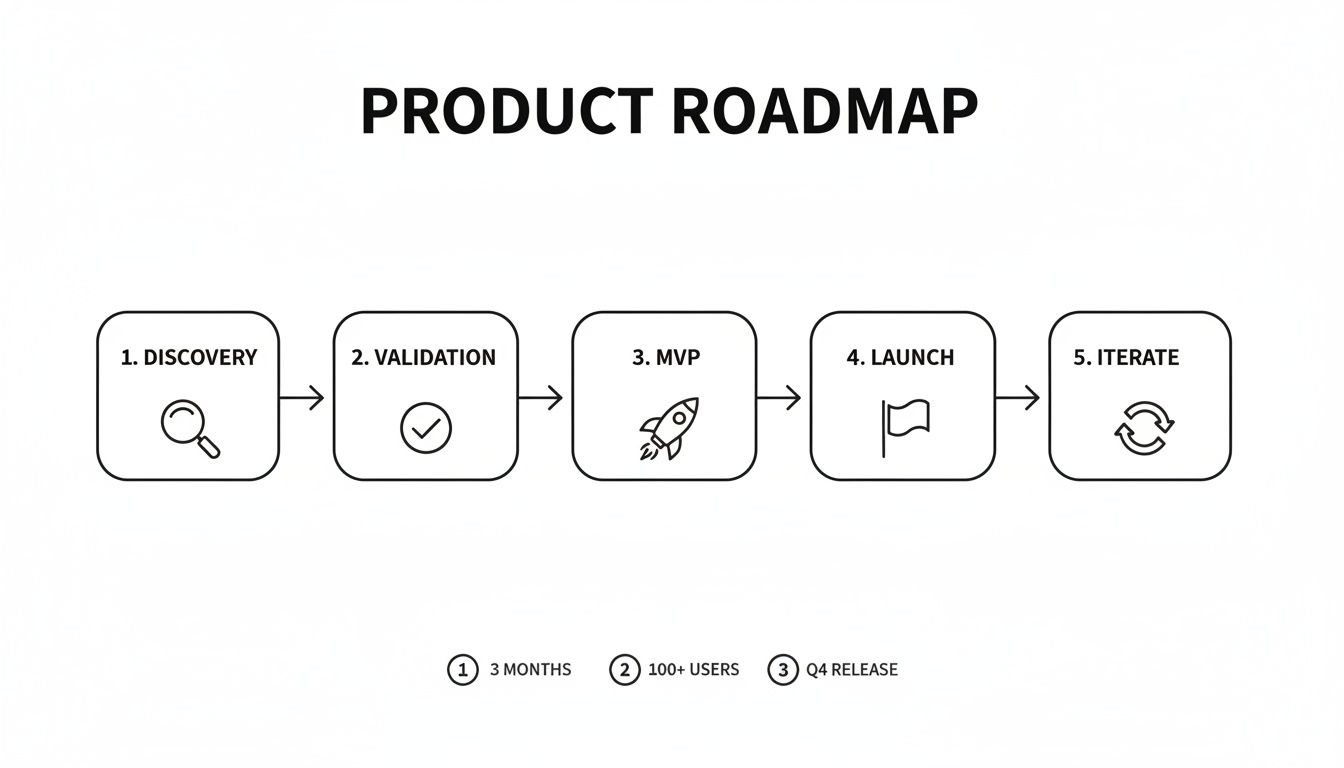
As you can see, each stage logically flows into the next, creating a powerful feedback loop that fuels real, sustainable growth.
Here’s a quick breakdown of what to expect at each point in the journey.
The 5 Stages of Startup Product Development
Stage | Key Objective | Primary Deliverable |
|---|---|---|
Discovery | Uncover and deeply understand a real, painful user problem. | A validated problem statement and user personas. |
Validation | Confirm that people are willing to pay for your solution. | A prototype or landing page with user sign-ups. |
MVP | Build the most basic, core version of your product. | A functional product with just enough features to be useful. |
Launch | Get the product into the hands of early adopters. | A launched MVP with initial user feedback. |
Iterate | Use data and feedback to improve and grow the product. | Ongoing feature updates and product optimizations. |
This structured approach helps you stay focused and make progress without getting overwhelmed.
Why a Roadmap Matters
Without a clear framework, it's incredibly easy to fall into the classic startup traps: building features nobody asked for, running out of money before you even launch, or creating a "solution" that doesn't actually solve a problem for anyone. A roadmap is your defense against these common killers.
It helps you stay disciplined. For SaaS founders in particular, this initial plan is their north star. If you're navigating this path, a good founder's guide on how to launch a SaaS product can offer deeper insights, especially on the critical validation and MVP stages.
By understanding and committing to this process, you lay the groundwork for a product that doesn't just launch—it has a real shot at succeeding.
Stage One: Validating Your Idea Before You Build
So many startups make the same devastating mistake: they build a beautiful, elegant product that nobody actually wants. Before a single line of code gets written or one pixel is pushed, you have to be sure you’re solving a real, painful problem for a specific group of people. This first phase, a blend of discovery and validation, is the bedrock of everything that follows.
Think of it like building a bridge. You wouldn't just start construction without first checking if people actually need to cross the river. You’d talk to them, watch their current journey, and figure out what they’d be willing to pay—in time, money, or effort—for a better way to get to the other side. Validation is your insurance policy against building a "bridge to nowhere."
Finding Problem-Solution Fit
Your first big win isn't a working product; it's achieving Problem-Solution Fit. This is that magic moment when you have hard evidence that your solution genuinely solves a high-value problem for your target customers. It's when you can confidently say, "I get their pain, and my idea fixes it in a way they truly care about."
Getting there means you have to get out of the building and talk to real humans. It’s all about swapping out your assumptions for actual evidence. It’s easy to fall in love with your solution, but the founders who make it are the ones who fall in love with their customer's problem.
The Power of Customer Interviews
Forget about broad surveys or expensive market research reports for now. The most direct path to real insight is through simple, one-on-one conversations. Your goal isn't to ask people if they would use your product—they'll almost always be nice and say yes. You need to dig into their past behavior and current frustrations.
A handful of thoughtful interviews will give you more truth than a hundred generic survey responses. Here’s how to do it right:
Focus on the Problem, Not Your Solution: Don't pitch. Ask open-ended questions about how they work, what drives them crazy, and what tools they’re already using to get by.
Listen for "Hacks": Pay close attention when someone describes a clunky workaround they've invented. If they're stitching together three different spreadsheets to manage something, that’s a massive flare signal of an unmet need.
Ask About Past Behavior: Questions like, "Tell me about the last time you struggled with X..." or "How much did you spend to fix this before?" give you facts, not opinions. It shows you how painful the problem really is.
Quantify the Pain: Get to the bottom of the cost. Is this problem wasting 10 hours a week? Is it costing their company $5,000 a month? This is the data that will later justify people paying for your product.
When you focus on the customer's world instead of your own product, you stop trying to sell an idea and start uncovering a genuine need. That insight is the most valuable currency you have.
Analyzing the Competitive Landscape
While you’re talking to customers, you also need to scope out who else is trying to solve this problem. A competitive analysis isn't about stealing features; it's about finding gaps in the market you can drive a truck through.
And don't just look at direct competitors. You have to consider the indirect ones, too—the other tools and processes people are using right now. That messy spreadsheet? That's your competitor. A tedious manual process? That's your competitor, too.
Ask yourself these questions:
What do existing solutions do well? This tells you the "table stakes"—the basic features everyone will expect.
Where are they weak? Customer complaints, bad reviews, and missing features are pure gold. That’s your opening.
How are they positioned? Look at their marketing. What story are they telling? This will help you find a unique angle to tell your own.
This research, paired with what you hear directly from customers, gives you the confidence to move forward. By validating your idea first, you make sure the product you end up building already has an audience waiting for it. It’s a research-backed gut check that clarifies your strategy and sets you on the right path.
Stage Two: Building Your Minimum Viable Product the Smart Way

Okay, you’ve done the research and confirmed there’s a real problem out there waiting for your solution. Now it’s time to build. This is the moment where so many startups get it wrong, falling into the trap of trying to build the perfect, all-singing, all-dancing product right out of the gate.
The smarter path? Build a Minimum Viable Product (MVP). Think of it not as a half-baked product, but as a strategic tool built for one thing and one thing only: learning. It's the simplest version of your product that solves the core problem for your very first users. If you want to dive deep, here's a great guide on how to build an MVP that validates your idea fast.
I love the skateboard analogy. If your user needs to get from Point A to Point B, you don't start by handing them a single car tire. A tire by itself is useless. Instead, you give them a skateboard. It's basic, sure, but it's a complete, functional tool that solves their immediate need. Your MVP needs to be that skateboard.
What Puts the "Viable" in MVP?
The most important word here is "viable." This isn't just a prototype or a wireframe—those are just sketches of how something might work. An MVP is a real, working product that people can actually use to get something done.
It might not be pretty, and it will definitely be missing a lot of features you've dreamed up, but its core function has to be rock-solid.
Let’s be honest, the startup world can be brutal. With failure rates as high as 90%, every decision matters. A well-executed MVP is a massive differentiator; in fact, 85% of product managers see it as essential. And when you consider that a poor product is behind 17% of all startup failures, you realize that getting this stage right isn't just a good idea—it's everything.
How to Prioritize Features and Dodge Scope Creep
The single biggest enemy of an MVP is "scope creep." It’s that sneaky voice whispering, "Just add one more little feature..." before you know it, your launch is months behind schedule and your simple product has become a bloated mess.
You need to be ruthless. One of the best frameworks for this is the MoSCoW method. It forces you and your team to sort every single feature idea into one of four clear buckets. This approach helps you focus on what's absolutely essential for day one. We touch on similar principles in our guide to website development processes, which has lessons that apply to any product build.
Here's the MoSCoW breakdown:
Must-have: These are the absolute, non-negotiable features. Without them, your product is just a pretty design. For our skateboard, this is the deck and wheels.
Should-have: Important features that add real value but aren't deal-breakers for the initial launch. Think of the grip tape on the skateboard deck—it makes the experience much better, but you can technically ride without it.
Could-have: These are the "nice-to-haves." Desirable, but not essential. This could be a cool graphic on the bottom of the board. You can add these later if users ask for them.
Won't-have (this time): Features you are actively deciding not to build right now. Listing these out loud is powerful—it keeps them from creeping back in and sets clear expectations.
By running every idea through this filter, you create a focused, defensible scope for your MVP. It gets your product into the hands of real users faster, which is the whole point.
Making Smart Engineering Trade-Offs
Finally, building an MVP means making some tough calls on the engineering side. The classic startup dilemma is speed vs. scalability. Do you use a no-code tool to get something out the door in a few weeks, or do you spend months building a custom backend that can handle a million users?
For an MVP, speed almost always wins. Remember, the goal is to learn. The faster you can ship and get real-world feedback, the better your chances of survival.
This often means choosing a tech stack that’s built for rapid development, like Ruby on Rails. You can always refactor or rebuild down the road once you've actually proven your concept has legs. Build for the company you are today, not the one you hope to be in five years.
Stage Three: Designing for Conversion and Engagement

Getting a functional MVP out the door is a massive win, but let's be honest—it’s only half the battle. A product that simply works isn't enough. It has to feel intuitive, be enjoyable to use, and gently guide people toward taking the actions you want them to take.
This is where thoughtful User Experience (UX) and User Interface (UI) design become the backbone of your startup's success.
Think of your product's code as the engine of a car. UX is the steering wheel, pedals, and dashboard that actually let you drive it. UI is the slick paint job and comfortable interior that make you want to get in. You absolutely need both to build something people come back to again and again.
This stage is all about transforming your MVP's raw function into a smooth, effortless journey for the user. It’s where we refine the clunky parts into a polished experience designed for one thing: to get results.
The Foundation: User Flow and Wireframes
Before you even think about colors or fonts, you have to map out the user's path. A user flow is basically a blueprint of every single step someone takes to get something done in your app—from signing up to making a purchase. This step is critical because it forces you to see the product through their eyes, spotting friction points before they become real problems.
Once you have a clear flow, it's time for wireframes. These are the simple, black-and-white layouts that focus on one thing: structure. They’re intentionally basic, stripping away all the visual fluff to answer a fundamental question: does this layout make sense? Nailing this early on saves a staggering amount of time on redesigns down the road.
From Structure to Visuals: UI and Design Systems
With a solid blueprint in hand, we can finally move on to the UI—the visual layer that brings the whole thing to life. This isn't just about making things look pretty. It's about creating a visual language that communicates trust, clarity, and professionalism.
A huge part of this is building a design system. Think of it as a centralized library of reusable parts—buttons, icons, color palettes, form fields—that keep your entire product consistent. For a startup, this is a game-changer:
Speed: Your developers can build new features way faster by pulling from a pre-made library of components.
Consistency: The user experience feels familiar and predictable, which builds trust and cuts down on confusion.
Scalability: As your product and team grow, a design system is the guardrail that keeps everything from falling apart visually.
A great design doesn’t just look good; it feels good. It removes friction, builds trust, and makes users feel smart and capable. This is the difference between a product that is merely used and one that is truly loved.
Designing for Action and Impact
Every single design choice should have a purpose. When it comes to product development for startups, the end goal is always to drive a specific outcome, whether that's more sign-ups, higher purchase rates, or better user retention.
For instance, simply cutting the number of fields in a sign-up form can have a massive impact on completions. We've seen projects where redesigning a checkout flow to remove just one click significantly boosted conversion rates. This is the real, tangible business impact of research-backed UX.
If you want to dive deeper, our article on website design for startups unpacks how these principles create measurable results.
At Shalev Agency, we blend deep user research with crisp, clean UI to build these kinds of conversion-focused experiences. The outcome is a polished product that not only works perfectly but also guides users effortlessly toward the actions that will actually grow your business.
Stage Four: Launching, Iterating, and Scaling Your Product
Many founders see the launch as the finish line. That’s a huge mistake. Launch day is actually the starting gun for the most important race you’ll ever run: the race to product-market fit. Your product is finally live, which means you’ve unlocked a superpower—the ability to learn from real user behavior.
This stage is all about building a tight, continuous feedback loop: Launch -> Measure -> Learn -> Iterate. The insights you gather now are pure gold, guiding every decision as you refine your product and get ready to grow. You’re shifting from building based on assumptions to improving based on cold, hard evidence.
Building Your Feedback Loop
To make smart moves, you need a steady stream of both qualitative and quantitative feedback. Qualitative data tells you why people are doing things, while quantitative data tells you what they’re doing and how many are doing it. You need both to get the full picture.
Here are a few great ways to collect that feedback:
In-App Surveys: Think short, contextual pop-ups. Asking a quick question right after a user completes an action provides immediate, relevant insights.
Session Recording Tools: Services like Hotjar or FullStory let you watch anonymized recordings of user sessions. It’s like looking over their shoulder to see exactly where they get stuck or confused.
Direct Customer Interviews: Seriously, just talk to your users. Schedule regular calls with your early adopters. Their stories, frustrations, and "aha!" moments are pure gold.
The goal isn’t just to collect data; it's to turn raw feedback into actionable insights. This continuous discovery process ensures your product evolves in lockstep with what your users actually need.
The Metrics Every Founder Needs to Obsess Over
While stories from users are powerful, you need hard numbers to prove you're on the right track—especially when talking to investors. These core metrics paint a clear picture of your startup’s health and direction.
Customer Acquisition Cost (CAC) This is simple: how much does it cost you in sales and marketing to get one new customer? A high CAC can torch your funding in no time, so keeping this number on a tight leash is critical.
Lifetime Value (LTV) LTV is the total amount of money you expect to make from a single customer over their entire time with your product. For your business to work, your LTV needs to be way higher than your CAC. A good rule of thumb is an LTV-to-CAC ratio of at least 3:1.
Churn Rate This is the percentage of customers who cancel or just stop using your product over a certain period. High churn is like trying to fill a leaky bucket—it can sink your startup, no matter how many new users you pour in.
Tracking these isn't just for a dashboard. They tell you where to focus. If churn is high, that's a blinking red light telling you to fix the user experience or add features that make your product stickier.
When to Scale vs. When to Iterate
One of the toughest calls you'll make is deciding between building more features and beefing up your tech. Should you build that shiny new thing everyone is asking for, or should you refactor the database to handle more traffic?
Early on, the answer is almost always to focus on features and iteration. Don't waste time and money building an infrastructure for a million users when you only have a hundred. Premature scaling is a classic, costly startup mistake.
Get to product-market fit first. Once you have a product that users love, are willing to pay for, and your growth starts to strain your current systems, that’s the time to invest in scalability.
New tools can also give you a serious advantage here. For example, Generative AI is helping companies accelerate their time-to-market by 5% and boosting product manager productivity by a whopping 40%. Startups that embrace these digital tools see 19% jumps in efficiency and launch 17% faster. Meanwhile, ignoring AI introduces a 28% risk of a failed launch. You can learn more about how AI is shaping product development trends on altar.io.
Ultimately, this phase is all about disciplined learning. Systematically measure what matters, listen to your users, and iterate intelligently. That's how you build a real, sustainable foundation for growth.
How to Partner for Success: Your Next Steps
Knowing the stages of product development is one thing. Actually executing them with the right team is a completely different ballgame. As a founder, your time and capital are everything. Choosing a design and development partner isn't just about hiring extra hands—it’s about finding a team that can genuinely speed up your path to product-market fit.
This all comes down to finding a partnership model that clicks with where you are right now and where you want to go. The first step is to get familiar with the different ways you can work with a team, which will help you make a smart, strategic choice.
Finding Your Ideal Engagement Model
Every startup is different, so a one-size-fits-all partnership just won't cut it. The best model for you hinges on how well-defined your project is, what your internal team looks like, and what your long-term vision is.
Fixed-Scope Projects: This is your go-to for building a well-defined MVP. If you know exactly what features you need and what you want to achieve, a fixed-scope project gives you a predictable budget and timeline. It's a great way to minimize risk for that crucial first launch.
Retainer-Based Partnerships: Once your product is live, the game changes. Now it's all about iterating and growing. A retainer is perfect for ongoing work like adding new features, polishing the UX, and scaling your platform. It gives you the flexibility to react to user feedback and shift priorities as you learn.
Choosing the right engagement model is a strategic decision. A fixed-scope project gets your MVP launched on budget, while a retainer provides the agile support needed to iterate and find product-market fit.
Augmenting Your Team or Leading the Way
Beyond the type of project, you also need to think about how a partner will fit into your day-to-day. The best product development for startups happens when everyone knows their role from the very beginning.
There are really two ways this can go:
Plug-In Model: Maybe you already have a team but are missing a key piece of the puzzle, like a deep understanding of UX research or a knack for stunning UI design. An agency can "plug in" to fill those specific gaps, giving your team a boost without the cost of hiring someone full-time.
Lead Delivery Model: For founders who don't have a product team yet, this model is a lifesaver. An agency like Shalev can take the reins, handling the entire process from strategy and design all the way through development and launch. This frees you up to focus on running the business.
Here at Shalev Agency, we keep things simple and efficient with a lightweight workflow using Notion, Slack, and async updates. We’ve seen firsthand how this modern approach helps teams ship polished products faster, which we break down in our guide on choosing a top-tier web app development agency.
The next step is to get clear on your path forward. A strategic chat can help you pinpoint exactly what to build, what to fix, and what to prioritize to hit your most important business goals.
Got Questions? We've Got Answers.
When you're diving into product development, a lot of questions pop up. It's totally normal. Here are some of the most common ones we hear from founders, along with some straight-up answers to help guide your thinking.
What's the Real Cost of Building an MVP?
This is the big one, and the honest answer is: it depends. The price tag for a Minimum Viable Product can swing wildly. You might get a simple no-code prototype off the ground for a few thousand dollars, but a more sophisticated app with custom code could easily run you over $50,000.
What drives that number? It really boils down to the complexity of the features, the tech stack you land on, and the experience level of the team you bring on board. This is why many founders prefer a fixed-scope project for that first version—it puts a clear boundary around the cost so there are no surprises.
How Long Until My Product Is Actually Live?
For most startups, you're probably looking at a timeline of three to six months to get from idea to a launched MVP. That window gives you enough time to move through discovery, nail down the design, build the core product, and do some initial testing.
But that's not a hard and fast rule. If you're disciplined about your scope and embrace an agile approach, you can definitely speed things up. The trick is to focus on solving just one core problem for your user first.
The quickest way to get to market is by building only what you absolutely need to test your biggest assumption. Everything else is a distraction until you get real feedback from real people.
Should I Hire My Own Team or Go with an Agency?
For startups just getting started, bringing in an agency is usually the smarter, faster, and more budget-friendly move. Think about it: you get instant access to a full crew of specialists—designers, developers, strategists—without the headache and expense of recruiting.
This lets you get your MVP out the door and start testing your idea in the wild. Once you have some traction and are confident you're onto something, that's the time to start thinking about building your own in-house team for the long haul.
Ready to turn that idea into a product that people will actually use and love? At Shalev Agency, we mix research-backed UX with practical engineering to help you ship faster and see real results. Let's talk strategy and see how we can get you started.