Discover how a web app development agency can transform your idea into a scalable, user-friendly app. Learn how to choose the right partner.
Jan 11, 2026

A web app development agency is your partner for designing, building, and launching custom digital products. They bring a whole team to the table, product strategists, UX/UI designers, and software engineers—all focused on turning your business idea into a real, working application.
Why Your Next Project Needs a Web App Development Agency
So, you have a great idea for a web app but aren't quite sure how to get it built and out into the world. This is the exact moment a web app development agency becomes your most important ally. From startups trying to get their first MVP off the ground to established companies looking to improve their SaaS platform, businesses turn to agencies for a very good reason.
Think about it like building a house. Sure, you could hire a plumber, an electrician, and a carpenter separately and try to manage the whole chaotic process yourself. The alternative? You hire an architect and a general contractor who handle everything, making sure all the pieces fit together seamlessly. A good agency is that general contractor for your digital product.
The Strategic Advantage of a Partner
An agency doesn't just write code; they bring together design, engineering, and product strategy to solve real business problems. They're focused on building applications that are not only easy for people to use but are also built to grow with your business. For companies that need to scale quickly or require very specific skills, exploring software development outsourcing with an agency can be a game-changer.
This all-in-one approach is becoming more and more critical. The web development market is expected to grow by a massive USD 40.98 billion between 2024 and 2029, largely because of the demand for things like AI integration and mobile-first design. With that kind of growth, having an expert agency on your side is vital if you want to keep up. You can read more about the industry's growth from Technavio's report.
The real value of a great agency isn’t just their technical skill. It’s their ability to bring clarity to the project. They help you nail down what to build, why you're building it, and how it’s actually going to help your business succeed.
At the end of the day, working with an agency is about reducing risk and speeding up your growth. They offer a proven process, a dedicated team, and a clear plan from the first sketch to the final launch. This is particularly true for new businesses where getting the foundation right is everything. For more on that, take a look at our guide on website design for startups, which breaks down how a smart approach can set you up for success. An agency makes sure your vision becomes a high-performing web application that actually works.
Understanding What a Web App Agency Actually Does
A great web app development agency does a lot more than just write code. They’re strategic partners who exist to solve your business problems. Forget thinking of them as order-takers who just tick off a list of features. A true partner acts as an architect, designing and building your digital product from the ground up to make sure every single piece serves a real purpose.
Their job isn't just the technical part. A good agency walks you through a structured process, turning a rough idea into a polished, market-ready application. This journey usually happens in three core phases, with each one building on the last to create something that’s not only a joy to use but also commercially successful.
The Discovery and Strategy Phase
Everything starts with strategy. This is the blueprint for the entire project, and it's where the agency works side-by-side with you to define what success actually looks like. It’s all about asking the tough questions before anyone even thinks about design or code.
Here's what that looks like in practice:
Goal Alignment: Getting crystal clear on your business objectives. Are you trying to boost sales, make your internal team more efficient, or break into a brand new market?
User Research: Figuring out who will use the app, what problems they're struggling with, and what they genuinely need to solve those problems.
Competitive Analysis: Sizing up the competition to spot opportunities where you can stand out and avoid the mistakes they’ve already made.
Product Roadmap: Creating a prioritized plan that lays out what gets built first (usually a Minimum Viable Product, or MVP) and what can wait for a later version.
Getting this initial work right is crucial. It stops you from wasting time and money by making sure everyone is on the same page, aiming for the same clear goals.
The UX/UI Design Phase
With a solid strategy in place, the focus shifts to how the app will look and feel—the user experience (UX) and user interface (UI). This is where your application gets its structure and personality. Think of UX design as the invisible architecture that makes an app easy and intuitive, while UI design is the visual polish that makes it look sharp and feel great to use.
First, UX designers create wireframes, which are like simple sketches of the app’s layout and how users will move through it. Then, they build interactive prototypes that let you click around and get a real sense of the functionality. Finally, the UI designers bring it all to life with branding, colors, fonts, and images.
To give you a better idea of what to expect, here's a breakdown of the key services you'll get from a full-service partner like us.
Core Services of a Full-Service Web App Agency
Phase | Key Activities | Primary Outcome |
|---|---|---|
Strategy & Discovery | Market research, user interviews, competitive analysis, feature prioritization. | A validated product concept and a clear, actionable roadmap. |
UX/UI Design | Wireframing, prototyping, visual design, user testing. | An intuitive, engaging, and visually polished design ready for development. |
Engineering | Front-end & back-end development, API integration, database architecture. | A fully functional, secure, and scalable web application. |
QA & Testing | Manual and automated testing, bug fixing, performance checks. | A stable, reliable product that works flawlessly for users. |
Launch & Maintenance | Server deployment, ongoing monitoring, updates, and feature enhancements. | A successful launch followed by continuous improvement and support. |
As you can see, a top-tier agency guides you through every single step, ensuring a cohesive and successful final product.
A great design isn't just about looking good; it's about creating clarity. The real goal is an experience so smooth that users can get things done without ever feeling confused.
This diagram shows how these key areas—strategy, design, and engineering—all come together.
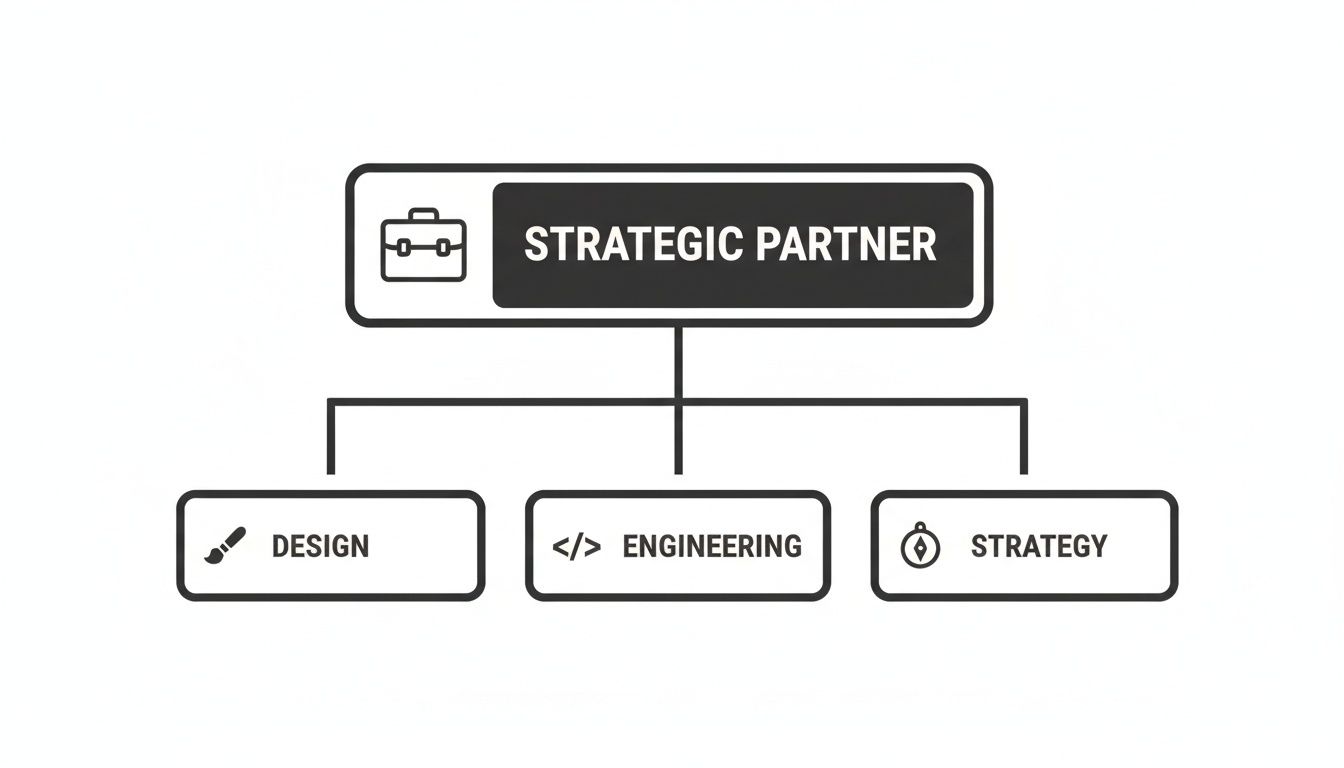
A truly valuable agency doesn't just offer these as separate services. They weave them together to deliver a complete solution.
The Engineering and Development Phase
Once the strategy is solid and the design is approved, the engineering team gets to work on the build. This is where the visual prototypes are turned into a real, working web application. The process is typically split into two key areas: front-end and back-end development.
Front-End Development: This is everything your users see and click on in their browser. Developers use tools like HTML, CSS, and JavaScript to build out the user interface from the designs.
Back-End Development: This is the engine under the hood. It includes the server, the database, and the APIs that make everything run, handling all the complex logic, user data, and behind-the-scenes work.
To really get the most out of an agency partnership, it helps to understand what’s involved when you outsource web development. A professional firm manages the entire technical process for you—from testing and deployment to ongoing maintenance—so you can be confident your app is secure, scalable, and reliable. This all-in-one approach is why the market for these services is exploding, with projections showing it will nearly double to $3.0 billion by 2035 as more businesses look for expert partners to deliver results.
Finding the Right Engagement Model for Your Project
How you work with a web app development agency is just as important as what they build for you. The right kind of partnership lines up your goals, budget, and timeline with how the agency actually gets work done. Pick the wrong one, and you’re setting yourself up for missed deadlines, blown budgets, and a whole lot of frustration.
Think of it like this: you wouldn't use the same plan to build a garden shed that you would for a skyscraper. Every project is different, and the way you engage with your development partner needs to reflect that. This one choice shapes your project’s flexibility, budget predictability, and how fast things get done.
Most agencies have two main ways of working together. Let's break them down so you can figure out what makes sense for you.
Fixed-Scope Project Model
A fixed-scope project is a lot like commissioning a custom-built car. You agree on every detail—the engine, the color, the features, the delivery date, and the final price—before a single wrench is turned. This model is perfect when you know exactly what you need, have a firm budget, and a hard deadline.
It's the go-to choice for specific, well-defined jobs, like:
Building a Minimum Viable Product (MVP) with a precise list of features.
Creating a standalone marketing landing page for a new product launch.
Adding one new, clearly outlined feature to an app you already have.
The biggest win here is predictability. You know what you're getting, when you're getting it, and exactly what it will cost. Everything is mapped out and signed off on from the start, which keeps financial surprises at bay.
The downside? It’s rigid. If a brilliant new idea strikes you halfway through the project, or you realize you need to pivot, it usually means hitting the brakes. You'll have to draft up a new contract or a "change order," which can add time and money to the project.
Retainer or Dedicated Team Model
On the other hand, the retainer model is like having a world-class pit crew on standby for your race team. You aren’t paying for one specific outcome; you're securing a set amount of your agency's expert time and brainpower every single month. This approach is all about flexibility and building a long-term relationship.
This is the ideal setup when you know things are going to change, for example:
Ongoing product development where you're constantly adding new features and making improvements.
Needing to add specialized design or engineering firepower to your own team.
Long-term support for a live app, including bug fixes, updates, and performance tuning.
The key advantage of a retainer is adaptability. You can shift priorities on a dime based on what your customers are saying or what the market is doing, all without endless contract renegotiations. It’s a truly agile way to work, letting you test, learn, and improve your product week after week.
The best model depends entirely on where your project is today and where you want it to go tomorrow. A fixed-scope project is about building a specific thing, while a retainer is about building a continuous capability.
Choosing between them isn't always a one-time decision. In fact, many great partnerships start with a fixed-scope project to launch an MVP. Once the app is out in the wild and gathering real-world feedback, the relationship often shifts to a retainer model for continuous growth. A good web app development agency will walk you through these options and help you land on the right approach for right now.
How to Evaluate and Choose the Right Agency Partner
Picking a web app development agency is easily one of the most important decisions you'll make for your product. Get it right, and your new partner will feel like a true extension of your team, hitting your goals and bringing your vision to life. But the wrong choice can burn through your budget, derail your timeline, and result in a product that just doesn't work.
This isn’t about finding a team that simply writes good code. It’s about finding a strategic partner who genuinely gets your business goals and can turn them into a web app that people love to use. To do that, you need to vet them properly, focusing on real proof of their skills and a good cultural fit.
So, how do you make a confident choice? It all boils down to looking at their past work, the expertise of their team, and how they actually manage projects and talk to their clients.
Dig Into Their Portfolio and Case Studies
A portfolio is way more than a gallery of pretty screenshots. It’s a record of real problems they’ve solved for real businesses. Don't just glance at it; you’re looking for hard evidence that their work made a measurable difference. Any agency worth its salt will be excited to show you this.
As you look through their work, keep an eye out for these things:
Measurable Outcomes: Do they talk about metrics? Look for things like increased user engagement, higher conversion rates, or streamlined operations. Vague promises are a huge red flag.
Industry Relevance: Have they built apps in your field or a similar one? It’s not a deal-breaker, but relevant experience means they’ll get up to speed on your challenges and audience much quicker.
Technical Complexity: Can they handle a project like yours? Look for examples of custom features, complex integrations, or apps built to handle a ton of users.
You can see how we put results first by checking out
our past projects at Shalev Agency
. Each one breaks down the specific business problem we tackled and the results we delivered.
Assess Their Team and Technical Expertise
Behind every great web app is a team of smart, dedicated people. You need to feel certain that the agency has the right talent in-house, and that means more than just developers. You need strategists, UX researchers, and UI designers, too.
The most important skill an agency can have isn't technical proficiency—it's the ability to listen. A great partner invests time in understanding your business deeply before they ever write a single line of code.
Ask who, specifically, will be working on your project. What’s their experience level? What skills do they bring to the table? A transparent agency will have no problem introducing you to the key players you’ll be working with. This helps ensure you’re getting the expertise of the people who will actually build your app, not just the agency’s brand name.
Understand Their Process and Communication Style
A clear, well-defined process is the mark of a professional agency. It shows they have a reliable system for delivering quality work on time and on budget. Ask them to walk you through their typical project, from the initial discovery and strategy sessions to design, development, testing, and launch.
Of course, a great process falls apart without great communication. This is the glue that holds the whole partnership together. How will they keep you in the loop? Do they use a project management tool like Notion or Asana? How often will you have check-in meetings? A top web app development agency makes you feel like an active collaborator, not just a client waiting for updates.
To help you get a clear picture and compare different agencies, we’ve put together this quick checklist. Use it during your discovery calls to ask the right questions and spot potential problems before they start.
Agency Evaluation Checklist Questions and Red Flags
This checklist helps you compare potential web app development agencies by asking the right questions and spotting potential issues early.
Evaluation Area | Key Question to Ask | Potential Red Flag to Watch For |
|---|---|---|
Portfolio & Results | "Can you show me a project where you solved a similar business problem and share the specific results you achieved?" | They only talk about design aesthetics and can't provide any performance data or business metrics. |
Team & Expertise | "Who from your team will be dedicated to my project, and what is their experience with [your specific technology]?" | They are vague about team assignments or can't introduce you to the people who will do the work. |
Process & Workflow | "What does your end-to-end process look like, and how do you handle changes in project scope?" | They don't have a clear, structured process and seem to "wing it" on a case-by-case basis. |
Communication | "How will we communicate day-to-day, and how often can I expect to receive progress updates?" | Their communication plan is unclear, or they seem reluctant to provide direct access to the project team. |
Ultimately, choosing the right agency comes down to doing your homework. By focusing on these core areas, you can see past the sales pitch and find a true partner who is genuinely invested in your success.
From a Great Idea to a Market-Ready App
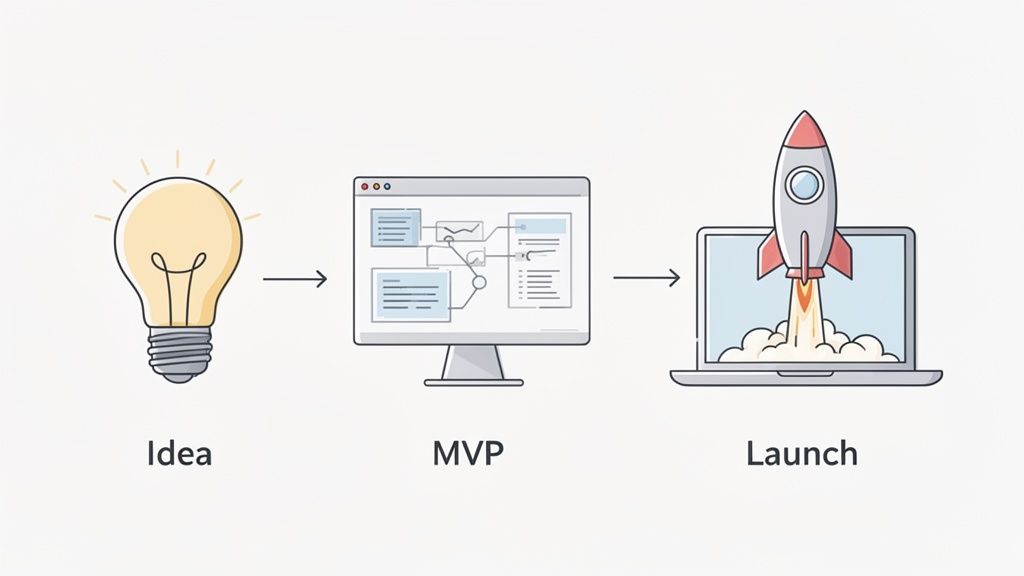
Turning a brilliant idea into a real, working product can feel like an impossible mountain to climb. That’s where a good web app development agency comes in. They act as your guide, taking that abstract concept and making it something people can actually use.
Let's walk through what this looks like with a simple example: a startup founder who wants to build a new project management tool specifically for creative agencies. They have the vision, but they need a technical partner to bring it to life. This journey doesn't start with code; it starts with a conversation.
Nailing Down the Strategy
First things first, the agency sits down with the founder for a deep-dive strategy session. The goal here is simple: get to the core of the business. What’s the single biggest problem this app will solve? Who are we building this for, and what drives them crazy about the tools they're using now?
From there, we work together to define the essential features for a Minimum Viable Product (MVP). It’s tempting to build every feature you’ve ever dreamed of, but the smart move is to prioritize what delivers immediate value. This phase gives us a clear product roadmap, making sure we’re all aiming at the same target before a single pixel is designed.
A great launch starts with a clear strategy. An MVP isn't about building a perfect, finished product. It's about building just enough to start learning from real users as fast as possible.
Designing an Experience People Love
Once the "what" and "why" are locked in, the focus shifts to the user experience (UX) and user interface (UI). The agency's designers will start by creating wireframes, which are basically simple blueprints of the app. They map out the user’s journey and the layout of each screen, focusing entirely on making the app feel intuitive.
After the flow is solid, the UI designers add the visual polish. They craft an interface that not only looks clean and modern but also makes using the app a genuinely pleasant experience. The result of this stage is an interactive prototype. It looks and feels like the final product, letting the founder click through and test the entire concept before any code gets written.
Building a Solid, Scalable Product
Finally, the engineers get to work. They take the approved designs and breathe life into them, focusing on building a secure and scalable app from the ground up. Front-end developers build the part you see and interact with, while back-end developers create the engine—the server, database, and all the logic that makes it run.
The team builds and tests features in focused cycles, which keeps things moving and catches issues early. This methodical approach ensures the final MVP isn't just functional, but also strong enough to handle its first wave of users. By the end, the startup has a high-quality product ready for launch.
If you want to dig deeper into the nuts and bolts of this journey, our guide on the phases of the website development process breaks it down even further.
Why the Right Agency Is an Investment in Growth
Choosing a web app development agency isn't just another line item on a budget. Think of it as a strategic investment in where your company is headed. A great partner delivers so much more than just code—they bring the strategic insight and design thinking needed to build a product that can actually stand out in a ridiculously crowded market.
The right agency essentially becomes an extension of your own team. They help you innovate faster, truly understand and connect with your users, and hit those big, ambitious business goals you've set. Go it alone, and you risk ending up with a product that looks nice but ultimately falls flat.
Thriving in a Competitive Market
Let's be honest: the digital world is ruthless. With 252,000 new websites popping up every single day and the market projected to reach USD 142 billion by 2033, simply having a web app isn't enough. You need an edge.
That’s where an agency’s strategic consulting and user-focused design come in. The demand for great developers is only getting steeper—a 17% rise in jobs is expected by 2033—making it incredibly tough to find and hire the right talent on your own. A proven partner who lives and breathes conversion-focused design is invaluable. You can dig deeper into these numbers in the 2025 Web Professional Industry Report.
In this kind of environment, things like speed, a clear message, and a design that drives action aren't just nice-to-haves. They're table stakes.
A great agency doesn't just build your web app; they build your competitive advantage. They equip you with a product that is not only functional and beautiful but also strategically positioned to capture market share and drive real business growth.
Ultimately, working with an agency like Shalev Agency means you get a dedicated ally who is genuinely committed to your success. We blend research-backed UX, sharp UI, and practical engineering to turn your vision into a polished, high-performing reality. Our job is to clarify your positioning, simplify your workflows, and deliver real results, like higher conversions and better-qualified leads.
When you pick the right web app development agency, you're not just buying a service. You’re investing in a clear path to growth and turning your idea into a scalable, successful product ready to make an impact.
Frequently Asked Questions
Even after getting the lay of the land, you probably still have a few practical questions. That’s completely normal. Choosing to bring in a development agency is a major decision, and you need clear, straightforward answers before you can move forward.
This section gets right to the point, tackling the most common questions we hear from founders, project managers, and marketing leaders. Let's clear up any lingering uncertainties.
How Much Does It Cost to Hire a Web App Development Agency?
The honest answer? It varies—a lot. The cost really depends on the scope, the technical complexity, and even the agency's location. A simple marketing site might start in the low five figures, but a complex SaaS platform with custom logic could easily run from $50,000 to over $250,000.
But the price tag isn't the whole story. The real focus should be on the return you'll get from that investment. A great agency won't just hand you a number; they'll give you a detailed proposal that ties every dollar to a specific outcome and its value to your business. They want you to see exactly how their work will drive tangible growth.
What Is the Difference Between a Web App and a Website?
Think of it this way: a traditional website is like a digital brochure. Its job is to present information, like a company story or a restaurant menu. A web app, on the other hand, is an interactive tool. You don't just read it; you use it to get something done.
Website Example: A local bakery's site showing its menu, hours, and location.
Web App Example: An online banking portal where you transfer funds and pay bills, or a project management tool like Trello.
A web app development agency specializes in building these dynamic, interactive experiences that solve a real problem for users. In many cases, these apps are the entire business.
The key distinction is function. A website informs, while a web application does something. It’s a tool that provides a service, not just content.
How Long Does It Take to Build a Web Application?
Timelines are tied directly to complexity. A streamlined Minimum Viable Product (MVP)—which includes just the core, must-have features—can often be designed, built, and launched in 3 to 6 months.
On the other hand, a large, feature-heavy application with lots of third-party integrations might take 9 months to a year, or sometimes even longer. A good agency will work in sprints, focusing on the most important features first to get a working product in front of users quickly. This agile approach lets you gather real-world feedback to inform the next phase of development, which is a much smarter way to build.
Do I Need a Technical Background to Work with an Agency?
Absolutely not. In fact, a great agency acts as your dedicated technical co-founder and guide. Their entire job is to translate your business vision into a technical reality. They should be able to break down complicated concepts into plain English.
You bring the deep industry knowledge and business goals; they bring the engineering and product expertise. The best partnerships are built on clear communication and trust. When you're vetting potential agencies, pay attention to how they talk to you. They should make you feel empowered and in the loop every step of the way, no matter your technical skill level.
Ready to turn your idea into a high-performing web application that drives real business results? At Shalev Agency, we combine research-backed UX, crisp UI, and pragmatic engineering to help you ship faster and achieve your goals. Schedule a call with us today to see how we can help you build what's next.