Discover how product development consulting services turn ideas into market-ready products. Learn when to hire a consultant and how they deliver real ROI.
Jan 11, 2026
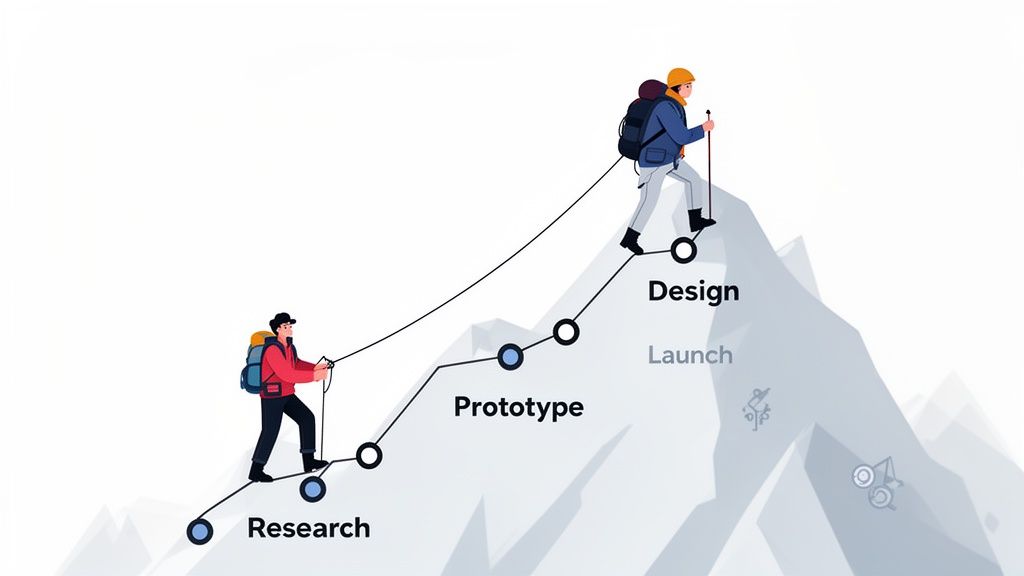
Bringing a new product to life is a lot like climbing a mountain. You have a clear summit in mind—a successful launch—but the path is filled with unexpected challenges, steep climbs, and potential wrong turns. Product development consulting services act as your expert guide, or sherpa, for this journey. They've been up the mountain before and know the best route to get you from a raw idea to a market-ready product, helping you sidestep common pitfalls along the way.
Charting Your Course From Idea To Impact
So many businesses start with a brilliant, game-changing idea but hit a wall. They might not have the right in-house team, the specific technical skills, or simply the time to dedicate to building it out properly. This is the exact moment a product development consultant becomes invaluable, bridging that critical gap between a great concept and a profitable product customers actually want to use.
Their job is about so much more than just writing code or mocking up designs. A great consultant provides a complete strategic framework to make sure you're building the right thing, in the right way, for the right people. It's no wonder the demand for this kind of expertise is booming. The global market for product development consulting is expected to surge from $2.7 billion in 2025 to a massive $6.1 billion by 2033. This growth isn't just a trend; it's a testament to the real value these experts deliver.
More Than Just Hired Guns, They're Strategic Partners
It's easy to think of consultants as just an outsourced team of coders, but that's a huge misconception. Their real power lies in the strategic oversight they bring to every stage of your product's life.
"A consultant's true job is to provide an outside perspective. They are not bogged down by internal politics or historical 'we've always done it this way' thinking, allowing them to focus purely on what will make the product succeed."
This partnership gives you the confidence to navigate tricky decisions. A skilled consultant becomes a true extension of your own team, laser-focused on hitting your business goals through smart, informed product choices.
What Does This Partnership Actually Look Like?
When you work with a product development consulting service, you're tapping into a wide range of skills that cover the entire creation process. To really get it, it helps to understand the key product development lifecycle stages. A consultant guides you through each one.
To make this clearer, let's break down the core services you can typically expect.
Core Components of Product Development Consulting
Service Area | What It Delivers | Primary Goal |
|---|---|---|
Market & User Research | Customer interviews, competitor analysis, and market validation reports. | To confirm there's a real need for your product before you build it. |
Product Strategy & Roadmap | A clear product vision, defined features, and a prioritized timeline. | To align development with your business goals and budget. |
UX/UI Design & Prototyping | Wireframes, user flows, high-fidelity mockups, and interactive prototypes. | To create an intuitive and engaging user experience that can be tested early. |
Tech & Development | A scalable technical architecture plan and agile, iterative coding. | To build a robust, secure, and high-performing product. |
Launch & Iteration | A go-to-market strategy, launch plan, and systems for gathering user feedback. | To ensure a successful launch and continuous improvement post-launch. |
By walking with you through each of these steps, consultants help transform what could be a risky, expensive gamble into a calculated and strategic investment. They help you avoid costly mistakes, get to market faster, and ultimately build a product that your customers will love and that will fuel your company's growth.
When Should You Hire a Product Development Consultant?
Figuring out the right time to bring in an expert can feel a bit like trying to time the market. It’s tricky, but getting it right can be a game-changer. Rather than just guessing, it's better to look for clear signs that your business is ready for the kind of specialized help a product development consultant offers. These moments usually pop up when a fantastic opportunity runs into a gap in your own team's resources.
Think of it like this: you wouldn't build a house without an architect, even if you have a perfect vision for the layout. A consultant is the architect for your product, making sure it’s built on a rock-solid foundation.
So, how do you know it's time to make the call? There are a few common, high-stakes situations where a consultant can be the difference between hitting a wall and breaking through to the next level.
You Have a Great Idea But No Technical Team
This is the classic reason. You’ve spotted a real problem in the market, dreamed up an amazing solution, but your current team doesn't include the designers, engineers, or product managers to actually build it.
Without the right skills on board, your idea is stuck on the drawing board. A consultant can drop in an instant, skilled team to turn your vision into a real, tangible product—saving you the long and costly process of hiring a full-time staff from scratch. They show up with the whole toolkit, from UX pros to developers, ready to go on day one.
A consultant is like a "team-in-a-box," giving you the specialized skills you need to get from concept to code. This lets non-technical founders or business leaders move forward on their vision, confident that the technical side is in expert hands.
For example, a marketing agency might come up with a brilliant SaaS tool for its clients but have zero in-house developers. Hiring a consultant lets them build and launch that new revenue stream while their own team stays focused on what they do best. This single move can unlock entirely new business models. You can dive deeper into this approach in our guide on product development for startups, which explains how outside expertise can fuel serious growth.
Your In-House Team Is Overloaded
Even companies with amazing internal teams hit their limits. Your engineers might be completely swamped maintaining current products or deep in another high-priority project. When a new, time-sensitive opportunity comes along, pulling them off their work could risk existing deadlines and lead straight to burnout.
In this scenario, a consultant acts as a strategic reinforcement. They can take full ownership of a new project, letting your team stay focused and keep their momentum without being stretched thin. This is a super common challenge for growing companies, where new ideas often move faster than the team can.
Here’s a quick look at how Shalev Agency can help teams ship faster.
This shows how an agency partner can step in to handle everything from websites to internal tools, freeing up your internal experts.
You Need to Get to Market—Fast
In a crowded market, speed is everything. A delay of just a few months could mean losing your first-mover advantage or missing a golden opportunity. If your internal processes are sluggish or your team is facing a steep learning curve with a new technology, you risk being left in the dust.
Product development consultants live and breathe efficiency. They've built and launched products time and time again, so they know how to navigate the development cycle quickly and without the usual roadblocks. By plugging into their proven workflows and deep expertise, you can drastically shorten your timeline from idea to launch, making sure you capture your audience before a competitor does.
Navigating the Product Consulting Journey
Kicking off a project with a product development consultant can feel a bit like setting sail into uncharted waters. You know your destination—a successful product—but the route to get there seems foggy and complex. The good news is that a professional consulting engagement isn't a shot in the dark; it's a structured, transparent process designed to turn that ambiguity into a clear, predictable roadmap.
This journey isn't some mysterious black box where you toss in an idea and just hope for the best. It’s a collaborative expedition, broken down into distinct phases, each with its own set of activities and concrete outcomes. Think of it like building a custom home: you wouldn't just start throwing up walls without a solid blueprint. A consultant makes sure every brick is laid with purpose, from the first sketch to the final coat of paint.
This flowchart shows the common triggers that lead companies to seek out this kind of structured help, whether it's a brand-new idea or an internal team that's completely swamped.
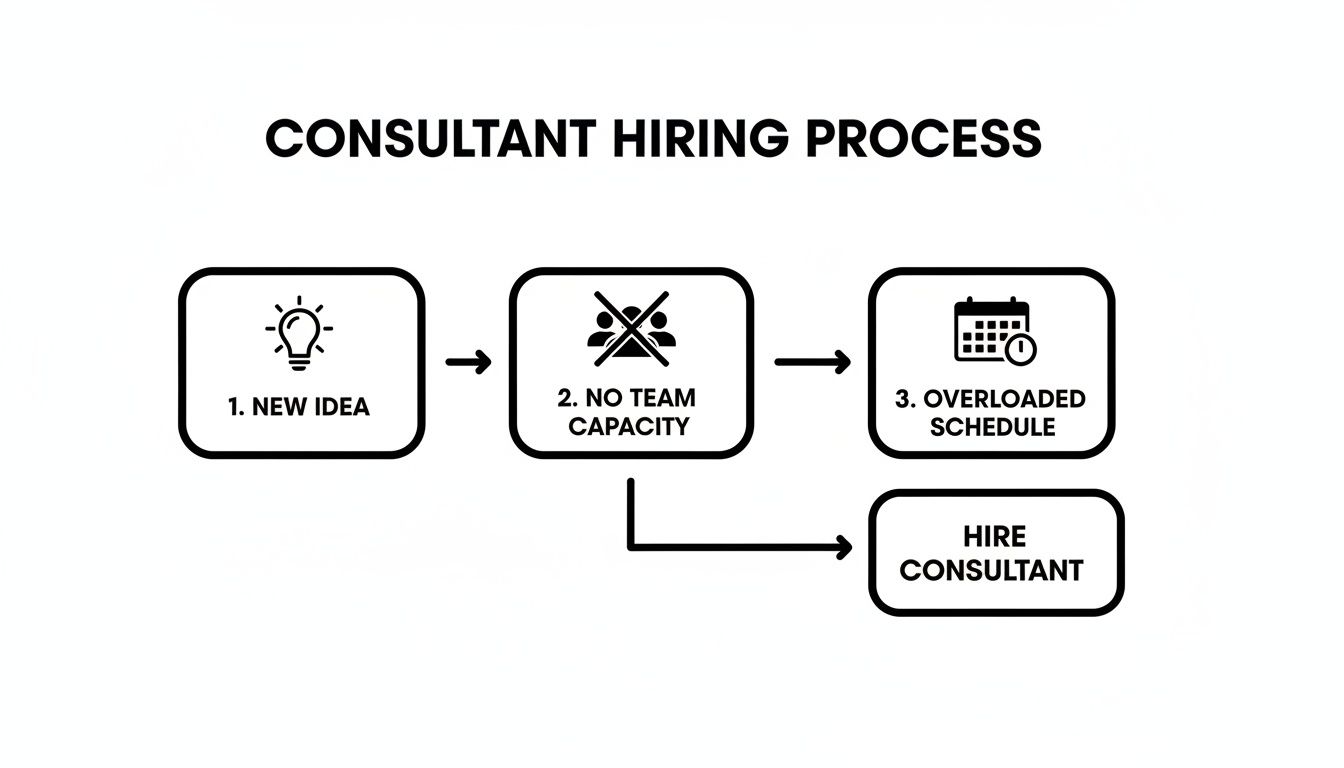
As you can see, the need for an outside expert often pops up from specific pain points, like not having the right people on staff or simply running out of hours in the day to move a great idea forward.
Phase 1: Discovery and Strategy
Everything starts with a deep dive into your vision and the market you're trying to win. This isn't just a quick chat. It’s a foundational phase where consultants effectively become temporary experts on your business. They’ll dig into user research, size up the competition, and poke holes in your core assumptions to make sure you're solving a real problem for a real audience. Getting this right is everything—a mistake here can mean building something nobody wants.
The main goal is to de-risk your investment before anyone writes a single line of code. The global product design and development services market is massive, generating an estimated USD 18,507.3 million in 2024, and a huge chunk of that is spent on this foundational strategy work. It just goes to show how critical this first step is for a successful outcome.
Key Deliverables:
Market Validation Report: Hard data confirming that your target audience exists and actually needs what you're building.
Product Roadmap: A strategic, prioritized timeline that lays out features and milestones.
Technical Brief: An initial game plan for the technology stack and overall architecture.
Phase 2: Design and Prototyping
With a solid strategy locked in, the focus shifts to bringing your idea to life visually. Designers will start creating user flows, wireframes, and eventually, high-fidelity mockups that map out the entire user experience. This stage is all about collaboration, turning abstract concepts into something you can actually see and interact with.
The most powerful thing to come out of this phase is an interactive prototype. This isn't just a pretty picture; it's a clickable mockup that lets you feel the product's flow and function. It's the perfect tool for getting early feedback from stakeholders and potential users before you commit to the expensive work of development.
A prototype is worth a thousand meetings. It gets everyone on the same page and helps you spot usability issues early on, saving a ton of time and money down the road.
Phase 3: Development and Testing
This is where the rubber meets the road and your product actually gets built. Most modern consultants use an agile methodology, which means engineers develop the product in short, iterative cycles called sprints. This approach keeps progress steady and gives you the flexibility to adapt if new insights or priorities emerge.
All along the way, quality assurance (QA) testing is happening in the background to squash bugs and fix issues. This constant testing ensures the final product is stable, secure, and works just as it should for your users. Understanding the steps for efficient MVP development is a key part of this phase, as it helps you launch quickly and start learning from real users.
Phase 4: Launch and Iteration
The final phase isn't really an endpoint, but a new beginning. Once the product is built and tested, your consultant will help you gear up for a successful launch. This can include anything from creating a go-to-market strategy to setting up analytics to see how people are actually using the product. A great consultant sticks around to see you succeed.
After launch, the journey moves into a continuous cycle of iteration. By analyzing user data and gathering feedback, you can make smart, informed decisions about what to improve or build next. This ensures your product keeps evolving to meet customer needs. This entire journey shares many principles with other structured projects, a topic we cover in more detail in our guide to website development processes.
How to Choose the Right Consulting Partner
Picking a product development partner is a huge decision, one that can make or break your project. You're not just hiring someone to check off tasks on a list; you're looking for a strategic ally who will become a genuine extension of your team. The best partners challenge your assumptions, bring fresh ideas to the table, and stay laser-focused on your actual business goals.
Think about it this way: you’re handing over a critical piece of your business strategy to an outside expert. That means you need to look past a simple price quote and really dig into their process, their expertise, and how they communicate. It's all about finding the right fit.
Look Beyond the Portfolio
A slick portfolio is great, but it only shows you what a consultant has built. It doesn't tell you how they built it or, more importantly, what results it drove for the business. Your mission is to find a partner who thinks strategically, not just a team that follows orders. They should be able to walk you through the "why" behind every design choice and technical decision.
A great consultant doesn't just ask what you want to build. They start by asking what business problem you're trying to solve. This focus on outcomes over outputs is the hallmark of a true strategic partner.
When you're looking at their past work, ask about the roadblocks they hit and how they navigated them. Dig into the real-world impact of their projects. Did they help a client boost conversions? Did they cut operational costs or help them land their next funding round? The answers will tell you if you’re talking to a task-taker or a genuine problem-solver.
Essential Questions for Your Evaluation
To cut through the sales pitches, you need a game plan. Going in with a checklist of smart questions helps you probe their real capabilities and working style. This allows you to compare potential partners fairly and find the one that truly fits your needs.
Here are a few key areas you’ll want to zero in on:
Industry and Technical Expertise: Have they worked in your space before (SaaS, FinTech, Healthcare, etc.)? Can they prove they have deep knowledge of the specific technologies your project needs? Around 70% of companies say getting access to specialized skills is a top reason they hire outside help, so make sure their skills match your roadmap.
Process and Methodology: How do they take a project from an idea to a full-blown launch? Ask them to walk you through their design process, their development methodology (like Agile or Scrum), and how they manage the day-to-day of a project. A clear, well-defined process is a great sign you're dealing with a mature and reliable team.
Communication and Collaboration: How will they keep you in the loop? What tools do they use to stay connected (like Slack or Notion)? A staggering 54% of offshore projects run into communication issues, so this is a critical point to get straight. You want a partner who values clear, consistent, and proactive communication.
Gauging the Fit Through Their Answers
Finding the right consulting partner involves more than just a simple Q&A. You need to read between the lines and really listen to how they answer your questions. This is where you can separate the true experts from the ones who just talk a good game.
To help you with this, we've put together a checklist of key questions to ask and what a strong answer should sound like.
Consultant Evaluation Checklist
Evaluation Category | Key Questions to Ask | What to Look For in an Answer |
|---|---|---|
Strategic Thinking | Can you tell me about a time you disagreed with a client's request and what happened? | A great partner isn't afraid to push back respectfully. Look for answers that show they prioritize the project's long-term success over simply saying "yes." |
Process & Methodology | Walk me through your typical project lifecycle, from discovery to launch and beyond. | They should describe a structured yet flexible process. Vague answers are a red flag. A strong response will detail specific phases, deliverables, and feedback loops. |
Technical Expertise | What are the potential technical challenges you foresee with our project, and how would you approach them? | A confident team will have already thought about this. They should be able to identify risks and propose concrete solutions, showing foresight and deep technical knowledge. |
Communication Style | How do you handle unexpected delays or changes in scope? | Look for transparency and a proactive approach. The best partners communicate issues early and come to the table with a plan, not just excuses. |
Measuring Success | How do you define and measure success for a project like ours? | Their answer should be tied to your business goals (e.g., user adoption, revenue, efficiency), not just technical milestones like "code complete." |
The way a consultant responds reveals a lot. Are they transparent and direct, or are they hiding behind buzzwords? A confident partner will welcome your toughest questions and give you detailed, thoughtful answers.
For instance, when you ask about their design process, a solid answer goes way beyond just saying "we're user-centered." They should be able to explain their specific methods for user research, prototyping, and gathering feedback. You can learn more about what to look for in our guide on UX design for startups, which breaks down why a research-first approach is so crucial.
Ultimately, choosing the right consultant comes down to finding a team that has the skills and shares your vision. They should feel less like a vendor and more like a partner who's truly invested in your success, ready to guide you through the complexities of building a great product.
Measuring the Real-World Impact of Consulting
Hiring a product development consultant is a serious investment. So, it's fair to ask the big question: what's the actual return? Beyond a slick final product, the real value shows up on your bottom line. We're talking about tangible results that directly affect your company’s health and future. A good consulting partner doesn’t just hand over a finished project; they deliver measurable outcomes like more revenue, better efficiency, and faster growth.
This focus on clear ROI is exactly why the product development consulting market is booming. In 2024, it hit USD 10.5 billion globally and is expected to climb to USD 18.2 billion by 2033. This isn't just hype; it's driven by companies that see how consultants help them dodge risks, control costs, and get to market quicker. You can get a closer look at these trends in this deep dive into the product development consulting market.
Let’s move past the abstract and look at some real-world examples. Each of these stories, inspired by actual projects, connects a tough business challenge to a smart solution and a result you can count. This is how the investment pays for itself.
From MVP to Market Leader
Imagine an early-stage startup with a brilliant SaaS idea but a very short timeline to lock in their next round of funding. Their team was small, passionate, but didn't have the specific know-how to build and launch a minimum viable product (MVP) fast enough.
The Problem: They were in a race against time to launch a working product and prove to investors that their idea had legs.
The Solution: We brought in a consulting team to hit the accelerator. They quickly refined the product roadmap, zeroed in on the absolute essential features for an MVP, and got the team running with an agile workflow.
The Measurable Outcome: The startup launched its MVP a whopping 40% faster than they had planned. This speed allowed them to sign up their first paying customers, collect invaluable user feedback, and walk into their investor meetings with a compelling, proven concept that sealed the deal.
Revitalizing a Stagnant User Experience
Here’s another common scenario. A well-established B2B software company started seeing user engagement dip and conversions go flat. Their product was powerful, no doubt, but years of adding features without a clear design strategy had made it clunky and confusing.
The Problem: A frustrating user experience was turning customers away and killing their lead conversion rates.
The Solution: A UX/UI consultant dug deep into user research, mapping out pain points and redesigning the core user journeys. They created a modern, intuitive interface and built an interactive prototype to validate the new design with real users before a single line of code was written.
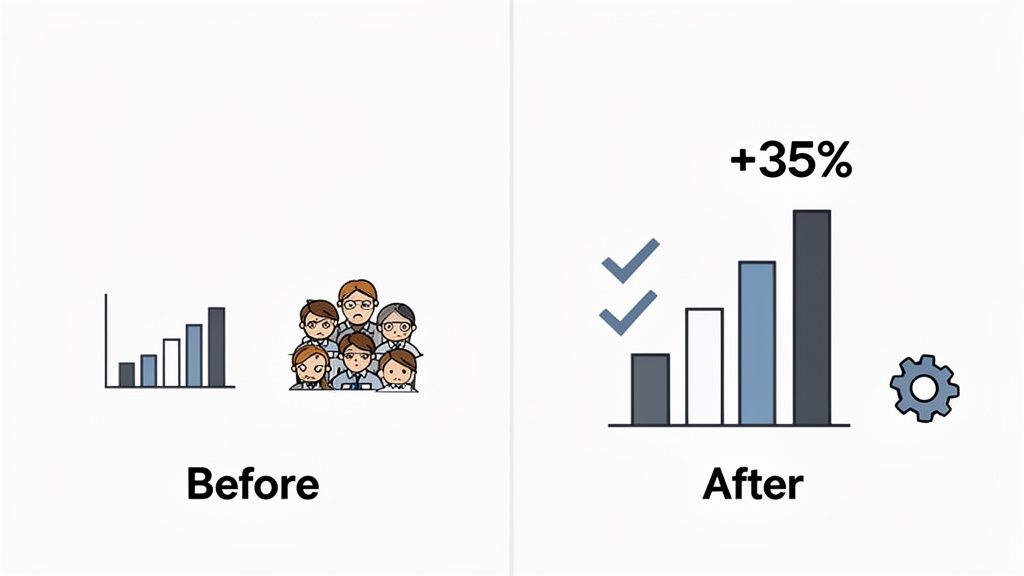
The Measurable Outcome: Just three months after the redesigned interface went live, the company saw a 35% jump in qualified lead conversions. Even better, their support team saw a major drop in tickets related to usability problems.
"The goal of a great consultant isn't just to build what you ask for; it's to build what your business needs. True ROI comes from solving the underlying problem, not just checking off a list of features."
Automating to Unlock Team Potential
Think about the operations team at a mid-sized logistics company, practically drowning in manual data entry. They were burning countless hours every week just copying information between spreadsheets and old systems. It was a recipe for errors and burnout.
The Problem: Inefficient, manual work was eating up precious employee time and creating serious operational bottlenecks.
The Solution: A consultant came in, analyzed their entire workflow, and then designed and built a simple, custom internal tool. This tool automated the data syncing between all their systems and could generate complex reports with a single click.
The Measurable Outcome: The new automation saved the operations team an estimated 20 hours per week. That’s time they could finally dedicate to higher-value work, like improving client satisfaction and making the supply chain run smoother.
Frequently Asked Questions About Product Consulting
Even when the benefits are clear, bringing on a consulting partner is a big move. You probably have a few practical questions rolling around in your head. We get it. To help, we’ve pulled together the most common questions we hear from business leaders just like you.
Think of this as the final pre-flight check before we get this thing off the ground. Answering these questions upfront helps everyone get on the same page and sets the stage for a great partnership.
What Is the Typical Cost of Product Development Consulting?
This is usually the first question on everyone's mind, and the honest answer is: it really depends. The cost for product development consulting services can vary quite a bit based on how big, complex, and long your project is. A small, focused project will naturally cost less than building a massive, feature-rich platform from the ground up.
Good consultants don't have a one-size-fits-all price tag. They'll offer different ways to work together.
Fixed-Scope Pricing: This is perfect for projects with a clear finish line, like building a Minimum Viable Product (MVP). You know exactly what you're getting and exactly what it will cost, all laid out from day one.
Monthly Retainers: If you need ongoing help, continuous improvements, or if you expect the project to evolve, a retainer is a great fit. It gives you consistent access to a dedicated team that’s always there for you.
No matter the model, you should always get a detailed proposal that breaks everything down. No one likes surprise costs.
How Do You Ensure the Final Product Aligns with Our Vision?
Keeping everything aligned with your vision is our top priority. This isn't one of those situations where a consultant disappears into a black box and pops out months later with a finished product. That’s a recipe for disaster.
Instead, we become an extension of your team. The process starts with a deep dive into your business, your goals, and what your users actually need. From there, it's all about open and constant communication—think regular check-ins, weekly progress updates, and interactive prototypes you can click through and give feedback on. This continuous feedback loop ensures the product we build is the product you imagined.
A great consulting partnership is built on communication. The goal is to eliminate surprises by making you a core part of the development journey, not just a spectator.
Who Owns the Intellectual Property of the Final Product?
Let's make this simple: you do. In any professional consulting agreement, the client owns 100% of the intellectual property (IP) once the project is paid for. This isn't just a handshake deal; it will be clearly spelled out in your contract.
This is a non-negotiable for us. All the source code, design files, and anything else created for your project belongs to your business, period.
How Quickly Can We Get Started on a Project?
We know that when you're ready to go, you want to move fast. The exact start date depends on our current schedule and how ready your project is, but nimble firms like ours are built to get going quickly.
Typically, we'll have an initial discovery call, send over a proposal for you to look at, and then sign the contract. For most projects, we can have the team assembled and ready to kick things off within one to two weeks after the paperwork is done. This way, you can build momentum right away.
Ready to turn your product vision into a market reality? At Shalev Agency, we help you ship faster with research-backed design and pragmatic engineering. Book a free strategy call to discuss your project.