mvp development for startups: Validate ideas, scope features, and launch a lean product that attracts early users and funding.
Jan 11, 2026
Let's get straight to it: building a startup is a race against the clock, and your cash is the fuel. This is why MVP development for startups isn't just another step in a playbook; it’s your most essential survival tool. It’s how you find out if you’re building something people will actually pay for before you run out of money.
Why a Fast MVP Is Your Best Insurance Policy

I’ve seen too many well-funded startups fail. The common thread isn’t a lack of engineering talent or a shortage of features. It's building a beautiful solution for a problem nobody has. In fact, over 90% of startups fail, and a massive reason is building a product for a market that simply doesn't exist.
Thinking of your Minimum Viable Product (MVP) as an insurance policy is the best mindset shift you can make. It’s not just a watered-down version of your final product. It’s a focused experiment designed to take the biggest risks off the table, fast.
The Hidden Cost of Building in a Bubble
Every day you spend tweaking features without real-world feedback, you're not just burning cash—you're drifting further from your potential customers. Your initial idea is nothing more than a guess, and the longer you wait to test that guess, the more you're gambling. Launching after a year or more means you're betting the farm on an unproven assumption.
The data tells a stark story. Startups that launch an MVP within 3 to 6 months have a two-year survival rate of around 68%. Compare that to the 35% survival rate for those who take 12 months or longer. Speed isn't just a vanity metric; it directly correlates to survival.
The table below starkly contrasts the business impact of a rapid launch versus a drawn-out development cycle.
Rapid vs Traditional MVP Launch Timelines
Metric | Rapid MVP (3-6 Months) | Traditional Development (12+ Months) |
|---|---|---|
Market Validation | Quick validation or invalidation of the core idea. | Delayed feedback; high risk of building the wrong product. |
Cash Runway | Preserves capital for scaling and pivots. | Significant cash burn on unproven features. |
Product-Market Fit | Achieved faster through iterative, data-driven cycles. | Slower, more expensive journey to find what customers want. |
Investor Confidence | Demonstrates traction and a learning-focused team. | Higher pressure to show massive results at launch. |
As you can see, a faster loop to get your product in front of users is about much more than just speed—it fundamentally changes your odds of success.
The real purpose of an MVP is to get the most learning for the least amount of effort. It forces you to answer the one question that matters: "Does anyone actually care about this?" Answering that quickly is your single best defense against failure.
Instead of asking, "What’s the most we can build?" you start asking, "What’s the absolute least we can build to learn something meaningful?" This focus on learning is what separates the startups that adapt and thrive from those that run out of runway.
Learning Is Your Most Important Metric
Rapid MVP development isn't just about shipping code; it’s about optimizing for learning. The raw, honest feedback you get from your first few users is worth more than a hundred internal strategy meetings.
This tight feedback loop helps you:
Prove (or disprove) your idea: Know if you're on the right track before you’ve spent your whole budget.
Stretch your runway: Spend less to find clarity, leaving you with more cash to double down on what works.
Find product-market fit faster: Each iteration gets you closer to a product customers genuinely love.
Build real momentum: Nothing motivates a team (or impresses an investor) like early signs of traction.
To get the most out of this approach, you need a process built for speed and iteration. Adopting Agile methodology best practices gives your team the structure to respond to feedback quickly. After all, the entire SaaS product development process is a journey of discovery, and your MVP is the critical first step.
Validate Your Idea Before Writing Any Code
Every founder thinks their idea is a game-changer. It's easy to get swept up in the vision. But I’ve seen countless startups burn through their funding building a beautiful, flawless product that nobody actually wanted.
The truth is, most ideas don't survive their first encounter with a real customer. That’s why the most critical first step has nothing to do with code. It’s about proving people have the problem you think they have, and that it’s painful enough for them to seek out a solution. Skipping this is the fast track to failure.
How to Test Your Idea Without a Product
Before you even think about hiring a developer or sketching out a tech stack, your one and only job is to get real-world signals that you’re onto something. This isn't about spending a lot of money; it's about being clever and getting your hands dirty.
Let’s say your big idea is a service that automates weekly meal planning for busy professionals. Your core hypothesis is that people will pay for this. How can you test that with the least amount of effort and cash?
This is where you get creative with low-fidelity validation methods:
The Landing Page Test: Put up a simple one-page website explaining what your service does. The key is a clear call-to-action—something like "Join the Waitlist" or "Request Early Access." The number of email sign-ups you get is a direct measure of how well your idea resonates.
The Concierge MVP: This is my personal favorite for service-based ideas. You literally become the product for your first 5-10 customers. For the meal planning app, you would manually email personalized meal plans and shopping lists. It's not scalable, but the direct feedback and deep understanding you gain are pure gold.
The Wizard of Oz MVP: This one is a bit more advanced. You build a simple front-end interface that looks and feels like an automated product. But behind the curtain, you or your team are manually doing all the work. Users think they're interacting with a slick algorithm, which lets you validate demand for the core function before building the complex backend.
The goal here isn't to run a business. It's to learn. You are testing a single, crucial assumption before you bet the farm on it.
Find the Pain, Find the Person
One of the biggest mistakes founders make is trying to build a product for "everyone." A great MVP doesn't solve a problem for a huge, generic audience. It solves a specific problem for a specific group of people.
Instead of targeting "people who eat," you zero in on "dual-income families with young kids who have less than 30 minutes to cook dinner." See the difference? Now you have a clear picture of who you're talking to and what their pain really is.
Once you have that niche, map out the absolute simplest path for them to get value. For our meal-planning example, that might look like:
User signs up and lists their family's dietary restrictions.
User gets a weekly meal plan and an organized shopping list.
User gives a thumbs-up or thumbs-down on the week's meals.
This intense focus stops you from getting distracted by shiny features and edge cases. It keeps your validation lean and mean. And before you pour money into custom development, you can even explore ways of building apps without coding to get a functional prototype into users' hands even faster.
You have to fall in love with the customer's problem, not your solution. Your first idea is just a guess. Be ready to change it—or even scrap it—based on what real people tell you.
This isn't just theory; it’s a proven playbook that investors now demand to see. A massive 82% of successful startups started with a basic, focused MVP. On the flip side, an estimated 90% of failures can be traced back to building a product without validating the market first. The numbers don't lie—proving demand before you build isn't just a good idea, it's a matter of survival.
Define Your Scope and Avoid Feature Bloat
You’ve validated your idea—congratulations. Now comes the hard part: resisting the urge to build everything at once. I've seen countless founders get this wrong. Their passion for their grand vision leads them down a path of feature bloat, creating a product that’s slow, expensive, and so unfocused it solves no one's problem well.
A great MVP is defined by what you courageously leave out. You're not building a Swiss Army knife. You're crafting a scalpel—a single, sharp tool designed to solve one specific problem with precision. This requires ruthless prioritization.
Use a Framework for Ruthless Prioritization
Gut feelings won’t cut it when you're trying to trim a long wishlist down to a core build. You need a system to force hard decisions. Two of the most practical methods I always recommend are the MoSCoW method and impact/effort mapping.
The MoSCoW method is fantastic because it forces you to bucket every single feature idea into one of four categories:
Must-have: These are non-negotiable. Without them, your product is dead on arrival and doesn't solve the core problem.
Should-have: Important, but not essential for day one. The app still works without them.
Could-have: The "nice-to-haves." These are shiny objects that are desirable but can absolutely wait.
Won't-have: Features you explicitly agree to exclude from the current build to protect your focus.
Going through this exercise brings incredible clarity. It shifts the entire team's mindset from "What else can we add?" to "What can we strip away to ship faster?"
Visualize Your Feature Decisions
Another simple yet powerful tool is the impact/effort matrix. It’s just a 2x2 grid where you plot each feature. The vertical axis is its impact on the user or business, and the horizontal axis is the effort required to build it.
Your MVP should come almost exclusively from the "High Impact, Low Effort" quadrant. These are your quick wins—the features that deliver the most bang for your buck. Anything in the "High Impact, High Effort" box is a strong contender for your next release, and anything with low impact should be cut without a second thought.
Let's walk through a real-world example. Imagine you're building a SaaS tool for freelance project management. After a brainstorming session, you have a list of 20 potential features.
Feature Idea | Impact/Effort Category | MoSCoW Category | Decision |
|---|---|---|---|
Project Creation | High Impact, Low Effort | Must-have | Build for MVP |
Task Tracking | High Impact, Low Effort | Must-have | Build for MVP |
Client Invoicing | High Impact, High Effort | Should-have | Postpone |
Team Chat | Low Impact, High Effort | Won't-have | Cut |
AI Time Suggestions | Low Impact, High Effort | Won't-have | Cut |
Custom Reporting | Medium Impact, High Effort | Could-have | Postpone |
Simple Time Logging | High Impact, Low Effort | Must-have | Build for MVP |
By running their ideas through these frameworks, the team ruthlessly slashes a 20-feature dream down to just three core functions: creating projects, tracking tasks, and logging time. That’s a focused, shippable MVP. It solves the main problem without the dead weight. For a deeper dive on mapping this out, check out our guide on how to create a product roadmap.
I’ve seen startups run out of money and energy for one simple reason: they added one too many features. Every new feature introduces complexity, not just in the code, but in your ability to manage, sell, and support the product.
This entire process—identify the problem, define the core solution, and test it—is the heart of a lean MVP. This simple flow diagram really captures the essence of it.
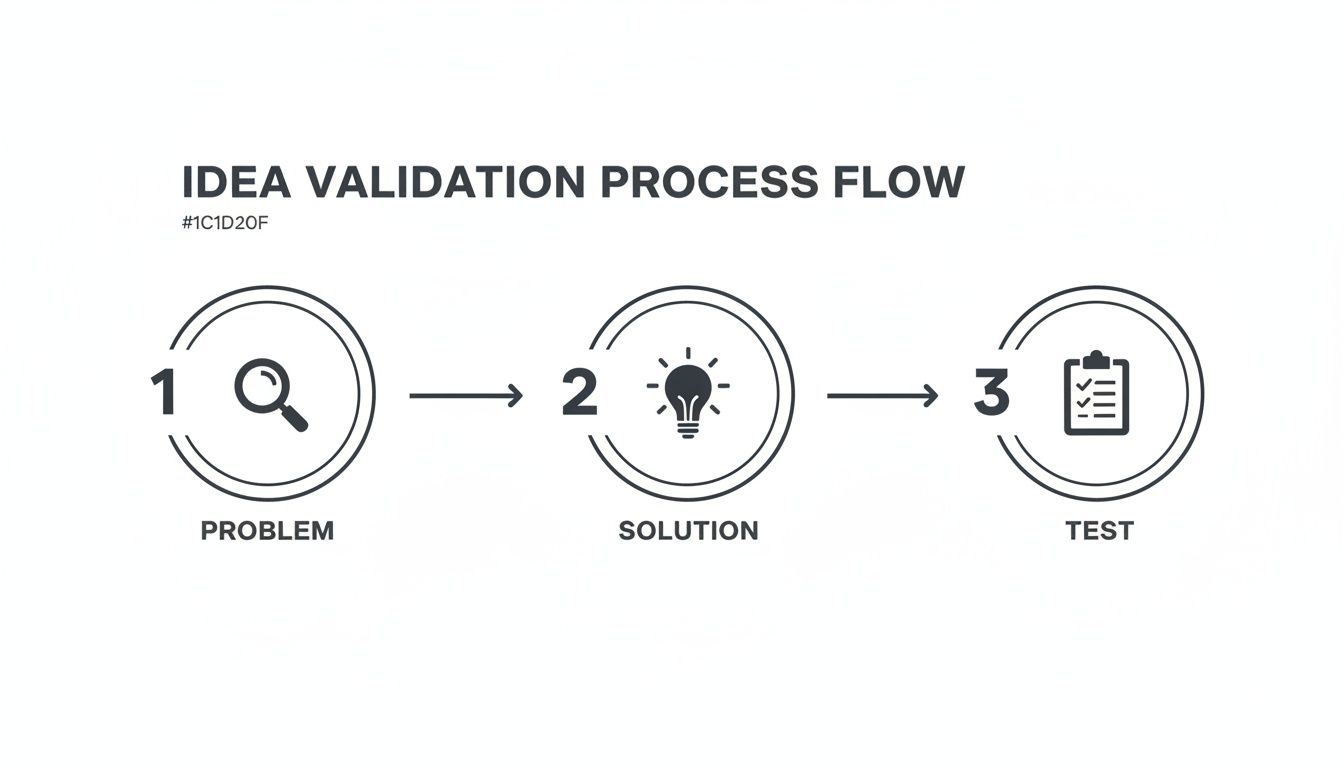
The takeaway here is that you confirm the problem and test your solution before you commit to a massive build. Resisting that "just one more thing" temptation is the discipline that separates successful MVPs from projects that never see the light of day. Scope creep is a silent killer; guard your focus like your startup depends on it—because it does.
Alright, let’s talk about the one thing that keeps every founder up at night: money. How much does an MVP actually cost, and how can you build one without going broke before you even launch?
Thinking about your MVP budget isn’t just about covering an expense. It's your first major strategic investment in figuring out what works.
The price tag on an MVP isn't one-size-fits-all. It’s a huge spectrum. A simple, no-frills product with just a couple of core features might land on the lower end, while a more complex build with third-party integrations or heavy logic will naturally climb higher. Getting this number right is absolutely critical for managing your runway.
Understanding MVP Cost Ranges
So what are the real numbers? Generally, you can expect MVP development to run anywhere from $10,000 to $50,000. For more ambitious projects, especially those dipping into AI, that cost can easily shoot past $150K.
Smart founders I've worked with don't see this as a cost but as a tactical investment. They typically allocate 20-30% of their seed funding to build an MVP that gets them validated traction—the kind of traction that fuels future funding rounds. If you want to dig deeper into this, there are some great market insights on startup investment trends on mexc.com.
So, what pushes your budget from one end of that spectrum to the other? It almost always boils down to a few key things:
Feature Complexity: A simple user login and a basic dashboard is a world away from building a real-time analytics engine. More moving parts mean more development hours.
Design & UX/UI: A polished, fully custom design will always take more time and resources than starting with a standard template or UI kit.
Third-Party Integrations: Need to connect to APIs for payments (like Stripe), maps (like Google Maps), or social media logins? Each one adds another layer of complexity and cost.
Tech Stack: Certain technologies, particularly anything involving AI or machine learning, require specialized (and more expensive) talent.
Choosing Your Development Path
Once you have a rough budget, you have to decide who is actually going to build this thing. This is a huge decision with major implications for your speed, cost, and the final quality of your product. You really have three main paths to consider.
Hiring Freelancers: This can be the most budget-friendly route, especially for a straightforward MVP. Platforms like Upwork give you access to a massive global talent pool. The catch? You instantly become the project manager, responsible for juggling everyone and making sure the quality is up to snuff.
Building an In-House Team: This approach gives you the most control and helps you build long-term knowledge inside your company. It’s also, by far, the most expensive and time-consuming option, involving recruiting, salaries, and benefits. It’s a move most startups make after an MVP has already shown serious promise.
Partnering with a Development Agency: This path offers a fantastic balance of expertise and speed. A good agency brings a complete, battle-tested team to the table—designers, developers, and project managers who already know how to work together. You can often get from idea to launch much faster than by hiring yourself. While the sticker price might look higher than freelancers, the efficiency and experience often deliver a much better return on investment.
Think of your MVP budget as an investment in data. Every dollar should be aimed at answering your biggest questions: Will users sign up? Will they actually use the core feature? And the big one—will they pay for it? Your MVP’s real job is to turn your assumptions into hard facts.
A Founder’s Story: From Budget to Funding
I once worked with a founder, Sarah, who had an incredible idea for a platform connecting local artisans with buyers. She had managed to raise a $150,000 seed round. Instead of trying to build her entire grand vision at once, she smartly allocated $45,000 (30%) to an MVP with one clear goal: prove that artisans would list products and that buyers would actually purchase them.
She decided to partner with a specialized agency to get it built fast and right. The MVP was lean, focusing on just three core features: artisan profiles, product listings, and a simple checkout process. Within four months of launching, she had 200 artisans on the platform and had facilitated over 500 sales.
When she walked into her Series A meetings, she didn’t just have a slick slide deck; she had real data, glowing user testimonials, and actual revenue. That traction, all generated from a strategically budgeted MVP, was the key that unlocked her $2 million funding round. Her story is the perfect example of how a focused financial strategy for your MVP isn't just about saving money—it's about making it. To see how a dedicated team can bring this level of clarity to your own project, see how a professional web development agency can accelerate your path to market.
What to Do in the First 90 Days After Launch

Okay, you did it. You launched. The high-fives have been exchanged, and you’re watching those first users trickle in. It’s an incredible feeling, but I have to be blunt: launching your MVP isn’t the finish line. It’s the starting gun.
What you do in these next 90 days is what separates the startups that build real momentum from those that fizzle out.
Your gut instinct will be to stare at download counts or new sign-ups. Don't. Those are vanity metrics—they feel good but tell you almost nothing about the health of your product. A thousand sign-ups are worthless if no one ever comes back. Your job now is to figure out if people are actually getting value from what you built.
Focus on Metrics That Matter
To get a real pulse on your product, you have to track the key performance indicators (KPIs) that show you what people are doing, not just that they showed up. These numbers will tell you if you're truly solving the problem you set out to fix.
Here’s what I tell every founder to track religiously in those first few months:
User Activation Rate: What percentage of people complete that one key action that makes your product click for them? For a project management app, it might be creating their first task list. For a social app, it’s probably making their first post. This is your "aha!" moment, and you need to know if people are getting there.
User Engagement: Are people coming back? Look at your Daily Active Users (DAU) and Monthly Active Users (MAU). The real magic is in the DAU/MAU ratio, which shows stickiness. If you can keep that ratio above 20%, you’re on the right track for an early-stage product.
Retention Rate: This is the big one. What percentage of users come back after day one? Week one? Month one? If your retention curve flatlines near zero, it’s a massive red flag that your product isn’t valuable enough to become a habit.
You don’t need some crazy expensive analytics setup for this. Tools like Mixpanel, Amplitude, or even a well-configured Google Analytics account will give you everything you need. The trick is to have it all set up before you launch.
Your MVP launch isn't about proving you were right. It’s about finding out where you were wrong, as quickly and cheaply as possible. The data you collect is your guide.
Data Tells You What, People Tell You Why
Analytics are fantastic for showing you what users are doing. You can see exactly where they drop off in your onboarding flow. But the numbers will never tell you why.
For that, there's no substitute for talking to your users. Seriously. Don't hide behind surveys and feedback forms. You need to get on the phone or a quick video call to hear it straight from them. This is how you close the loop between the cold, hard data and the human stories behind it.
For the first three months, make it a personal goal to speak with at least 5-10 users every single week. Don't just wing these calls; have a few open-ended questions ready:
"Can you walk me through the last time you used the product?"
"Was there anything you tried to do but couldn't figure out?"
"What's the single biggest benefit you've gotten from this so far?"
This kind of direct feedback is pure gold. It gives you the "why" behind your data and points you directly to the most important fixes and features you should build next.
Let Feedback Drive Your V2 Roadmap
The first 90 days are a frantic sprint to learn as much as you can. Every piece of data, every user conversation, every bug report—it all needs to be funneled directly into your product roadmap. This is how you ensure V2 is built on what your users actually need, not just what you think they want.
Start organizing all the feedback and look for the patterns. If you notice that 30% of the users you talk to are all getting stuck on the same screen, you've just found your top priority.
This cycle is the heart and soul of MVP development for startups. It moves you from a one-shot launch to a continuous loop of building, measuring, and learning. The insights you gather in these crucial early months will lay the foundation for a product people don't just use, but one they can't live without.
Common MVP Development Questions Answered
Alright, you've got a plan. But even the best plans leave room for those nagging "what if" questions that can stall progress. I've seen it happen to countless founders. Let's tackle some of the most common hurdles head-on so you can move forward with confidence.
Prototype vs. MVP: What's the Real Difference?
I can't tell you how many founders I've seen use these terms interchangeably. It seems harmless, but confusing them is a classic, costly mistake. They are two completely different tools for two completely different jobs.
A prototype is all about the look and feel. Think of it as a smoke-and-mirrors-version of your app, usually built in a tool like Figma. You can click around, and it feels real, but there's no code, no database, no engine under the hood. It’s a visual facade.
The only question a prototype answers is: "Is this design intuitive?" It's a quick, cheap way to validate your user experience before a single line of code gets written.
An MVP, however, is the real deal. It’s a functioning, coded product, albeit a stripped-down one. It has just enough features to solve a core problem for your first users and prove your entire business concept.
The MVP is built to answer a much bigger, more terrifying question: "Will anyone actually use this?" It's your first test against the harsh reality of the market.
Aspect | Prototype | Minimum Viable Product (MVP) |
|---|---|---|
Purpose | Test usability and user flow. | Test the core business idea and get market feedback. |
Functionality | Visual and interactive, but not functional. | A real, working product with limited features. |
Audience | A small group of internal stakeholders or test users. | Your first real, public users or early adopters. |
Effort | Low effort; focused on design and clicks. | High effort; involves real engineering and deployment. |
Here's an analogy I use: a prototype is the architect's 3D model of a house. It lets you see the layout. An MVP is the foundation, frame, roof, and working plumbing—the absolute bare minimum you need to actually live in it.
How to Choose a Tech Stack Without Over-Engineering
The "what tech stack?" question paralyzes founders. You get this nagging fear of picking the wrong thing, which often leads to building a fortress when all you need is a lean-to. My advice is always the same: focus on speed and simplicity.
Your job isn't to build a platform that can support a million users right now. It's to build something you can launch in three months. Period.
Here's a simple gut-check for making the choice:
Use what your team already knows. Is your first engineer a Python wizard? Don't force them to learn a trendy new language. The fastest path to launch is the one your team can walk with their eyes closed. Go with Django or Flask.
Pick frameworks built for speed. Don't reinvent the wheel. Technologies like Ruby on Rails, Next.js for React, or Laravel for PHP are popular for a reason—they handle tons of boilerplate work for you, saving precious time.
Offload your infrastructure. Please, do not try to manage your own servers. Use a managed service like Heroku, Vercel, or AWS Elastic Beanstalk. They take care of deployment and scaling so your team can focus on one thing: building your product.
Your MVP's tech stack is not a blood oath. You can—and likely will—rebuild it later. Just look at giants like Twitter and Airbnb. They completely re-architected their platforms after they proved people wanted what they were selling. Choose what gets you to market fastest, not what you think you'll need in five years.
Can I Build an MVP Without a Technical Co-Founder?
Yes. A thousand times, yes. While a great technical partner is invaluable, not having one is a terrible reason to let a great idea die on the vine. You have options.
One of the most direct routes is partnering with a specialized product development agency. You get an entire, pre-vetted team—designers, developers, project managers—who have a proven playbook for taking an idea from napkin sketch to a live, polished product. It’s often the quickest way to get a professional-grade MVP into the market.
You could also hire a team of freelancers from platforms like Upwork. This can work, but be warned: you instantly become the project manager. It requires serious organization and crystal-clear communication to keep everyone aligned and on schedule.
Finally, don't sleep on no-code tools. For many ideas, platforms like Bubble or Webflow are more than powerful enough to build a fully functional web app. You can get a product into the hands of real users without writing a single line of code yourself.
Feeling like you're in over your head with the technical side of things? Shalev Agency acts as a dedicated design and development partner, guiding founders through this exact process. We turn your vision into a high-quality MVP that’s built to get results. Learn how we can help you ship faster and smarter.