
Learn how to create a product roadmap that aligns teams and drives results. Our guide offers practical steps for strategy, prioritization, and communication.
Jan 11, 2026
A product roadmap is more than just a list of features and deadlines. It's your strategic guide, the story of why you're building what you're building. It aligns your team, excites your stakeholders, and connects every task back to the bigger picture.
Defining Your Strategy Before You Build
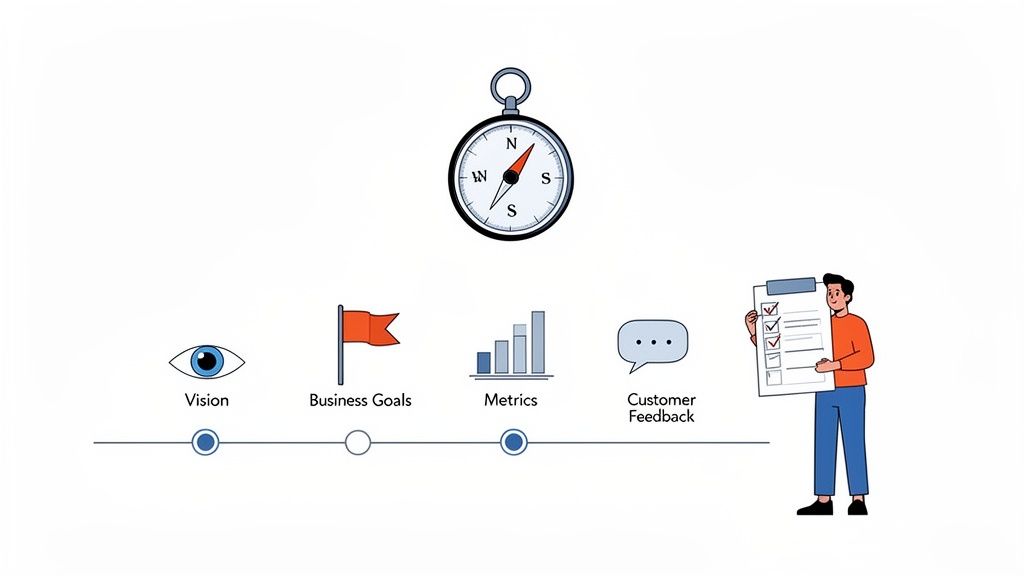
It’s tempting to jump right into brainstorming features, but a great roadmap starts with a rock-solid strategy. Building features without a clear "why" is like starting a road trip without a destination. Sure, you're moving, but you're probably heading in the wrong direction. This strategic foundation ensures the "what" and "when" fall into place naturally.
Think of your product vision as the North Star for every decision. It’s a clear, aspirational statement about the future you’re trying to build for your customers. It's not a feature list; it's the change you want to see in the world.
A product vision isn't just a feel-good line for a slide deck. It's a practical filter. When a new idea or feature request comes up, the first question should always be: "Does this move us closer to our vision?" If the answer isn't a clear 'yes,' it’s probably a distraction.
Once you have that compelling vision, you need to break it down into tangible business goals. These are the measurable outcomes that prove you're actually making progress.
Translating Vision into Measurable Goals
Goals like "improve user experience" are too vague. They’re impossible to measure and lead to unfocused work. You have to connect your high-level vision to specific, quantifiable key metrics.
Here’s how that translation looks in the real world:
Vision: "To become the simplest accounting platform for freelancers."
Business Goal: Slash the time it takes new users to send their first invoice.
Key Metric: Decrease the average "time-to-first-invoice" from 45 minutes to under 10 minutes in Q3.
Another Goal: Make users more self-sufficient and confident.
Key Metric: Cut support tickets related to "how to create an invoice" by 50%.
Metrics like these give your team a clear finish line. The conversation shifts from "Did we ship the feature?" to "Did we achieve the outcome we wanted?"
Gathering Your Strategic Inputs
A strong strategy can't be dreamed up in an isolated conference room. It has to be grounded in real-world data from both inside and outside the company. Effective product design process steps always kick off with this kind of deep discovery.
You'll need to pull from several key sources:
Customer Feedback: Don’t just rely on surveys. Get on the phone with customers. Run in-depth interviews to find out their real pain points and the clever workarounds they’ve invented because your product isn't quite there yet.
Sales and Support Teams: These folks are on the front lines every single day. They know which missing features are killing deals and which bugs drive customers absolutely crazy. Set up a clear, simple way for them to feed these insights back to the product team.
Competitive Analysis: The goal isn't to copy your competitors—it's to find their weaknesses. Where are their customers complaining online? Those gaps in their service are your strategic opportunities.
Market Trends: What’s happening in the wider world? New technologies, changing regulations, or shifts in user behavior can create massive threats or opportunities for your product.
Despite how critical this is, long-term strategic planning is surprisingly uncommon. Only 13% of companies maintain detailed product roadmaps for more than a year. The ones that do, however, see far greater success by grounding their plans in customer insights and clear business goals.
Without this foundation, it's easy to see why 23% of product development investments fail due to a fuzzy company strategy. By nailing down your strategy first, you ensure your roadmap is a plan for real business impact, not just a list of stuff to build.
Choosing a Roadmap Format That Fits Your Team
With your strategy locked in, it’s time to decide how you're going to visualize it. This is more than just picking a template; the format you choose fundamentally shapes how your team—and the entire company—thinks about time, commitment, and what success actually looks like.
There’s no one-size-fits-all answer here. The right format depends entirely on your company culture, your growth stage, and who you’re trying to keep in the loop.
Picking the wrong one can backfire, fast. Imagine a scrappy startup trying to use a rigid, date-driven roadmap—it's a recipe for missed deadlines and constant frustration. On the flip side, a massive enterprise team coordinating a huge launch with marketing, sales, and legal will find a super-flexible, high-level format completely chaotic.
Let's walk through the three most common formats I see in the wild.
The Traditional Timeline Roadmap
This is what most people think of when they hear "roadmap." It looks a lot like a Gantt chart, with features and big projects plotted against a calendar, usually broken down into months or quarters.
Its biggest strength is clarity. When you have hard, external deadlines, this format is your best friend. If you’ve promised a key feature to a major client or need to coordinate a massive launch for an annual conference, this is the way to go. It provides the predictability everyone craves.
But here’s the catch: it creates a false sense of certainty. Stakeholders see a date on a chart and treat it like a blood oath. This can kill agility, punishing teams for learning new things and adapting. Your roadmap quickly becomes a source of pressure instead of a strategic guide.
Use a timeline roadmap when coordinating a fixed-date launch across multiple departments is your #1 priority. Think of a hardware company launching a new phone—manufacturing, marketing, and retail distribution all have to hit their dates perfectly.
The Goal-Oriented Roadmap
I love this one. Sometimes called a theme-based roadmap, it shifts the entire conversation from what you're building to why you're building it. Instead of a laundry list of features, you organize work around strategic goals.
For example, a theme could be “Improve New User Activation by 15%” or “Reduce Involuntary Churn.” Under that goal, you’d list the projects and experiments you believe will get you there. This approach is brilliant for empowering your team and getting everyone laser-focused on results, not just shipping code.
The main challenge? It can feel a bit too abstract for stakeholders who just want to know, "When is feature X shipping?" It requires a mature product culture where teams are trusted to find the best path to an outcome, rather than just executing a checklist.
When you're trying to figure out which format fits your team, a detailed guide on Product Roadmap Tools can show you which software best supports each of these different styles.
The Now-Next-Later Roadmap
This agile-friendly format is probably the most popular one I see today, and for good reason. It strikes the perfect balance between giving strategic direction and maintaining flexibility.
It’s dead simple. You organize everything into three columns:
Now: What the team is actively building. These are committed, fully scoped, and happening as we speak.
Next: What’s on deck. These items are prioritized and are likely in the discovery or design phase, but they aren't 100% committed.
Later: Big ideas for the future. Think of these as placeholders for problems we want to solve down the line, with very little detail attached.
This format is fantastic for communicating priorities without getting trapped by dates. It tells everyone what’s important now and what’s on the horizon, all while giving the product team room to pivot as they learn. It’s an almost perfect fit for startups and any company in a fast-moving market where a detailed one-year plan is basically science fiction.
Which Product Roadmap Format Is Right for You?
Choosing a format isn't a permanent decision, but it's an important one. The table below breaks down the core differences to help you find the best starting point for your team and company culture.
Format Type | Best For | Key Advantage | Potential Pitfall |
|---|---|---|---|
Timeline | Teams with hard external deadlines and complex cross-functional dependencies. | Provides clear, date-based predictability for all stakeholders. | Creates a false sense of certainty; can stifle agility and punish change. |
Goal-Oriented | Mature product teams focused on outcomes over output; companies with clear business objectives. | Aligns everyone around the why and empowers teams to find the best solutions. | Can feel too abstract for stakeholders who want to know when features will ship. |
Now-Next-Later | Agile teams in fast-changing environments who need to balance direction with flexibility. | Communicates priorities clearly without the pressure of specific deadlines. | Can lack the long-term view needed for large, enterprise-level planning. |
Ultimately, the best format is the one that sparks the right conversations and keeps everyone pulling in the same direction. Don't be afraid to try one and adapt it if it's not working.
How to Prioritize Features with Confidence
A roadmap packed with great ideas is a good problem to have, but it’s just a wish list without a clear sense of what to tackle first. This is where prioritization comes in. It's the critical step where you move from gut feelings to a structured process that can justify every decision you make.
Without a solid framework, prioritization often gets hijacked by the loudest voice in the room or the latest customer complaint. That’s a reactive approach that leads to becoming a "feature factory"—building a lot, but achieving very little. Real prioritization ties every bit of development work directly back to your strategic goals.
This process ensures your team’s precious time and resources are always focused on the initiatives that will actually move the needle. It also gives you a defensible "why" when a stakeholder asks why their pet project isn't at the top of the list.
Quick Sorting with The MoSCoW Method
When you need to make quick, decisive calls, the MoSCoW method is a fantastic place to start. It’s a simple framework for bucketing initiatives into four categories, which makes it perfect for a workshop or early planning session.
Here’s the breakdown:
Must-have: These are the non-negotiables. The product or release simply won't work without them. Think of the "add to cart" button on an e-commerce site—it's table stakes.
Should-have: These are important but not critical for the initial launch. They add a ton of value, but the product can function without them for now. A "related products" section would fit well here.
Could-have: These are the "nice-to-have" features that would be great if you find yourself with extra time and resources. They improve the experience but have a smaller impact. A "save for later" feature is a classic example.
Won't-have: These are features that are explicitly out of scope for this specific timeframe. Calling them out helps manage expectations and keeps scope creep in check.
MoSCoW is brilliant for its simplicity, but it can be subjective. One person's "must-have" is another's "should-have." That’s why you often need a more data-driven method for the really tough decisions.
A Data-Driven Approach with RICE Scoring
For a more objective and analytical way forward, the RICE scoring model is a powerful tool. It forces you to put numbers behind your assumptions, turning a heated debate into a simple math problem.
The score for each feature is calculated using a straightforward formula:
(Reach x Impact x Confidence) / Effort = RICE Score
Let's break that down. Imagine a SaaS company is weighing three potential features: a brand-new dashboard, a Zapier integration, and an improved onboarding flow.
Reach: How many users will this feature affect in a set period? (e.g., 500 customers/month)
Impact: How much will this move the needle on a key goal? (Use a scale: 3 for massive impact, 2 for high, 1 for medium, 0.5 for low)
Confidence: How sure are you about your estimates? (Use percentages: 100% for high confidence, 80% for medium, 50% for low)
Effort: How much time will this require from your team? (Estimate in "person-months")
By calculating the RICE score for each idea, you get a prioritized list that’s backed by data, not just opinions. This makes the crucial work of product development for startups far more predictable.
A common mistake is treating the RICE score as an absolute truth. It's a guide, not a dictator. Use it to facilitate a discussion, not to end one. Sometimes a lower-scoring feature is still the right strategic move.
Customizing Priorities with Weighted Scoring
Weighted scoring is the most flexible framework of all because you get to build it around your unique business goals. You decide what criteria matter most—like "Strategic Alignment" or "Reduces Churn"—and assign a weight to each one.
For instance, if your main objective this quarter is to improve user retention, your scoring model might look something like this:
Reduces Churn: 40%
Increases User Engagement: 30%
Strategic Alignment: 20%
Effort (lower is better): 10%
You then score each potential feature against these criteria to get a final weighted score. This method is brilliant because it guarantees that your roadmap directly reflects your current strategic priorities. And to confidently decide what to build next, having a structured approach is a must. A modern AI Strategy 2025 Prioritization Framework for MVPs can offer even more advanced ways to think about this.
These frameworks ensure you're building a product roadmap based on a clear, consistent, and defensible process. You’ll be able to build with confidence, knowing you’re working on what truly matters.
Getting Your Whole Team on Board with the Roadmap
Let's be honest: building a brilliant roadmap is only half the job. A roadmap that just sits in a folder gathering digital dust is completely useless. Its real power comes to life when it’s a living document that gets your entire company pulling in the same direction.
Think of it as a communication tool first, a plan second.
Your main job now is to get everyone—from the CEO down to the newest engineer—to not only understand the plan but to actually believe in it. This means you’ll need to tailor your message, pick the right tools, and set up a regular communication rhythm that builds real momentum.
Choosing the Right Tool for the Job
The tool you use to build and share your roadmap will fundamentally shape how people engage with it. The goal isn't to find the fanciest software, but to find a solution that actually fits your team's size, culture, and day-to-day workflow.
For many startups and smaller teams, simple and flexible is the way to go. Tools like Notion or even a well-organized Google Slides deck can work wonders. They’re a breeze to update, easy to customize, and promote a more fluid, conversational style of planning.
But as teams grow, things can get messy fast. That's when having a single source of truth becomes non-negotiable, and dedicated roadmapping software starts to shine. Tools like Productboard, Aha!, or Roadmunk are designed to connect high-level strategy to the nitty-gritty of execution. They make it easy to link customer feedback directly to features and, crucially, to show different views to different people.
This isn’t just a nice-to-have; it's a strategic necessity. A 2023 report revealed that for over 50% of large product teams (50+ people), keeping the roadmap and processes consistent is their biggest headache. This kind of coordination breakdown is a key reason why 28% of product launches in major markets don't meet management's expectations. As detailed in the 2023 State of Product Management report, the right tool can make a massive difference here.
Tailoring Your Presentation for Different Audiences
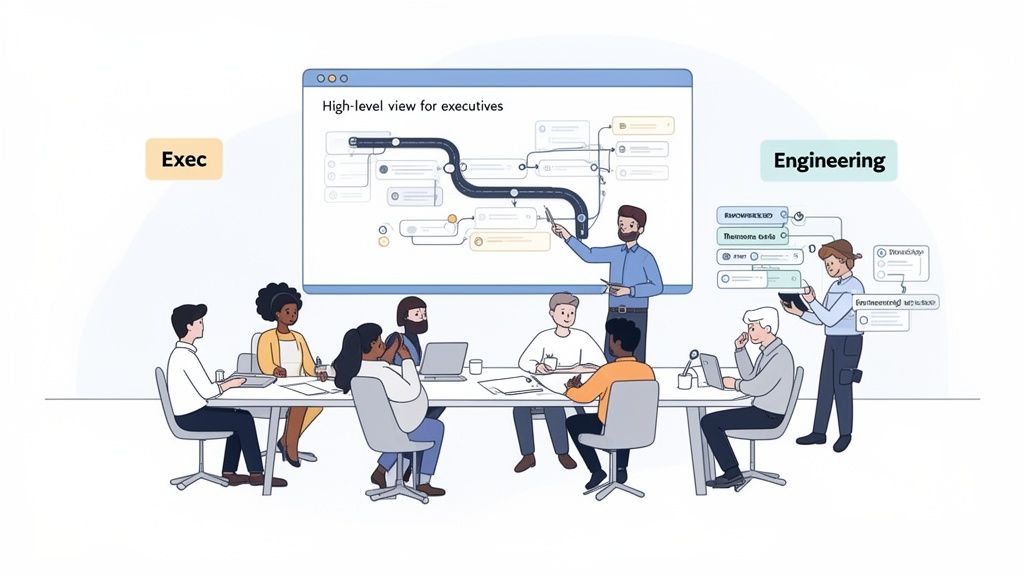
You wouldn't give your investors and your engineering team the exact same presentation, right? The same logic applies to your roadmap. A one-size-fits-all approach is doomed to fail because different teams care about different things. You need to create tailored "views" of the roadmap that speak directly to each audience.
For Executives: They need the 30,000-foot view. Stick to the why. Clearly connect every major initiative to business goals, OKRs, and market opportunities. Keep it high-level, visual, and focused on outcomes and timelines.
For Engineering: They need the what and the how. This view has to be more detailed, zeroing in on the problems to be solved, user stories, and technical requirements. For a seamless workflow, link roadmap items directly to tickets in your project management tool, like Jira.
For Sales & Marketing: They just need to know what's coming down the pipeline so they can get ready. This view should highlight the customer-facing benefits and tentative launch dates. It’s what they’ll use to build campaigns, create sales materials, and manage customer expectations.
A great roadmap tells a compelling story. For executives, it's a story of market wins and revenue growth. For engineering, it's a story of solving tough problems for users. And for sales, it’s a story of new value they can bring to customers. Get good at telling these different stories.
Running a Successful Roadmap Kickoff
Once the roadmap is locked in, it’s time to kick things off. This meeting sets the tone for the entire quarter or half. It's your big chance to get everyone genuinely excited and aligned around a shared mission.
A good kickoff isn’t just you talking at people; it’s a conversation. Here’s a quick checklist to make sure it hits the mark:
Start with the Vision: Before diving into the details, remind everyone of the North Star. Reiterate the product vision and the company goals this roadmap is built to serve.
Explain the "Why": Briefly walk through your prioritization process. Show them the frameworks you used (like RICE or MoSCoW) to prove that these decisions were objective and data-informed, not just random ideas.
Present the Plan: Now share the roadmap itself, using the version tailored to the people in the room. Focus on the goals for the upcoming period and what success looks like.
Clarify What's Not on the Roadmap: This is just as critical. Be upfront about popular feature requests that didn’t make the cut and explain the trade-offs. It shows you were listening and builds a ton of trust.
Open the Floor for Questions: Leave plenty of time for a real Q&A. A healthy debate isn't something to fear—it's a sign that your team is engaged and thinking critically.
When you communicate your plan with this level of clarity and conviction, your roadmap transforms from a static document into a powerful tool for alignment. And if you’re looking for ideas on how to present data and goals clearly, our guide on dashboard design best practices is a great place to start.
Common Roadmap Mistakes and How to Avoid Them
You can build a beautiful, detailed roadmap, but if you're not careful, it can become irrelevant almost overnight. I've seen it happen time and again. Teams fall into a few common traps that turn a powerful strategic tool into a dusty document nobody trusts. Learning to spot and sidestep these pitfalls is just as important as building the roadmap in the first place.
The biggest mistake? Treating the roadmap like a rigid, unchangeable contract. The moment stakeholders see a feature on a timeline, they often mentally etch it in stone as a promise. This locks you in, creates immense pressure, and punishes your team for learning new things that should change the plan.
A roadmap is a statement of intent, not a fixed delivery schedule. You absolutely have to frame it as a living document right from the start.
Forgetting That Outcomes Beat Outputs
It's so easy to fall into the "feature factory" trap. Success gets measured by the number of things shipped, not the impact they create. This is the classic mistake of prioritizing outputs (shipping stuff) over outcomes (actually solving customer problems). A roadmap stuffed with features that don't move the needle on your goals is just a roadmap to nowhere.
To fix this, anchor every single initiative to a clear business or user outcome.
Don’t just write "New Dashboard." Instead, frame it as "Reduce user onboarding time by 30%," with the new dashboard listed as one potential solution. This simple reframing changes the entire conversation. It gives your team the freedom to find the best solution and keeps everyone focused on what truly matters.
Your roadmap shouldn't be a list of features to build. It should be a list of problems to solve. This mindset shift is the single most powerful change you can make to improve your product development process.
Building Your Roadmap in a Silo
A roadmap cooked up in a vacuum by a lone product manager is dead on arrival. Without getting key people involved early, you miss out on crucial perspectives and, more importantly, you won't get their buy-in. Engineering might spot a technical iceberg you're sailing towards, while sales has frontline insights that could completely reshape your priorities.
The key is to pull people from engineering, design, marketing, and sales into the process while you're prioritizing, not after the decisions have been made.
Run collaborative workshops: Use a prioritization framework like MoSCoW or weighted scoring as a group exercise.
Share early and often: Send out rough drafts for feedback, making it clear it’s a work-in-progress and you need their expertise.
Build shared ownership: When people feel they helped shape the plan, they're far more invested in seeing it through.
This isn't about design by committee. It's about building a smarter, more realistic plan that the whole company can actually rally behind.
Making the Roadmap Too Granular
Another classic mistake is cramming your roadmap with too much detail, especially for things far off in the future. Listing every tiny user story for a project six months away gives a false sense of certainty and makes the roadmap a nightmare to read. It also guarantees it will be wrong.
Instead, think of it like a rolling wave of detail.
Now: What you're working on right now should be detailed, with clear user stories and a defined scope.
Next: The upcoming work cycle should have well-defined problems and initiatives, but the specific solutions can stay flexible.
Later: This bucket should only contain big-picture strategic themes or major problems you want to tackle, with almost no implementation details.
This approach gives your team clarity on what’s happening today while preserving the flexibility you need to adapt to whatever you learn tomorrow. Avoiding these common mistakes is essential when learning how to create a product roadmap that truly guides your team to success.
Your Product Roadmap Questions Answered
Even with the best templates and frameworks, you're going to hit some tricky spots. Roadmapping is as much an art as it is a science.
Let's tackle some of the most common questions that come up time and time again. Think of this as a field guide for handling those specific, real-world hurdles with confidence.
How Often Should I Update My Product Roadmap?
Your roadmap is a living document, not something you carve in stone. The best rhythm I've found is a quarterly strategic review to reassess your big-picture goals and themes. Alongside that, hold a monthly or bi-weekly check-in to fine-tune your immediate priorities—what’s in your 'Now' column. This keeps you both stable and agile.
But don't let the calendar be your only guide. A huge market shift, a competitor's surprise launch, or a flood of eye-opening user feedback are all valid reasons to pull the team together and re-evaluate right now. The key is to avoid daily tweaks that give your team whiplash, but never let the roadmap get so old it becomes irrelevant.
A roadmap that hasn't been touched in six months isn't a roadmap; it's a historical document. Its main value is showing how wrong your assumptions were. The goal is to keep it forward-looking and genuinely useful.
How Do I Say No to Stakeholder Requests?
Learning to say "no" without burning bridges is a superpower for product managers. When a stakeholder comes to you with an idea, your first move is always to just listen. Seriously. Make them feel heard and show you understand the problem they're trying to solve. That simple bit of empathy can disarm most of the tension right away.
Then, you can gently pivot the conversation back to the strategy and the prioritization framework you all agreed on. Instead of a flat "no," try framing it as "not now" and clearly explain the trade-offs.
You could say something like this: "That's a really interesting idea, and I can definitely see the value. Right now, our main company goal is to reduce customer churn, and this other initiative scored much higher against that objective. If we were to build your feature now, we'd have to push that project back and accept the hit to our churn goal. Do we think this new request is more critical than that?"
This approach turns a potential argument into a collaborative discussion about what truly matters most for the business.
What Is the Difference Between a Roadmap and a Release Plan?
This is a classic point of confusion, but getting it right is critical for managing expectations across the company.
A Product Roadmap is the why. It’s your high-level, strategic view showing the direction you're headed and the outcomes you want to achieve over the next few quarters. It's all about intent, problems, and themes.
A Release Plan is the how. This is the nitty-gritty tactical plan. It breaks down the specific features, user stories, and timelines for the very next launch, often sprint by sprint.
Here’s an analogy I like: planning a cross-country road trip. The roadmap is your map showing you're driving from New York to Los Angeles via Chicago and Denver. The release plan is the turn-by-turn GPS navigation telling you to "turn left in 200 feet." You need both, but they serve very different purposes.
At Shalev Agency, we partner with growing teams to turn strategic roadmaps into polished products and websites that actually convert. If you need a design and development team to help you build what's next, faster, let's talk. You can learn more about our process on our website.