
Discover how to choose a web development agency that fits your goals, define scope, ask smart questions, and manage a successful partnership.
Jan 11, 2026
A web development agency is essentially a team of specialists you hire to design, build, and look after your website or web app. They bring a mix of strategy, creativity, and serious tech skills to the table to build digital tools that actually help your business—whether that's getting more leads or making your internal processes run smoother.
Defining Your Project Before You Start Your Search
Before you even think about emailing an agency, you need to get your own house in order. Seriously. Hopping on calls without a clear plan is a recipe for disaster. It's like asking an architect to build you a "house" without telling them how many rooms you need or what your style is. You'll waste everyone's time, and the quotes you get back will be all over the place.
A little prep work now will save you a ton of headaches (and money) down the road. This is your chance to turn vague business goals into a tangible project plan. When you do this right, you’ll attract the right kind of agencies and they'll be able to give you a proposal that actually makes sense.
Know Your Audience and Problem
First things first: who is this for? And please, don't say "everyone."
Get specific. Are you building for busy parents who need a super-fast mobile experience, or for detail-oriented engineers who will appreciate data-heavy dashboards? The best way to figure this out is by conducting user interviews to get real feedback instead of just guessing.
Once you know your audience, nail down the exact problem your website or app is solving for them. A crystal-clear problem statement becomes your guidepost for every decision you make. For startups, getting this right is non-negotiable. If you want to dig deeper into this, our post on website design for startups is a great resource.
Identify Core MVP Functionalities
You can't build everything at once. And you shouldn't. The goal is to define a Minimum Viable Product (MVP)—the absolute bare-bones version of your product that solves the core problem for your first users.
Think through the main path a user will take:
What do they want to do? What’s their primary goal?
What's the one thing they must do? Is it signing up, buying a product, or booking a demo?
What features make that happen? For an e-commerce site, this would be a simple product catalog, a shopping cart, and a checkout flow. That's it.
Focusing on an MVP gets your product into the hands of real users faster. You can collect actual data and make improvements based on how people really use it, not just on what you think they want. It’s the smartest way to manage your budget and reduce risk.
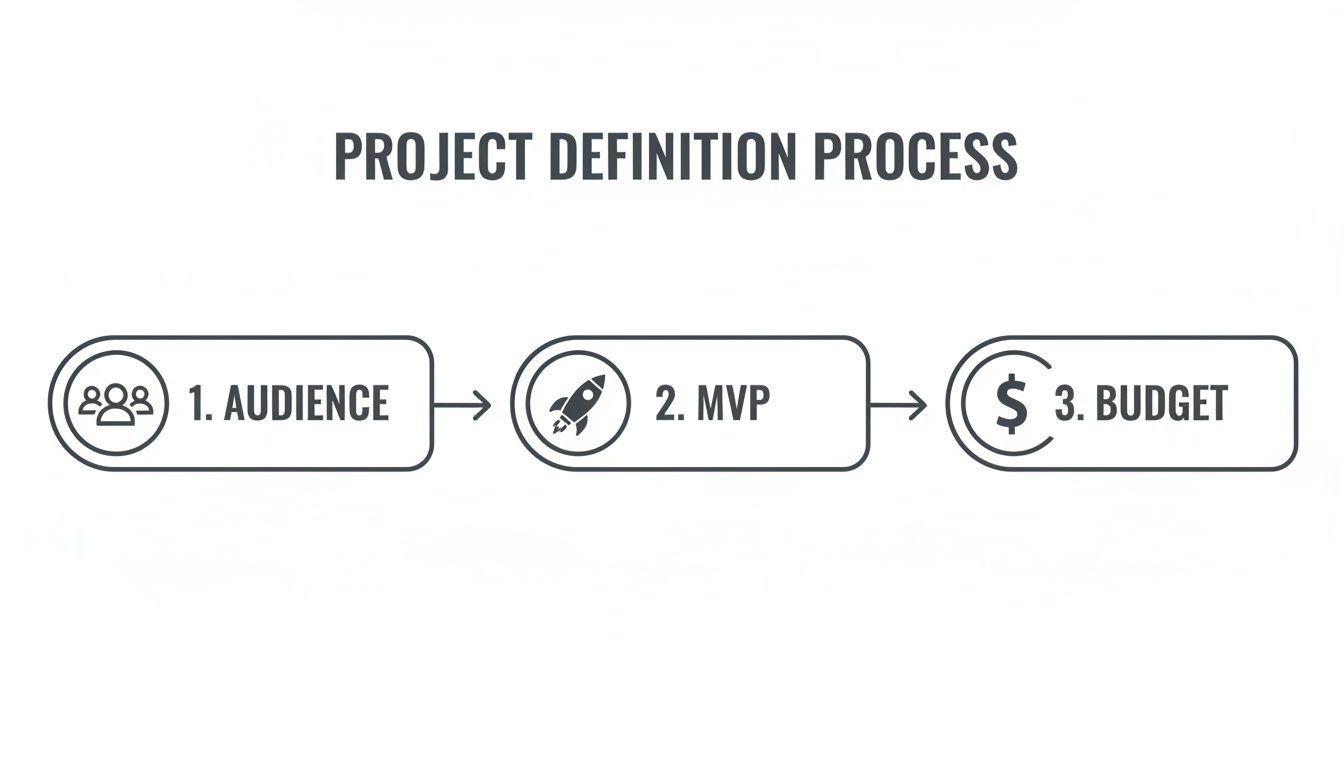
This simple flow is your starting point. Figure out your audience, scope out the MVP, and get a handle on your budget. These are the three pillars of a solid project brief that will set you up for success.
How to Evaluate a Web Development Agency
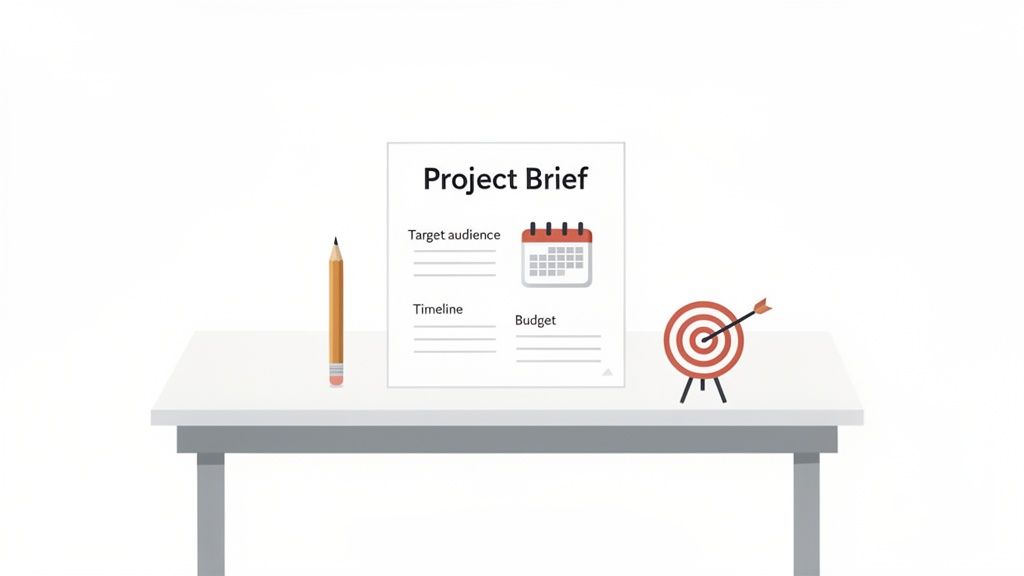
Alright, you’ve got your project brief locked and loaded. Now comes the hard part: finding the right team to bring it to life. This is where you separate the real partners from the slick sales pitches.
A flashy portfolio is just the starting point. It’s easy to be wowed by pretty designs, but you need an agency that delivers real business value, not just a facelift. Let’s dig into what you should really be looking for.
Look Beyond the Portfolio
A portfolio is more than a gallery of screenshots; it's a resume of results. Don’t just scroll through thinking, "Do I like this?" Instead, ask, "What did this project actually achieve for the client?"
Hunt for case studies that connect the dots between their work and tangible business metrics. Did their redesign for a SaaS company boost demo sign-ups by 30%? Did that new e-commerce site they built slash cart abandonment rates? You can see exactly how we tie our design and development work to business goals on our own project pages. If an agency can't show you the why behind their work with real data, they might be more focused on winning awards than growing your business.
Don't get star-struck by big-name logos. An agency might have a famous brand in their portfolio, but that doesn't mean your startup will get the A-team. Focus on projects that mirror your own in terms of scope and complexity.
Assess Technical and Design Expertise
You know your tech stack, and your agency partner needs to know it too. Whether you’re building on React for a snappy web app or need a headless CMS for flexibility, their team must have proven experience with the tools you need. Just ask them directly.
But great engineering is only half the battle. Their approach to user experience (UX) and user interface (UI) design is just as critical. A top-tier agency doesn't just make things look good; they create intuitive, user-friendly experiences. Their process should always start with user research, wireframing, and prototyping—never jumping straight into pixel-perfect mockups. This thoughtful, methodical approach is what separates products people tolerate from products people love.
Here are a few things to probe:
Engineering Chops: How do they maintain code quality? Do they use version control like Git? What's their process for testing and deployment?
Design Process: Can they walk you through their user-centered design philosophy? Ask to see wireframes or user flows from past projects, not just the final pretty pictures.
Communication Flow: How do they keep clients in the loop? Do they use tools like Slack, Notion, or Asana? A transparent, organized communication process is a massive green flag.
Clarify Ownership and Security
This is one of those crucial details that can get lost in the excitement of a new project, but you can't afford to overlook it. Before you sign anything, get this in writing: who owns the final code and design files? The answer should always be you, once the final invoice is paid.
Any agency that tries to retain ownership, license the code back to you, or lock you into a proprietary system is a huge red flag. Run, don't walk.
You should also bring up a Non-Disclosure Agreement (NDA) early on to protect your intellectual property. Any reputable agency will sign one without hesitation. With 12% of development work being outsourced in a global market expected to reach USD 82.4 billion by 2026, finding a trustworthy partner who guarantees full ownership and confidentiality is non-negotiable. It’s the only way to ensure your big idea stays yours.
Web Development Agency Evaluation Checklist
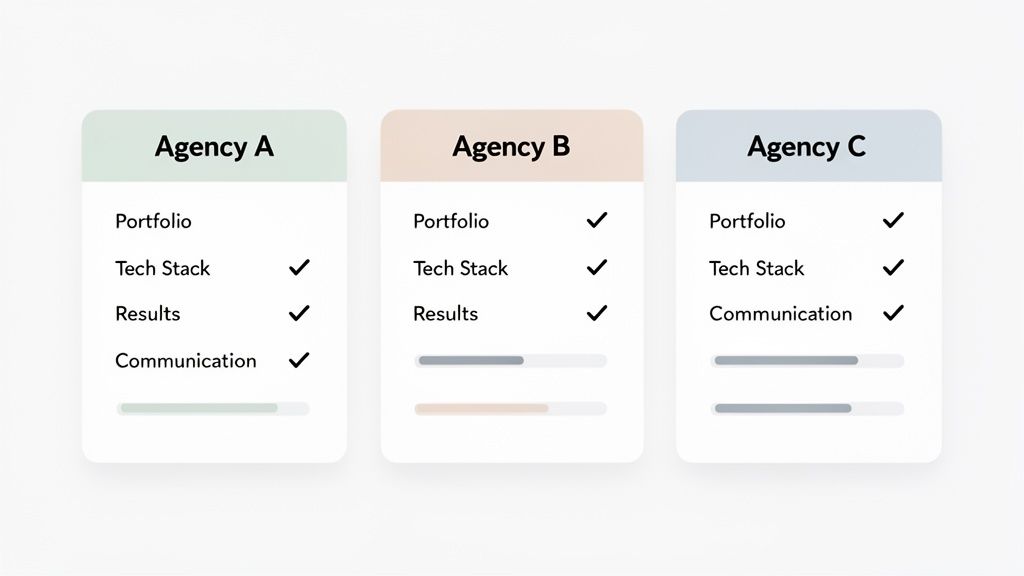
To keep things organized, use a simple checklist like the one below when you’re comparing a few different agencies. It helps you make an objective, side-by-side comparison rather than just going with a gut feeling.
Evaluation Area | What to Look For | Red Flag |
|---|---|---|
Portfolio & Results | Case studies with clear business metrics (e.g., increased revenue, conversion). | A gallery of screenshots with no context or performance data. |
Relevant Experience | Projects similar to yours in scope, industry, and technical complexity. | Only showing projects for giant corporations or tiny brochure sites. |
Technical Skills | Deep expertise in your required tech stack (React, Webflow, etc.). | Vague answers about their technical capabilities or a "we do it all" claim. |
Design Process | A user-centered approach: research, wireframes, prototypes, user testing. | Rushing straight to visual design without a strategic foundation. |
Communication | A dedicated project manager, clear processes, and familiar tools (Slack, Asana). | Messy, infrequent communication; no clear point of contact. |
Ownership | A contract that grants you 100% ownership of all final code and design assets. | The agency retains ownership or uses proprietary, locked-in tech. |
Security | Willingness to sign an NDA to protect your IP. | Hesitation or refusal to sign a standard NDA. |
This checklist isn't exhaustive, but it covers the core areas that will make or break your partnership. A great agency will have strong, confident answers for every single one.
Asking the Right Questions in Agency Interviews
This is where you get past the slick portfolio and find out how an agency really works. The interview is your chance to see their process, communication style, and problem-solving skills in action. Think of it less as an interrogation and more as a conversation to find a true partner who thinks strategically and enjoys collaborating.
Your real goal here is to picture what it’s like working with them day-in and day-out. What happens when things don't go according to plan? Do their answers give you a shot of confidence or leave you with more questions? The right questions will separate the talkers from the doers.
Probing Their Project Management Process
Every agency on the planet will tell you they’re "agile," but you need to know what that actually means for them. If you get vague answers, that’s a red flag. Dig for specifics on how they run their projects, manage tasks, and keep you in the loop.
Ask them to just walk you through a typical project week.
Who will be my main point of contact? You need to know if you'll have a dedicated project manager or if you'll be talking directly with the designers and developers. There's no single right answer, but you need to know their model.
What tools do you live in? Look for familiar names like Notion, Asana, or Jira. More importantly, listen for a clear system they use for updates and communication.
How often will I hear from you? A good agency will already have a suggested rhythm, like a weekly async update or a quick check-in call.
Getting a handle on their workflow is crucial. If you want to benchmark their responses, we’ve covered some proven methods in our guide to website development processes.
Pay close attention to how they talk about your role in the project. A great partner sees you as a collaborator, not just the person signing the checks. They should be asking you smart questions, too.
Gauging Their Problem-Solving Skills
Let’s be real: no project goes perfectly. Scope creep happens. Technical curveballs come out of nowhere. Priorities change. The real measure of an agency isn't avoiding problems—it's how they react when things get messy.
Toss them a hypothetical scenario that feels real to your project. Something like, "Okay, imagine we're two weeks from launching our e-commerce site, and we discover a key payment gateway integration is way more complex than anyone thought. What do you do?"
A solid answer will hit on these points:
Immediate Communication: They’d tell you right away, explaining the problem and its potential impact without any sugarcoating.
Solution-Oriented Options: They would come to you with a few ways forward, laying out the pros and cons of each (e.g., launch with a different gateway, push the launch date, etc.).
Collaborative Decision-Making: They'd work with you to figure out the best move based on your business goals.
Understanding Their Team and Culture
Finally, you need to get a feel for the actual people you'll be working with. The best agency partnerships are built on mutual respect. You're not just buying a service; you're bringing a new team into your world.
Who, specifically, is on our team? Ask about the experience of the actual developers and designers who will be assigned to your project.
How do you handle tough feedback? Their answer will tell you a lot about their ego and how open they are to iteration.
Tell me about a recent project you’re proud of—and not just because it looked good. This question gets to what they truly value. Was it a clever engineering fix, a great client collaboration, or hitting a nearly impossible deadline?
How they answer these questions will tell you everything you need to know about whether they're the right long-term fit for you.
Understanding Agency Pricing and Engagement Models
Figuring out the money side of things can be one of the trickiest parts of hiring a web development agency. You'll get proposals with wildly different numbers, and it's tough to know what's fair. The secret is to first understand the different ways agencies structure their work, which we call engagement models.
Each model is designed for a specific kind of project and client. Picking the right one means you won't overpay for things you don't need or, just as bad, under-budget for essential work down the road. Nailing this at the beginning sets clear expectations and builds a foundation for a great partnership.
Fixed-Scope Project Model
The fixed-scope model is as straightforward as it gets. You and the agency agree on a specific list of deliverables for a single, fixed price. This is perfect for projects where the outcome is crystal clear, like building a new marketing website or developing the first version of your MVP.
Pros: The budget is predictable, the timeline is clear, and everyone knows exactly what the finished product should be. No surprises.
Cons: It's not flexible. If you have a brilliant new idea for a feature halfway through, it’s going to require a new contract or a "change order." That means more money and more time.
This approach is best when you've done your homework and have a rock-solid plan. If your scope isn't going to change, a fixed-price deal is a safe and clear way to go.
Hourly and Retainer Models
What if your project is more fluid or you need long-term help? That’s where hourly and retainer models come in.
With an hourly model (sometimes called Time & Materials), you simply pay for the actual hours the team works on your project. It's ideal when the scope is likely to evolve, or when you just need to chip away at a backlog of bugs and small improvements.
A monthly retainer takes this a step further. You're essentially buying a block of hours or a dedicated team’s focus each month. This is the model for ongoing product development, continuous feature releases, and long-term support. A good retainer turns an agency from a simple vendor into a genuine extension of your own team.
A retainer is an investment in momentum. It allows the agency to deeply understand your business over time, proactively suggest improvements, and react quickly to new opportunities without the friction of starting a new project negotiation each time.
It’s important to come to the table with a realistic budget. Costs can be all over the map depending on what you need and where the agency is located. For context, even basic website designs can run from $6,500 to $15,000. Agencies might charge anywhere from $1,000 to $6,000 for a simple project, often bundling in services like SEO. As you can see in these web design statistics from VWO.com, matching your project's needs to the right model is absolutely key to managing your budget.
Onboarding Your Agency and Measuring Success
Signing on the dotted line isn't the end of the process—it's the beginning. The first few weeks with your new web development agency are absolutely critical. They set the tone for the entire relationship and can mean the difference between a smooth project and a frustrating one.
A solid onboarding process gets everyone aligned and establishes a clear rhythm for how you'll work together. The idea is to make collaboration feel natural, not like a constant game of telephone. For a look at how top-tier agencies stay organized, it's worth understanding the tools they use, like specialized agency client management software.
Setting Up Your Collaboration Hub
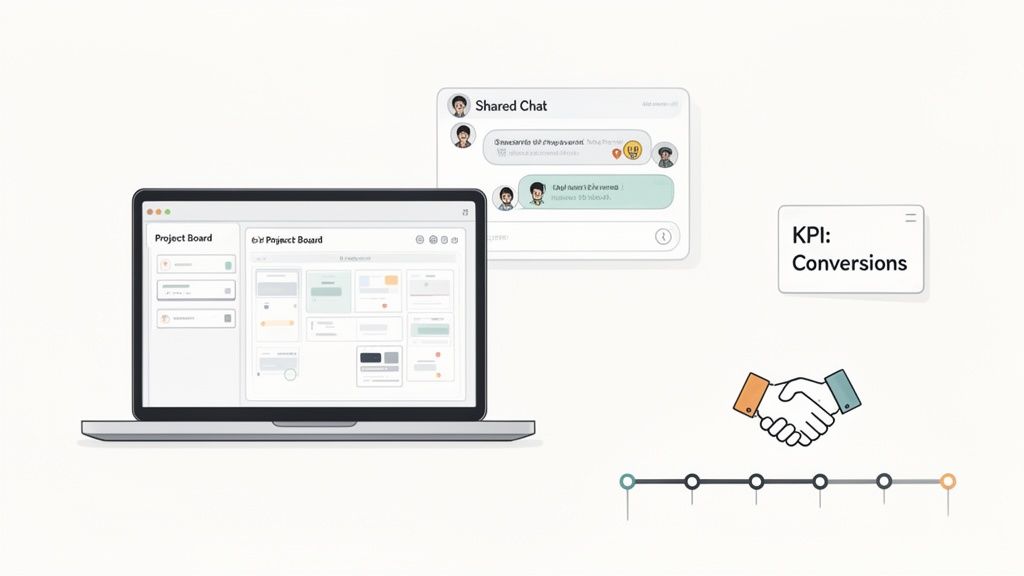
Right away, your first job is to establish a single source of truth for the project. If you're relying on email chains, you're already behind. Miscommunications and missed deadlines are almost guaranteed. Instead, get everything into one central place.
A couple of combinations work really well:
A shared Slack channel: This is perfect for the day-to-day stuff—quick questions, check-ins, and keeping that direct line of communication open with the agency's team.
A Notion or Asana board: Use this for the heavy lifting. It's where you'll track tasks, see progress on features, and store all the important documents like your brief, scope, and wireframes.
Also, sort out the roles and responsibilities immediately. Who is the main point of contact on your side? Who's the go-to person at the agency? Who gives the final thumbs-up on design changes? Nailing this down now saves a world of confusion later.
A great onboarding process is proactive, not reactive. The agency should come to the first meeting with a clear plan for your initial two weeks, outlining everything from the kickoff call to tool access and a schedule for regular check-ins.
Defining and Tracking What Matters
A great website isn't just about looking good; it's about moving the needle on your business goals. Before anyone writes a single line of code, you and the agency need to agree on what success actually looks like in terms of hard numbers.
These Key Performance Indicators (KPIs) should tie directly back to the goals you defined in your initial brief. For example:
Goal is lead generation? You should be tracking form submission rates, the number of qualified leads coming in each month, and your cost per lead.
An e-commerce brand? It's all about the conversion rate, average order value, and slashing that cart abandonment rate.
A SaaS product? Your dashboard should be showing user sign-ups, feature adoption rates, and how long it takes a new user to complete a key action.
Another thing to measure? The agency's own efficiency. Today, 77% of developers use AI coding tools to work faster and smarter. And with 75% of businesses planning to adopt AI-powered web tech, working with an agency that's ahead of the curve is a real, measurable advantage. It means they can deliver faster and more efficiently. You can find more data on these web development statistics on blacksmith.agency.
Common Questions About Hiring a Web Development Agency
If you're looking for a web development agency, you probably have a lot of questions. That’s a good thing. Getting clear on the details now can save you from major headaches down the road and build a foundation for a great partnership. Here are some of the most common questions we get from founders, marketers, and product managers.
How Much Should a Website Cost?
This is the big one, and the honest answer is always: "It depends." I know that’s not what people want to hear, but the cost of building a website is tied directly to a few key things: the complexity of the features, the depth of custom design work, and the experience of the team you're hiring.
A simple marketing site built from a template is a completely different beast than a custom web application with complex integrations. A good agency will never just give you a single number; they'll provide a detailed breakdown. You should be able to see exactly where your money is going, from strategy and design to development and QA. Always ask for a detailed proposal.
How Long Does a Project Typically Take?
Just like cost, the timeline is all about scope. A straightforward brochure website might take 4-8 weeks from kickoff to launch. A more involved web application could easily take 3-6 months, sometimes longer.
But the agency’s schedule is only half the story. The biggest wildcard in any project timeline is often the client's ability to provide feedback and content. Delays aren’t usually caused by coding problems; they’re caused by waiting for approvals, copy, or other assets from your team. A well-managed project needs a clear schedule with milestones for both sides.
Don't just fixate on the final launch date. Ask about their process for hitting milestones. A transparent agency will show you a clear timeline for deliverables like wireframes, designs, and development sprints. You should always know exactly where things stand.
What Happens After the Website Launches?
The launch isn't the finish line; it’s the starting line. Once your site is live, you absolutely need a plan for maintenance, security updates, and future improvements. It's not a "set it and forget it" asset. Most agencies offer support packages to handle this.
You should talk about post-launch support early in your conversations. A few common models are:
Monthly Retainer: You pay for a block of hours each month for ongoing work, bug fixes, or adding small features. This is predictable and ensures you have dedicated time.
Ad-Hoc Support: You pay by the hour whenever you need something. It's flexible, but budgeting can be tricky, and you might have to wait if the agency is busy.
Training and Hand-Off: The agency trains your team to handle day-to-day content updates, like adding blog posts or changing images on the homepage.
Finding the right web development agency is about finding a long-term partner, not just a one-time vendor. The best ones are invested in your success long after launch, helping you adapt as your business grows.
Ready to turn your ideas into a high-performing website or product? Shalev Agency combines research-backed UX, crisp UI, and pragmatic engineering to help you ship faster and achieve your business goals. Start your project with us today.