
A practical guide to help you find, vet, and partner with the perfect design and development agency to accelerate your business goals and build better products.
Jan 11, 2026
Hiring a design and development agency isn’t just about outsourcing work. It's a strategic decision to bring in a dedicated partner who can build or overhaul your digital products. This means finding a team that handles everything from user experience (UX) research and UI design to the complex engineering needed for a fully functional website or app.
An Agency Isn't Just an Extra Pair of Hands—It's a Growth Partner
Before you start making checklists or sending out RFPs, let's get one thing straight. Picking an agency is not about offloading tasks you don’t have time for. It’s about finding a partner that will multiply your company's strengths and accelerate your growth. The best agencies out there are more than just "design shops"—they're genuine growth engines.
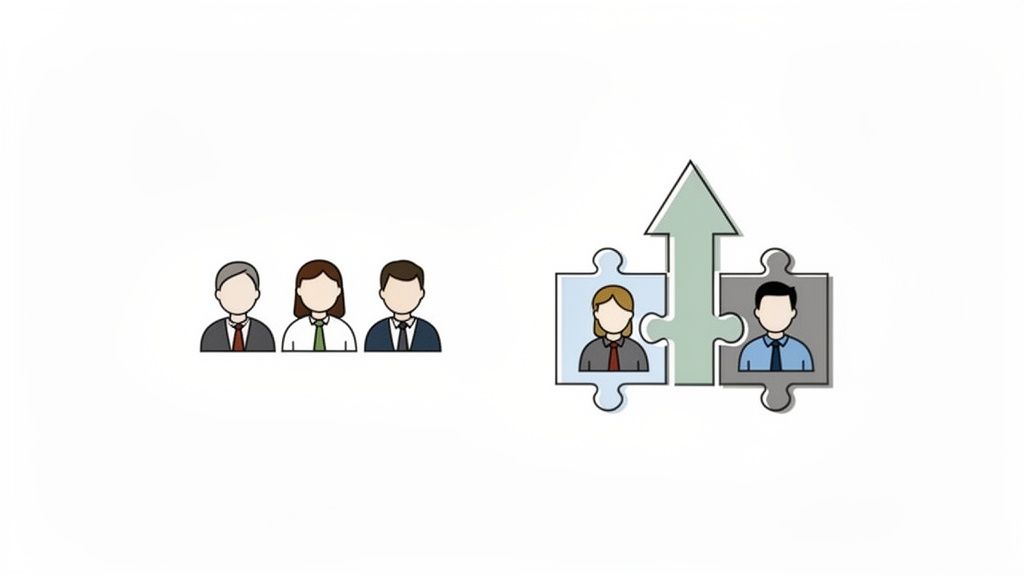
These teams bring together a level of specialized skill that’s incredibly difficult, expensive, and slow to build from scratch. They live at the intersection of business strategy, user psychology, and technical execution, with a laser focus on results that actually move the needle for your business.
From Pretty Pictures to Bottom-Line Impact
A great agency partnership isn’t measured by how slick the mockups look. The real value is in how design and code work together to hit your business goals.
This focus on tangible results is exactly why the industry is booming. The global design agency market was valued at a massive USD 267.7 billion in 2024 and is on track to reach USD 346.7 billion by 2030. This isn't just random growth; it shows how much businesses are relying on these partners to get ahead.
A true strategic partner helps you achieve concrete outcomes, like:
Higher Conversion Rates: They'll refine your user flows and sharpen your value proposition to turn more visitors into paying customers.
Better User Retention: A product that’s intuitive and solves a real problem keeps people coming back, which is the key to increasing customer lifetime value.
Faster Time-to-Market: Agencies come with proven processes and ready-made teams, letting you launch and adapt far more quickly than if you were building a team from the ground up.
A top-tier design and development agency doesn’t just build what you ask for. They challenge your assumptions, uncover blind spots, and push for solutions that create real value for your users and your business.
Gaining an Unfair Advantage
Think of a great agency as your secret weapon. While your in-house team is busy running the core business, the agency brings the focused firepower needed to win in a crowded market. They’ve already solved similar problems for dozens of other companies and can apply those lessons to your project, helping you sidestep common mistakes.
Before we go further, it's helpful to see a direct comparison. Here's a quick look at the strategic differences between partnering with an agency and building your own team.
Agency Partnership vs In-House Hiring
Factor | Design & Development Agency | In-House Team |
|---|---|---|
Speed to Impact | Immediate access to a full, experienced team. Faster launch times. | Slower ramp-up. Requires recruiting, hiring, and onboarding. |
Cost Structure | Project-based or retainer fee. Predictable, but higher upfront cost. | Ongoing salaries, benefits, and overhead. Lower initial cost, higher long-term. |
Expertise | Broad expertise across multiple disciplines (UX, UI, dev, strategy). | Deep expertise in your specific product and industry over time. |
Flexibility | Easy to scale up or down as project needs change. | Less flexible. Scaling the team up or down is a major process. |
Process | Brings established, battle-tested workflows and project management. | You have to build and refine your own processes from scratch. |
Perspective | Brings an outside perspective and learnings from other industries. | Can develop "tunnel vision" focused only on your company's world. |
Ultimately, choosing the right agency is an investment in speed, quality, and market intelligence—one that will keep paying off long after the project is done. They provide proven strategies for how to grow your online business and build a foundation for lasting success.
Clarifying Your Needs Before You Start Searching
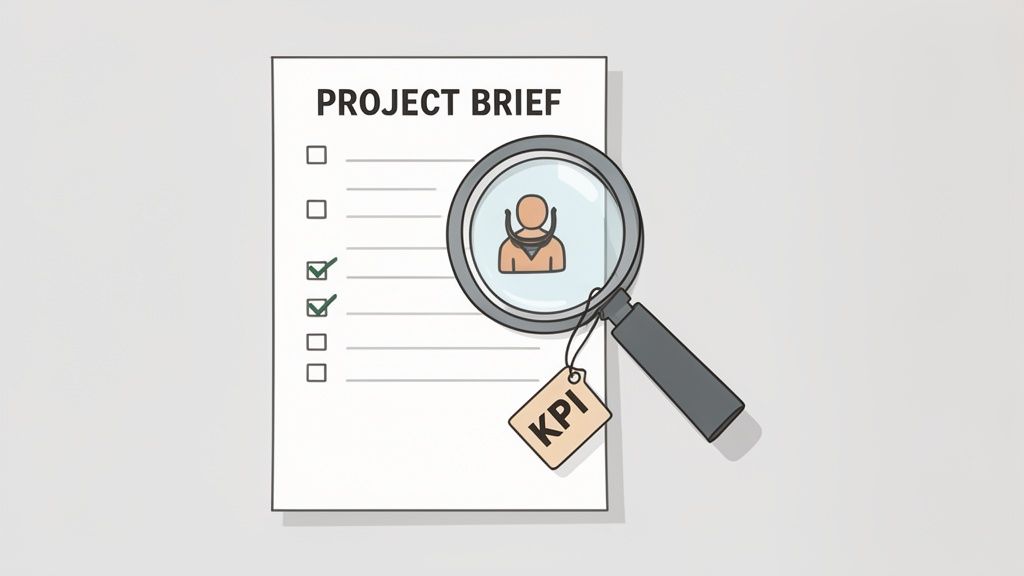
Before you even think about searching for a design and development agency, pause. The most critical work you’ll do happens right now, inside your own team. From my experience, rushing this internal planning stage is the single biggest reason partnerships go sideways, leading to blown budgets and endless scope creep.
Think of it this way: you wouldn't hire a builder and just say, "build me a house." You'd start with blueprints. The same goes for digital products. You need a solid project brief that moves beyond a vague wishlist and anchors your vision in reality. This brief becomes the foundation for everything that follows.
A great brief forces you to answer the hard questions first. It connects features to actual business goals, which helps you have grounded conversations about scope, timeline, and cost. When you can hand an agency a thoughtful brief, you get back an accurate proposal, not a wild guess.
From Vague Ideas to a Concrete Brief
So, how do you turn a loose concept into something an agency can actually work with? The key is shifting your thinking from what you want to build to why you need it.
Instead of starting with, "We need a new website," you need to get to a place where you can say, "We need a new website to increase qualified leads by 40% and cut down the time our sales team spends on manual qualification." See the difference? One is a task; the other is a business outcome.
This document does two critical things at once. First, it gets all your internal stakeholders on the same page. Second, it gives a potential design and development agency the context to act as a strategic partner, not just a team executing orders.
Checklist for Your Project Brief
Pulling together a brief doesn't mean writing a perfect, novel-length document. Just focus on being clear and thorough. Here are the essentials to include:
Business Goals: What measurable result are you after? Think in terms of revenue, user growth, or operational savings.
Target Audience: Who are you building this for? A few simple personas describing their jobs, goals, and frustrations are incredibly helpful.
Core Problem: What specific pain point are you solving for your customers or your business?
Scope of Work: What are the absolute must-have features for launch? Be honest about what can wait for phase two.
Technical Constraints: Are there any existing systems, APIs, or platforms this needs to connect with? Do you have a preferred tech stack?
Success Metrics (KPIs): How will you know if this project is a success? Define 2-3 primary key performance indicators, like conversion rate, user retention, or average order value.
Competitor Insights: Name 2-3 competitors. What do you admire about their products? Where do they fall short?
Budget Range: Be upfront with a realistic range. This isn't about showing your hand; it's about letting agencies propose a solution that actually fits your financial reality.
Timeline: Is there an ideal launch date? More importantly, are there any hard deadlines tied to an event, a marketing campaign, or a board meeting?
A detailed brief is your best defense against miscommunication. It forces you to define success on your own terms before anyone else does, setting the stage for a partnership focused on hitting your specific goals.
This upfront homework can feel like a chore, but it pays for itself tenfold in saved time, money, and headaches. It also shows a prospective design and development agency that you're an organized, serious client. Most importantly, it ensures you’re looking for a true partner, not just a pair of hands to build a fuzzy idea. With this clarity, you're finally ready to start the search.
How to Find and Vet Potential Agency Partners
Okay, you've got your project brief locked down. Now for the fun part: finding the right team to bring it to life. This isn't just about hiring a firm that can code and design. You're looking for a genuine partner, a team whose thinking and process click with yours. It’s about way more than just a pretty portfolio; you need to see real strategic muscle.
The market for top-tier design and development talent is hotter than ever. Projections show that jobs for web developers and designers are set to grow by 7% between 2024 and 2034. That’s about 14,500 new openings popping up each year in the US alone. With a median salary of $98,090, it's obvious companies are investing heavily in quality. This makes your choice of partner even more critical. If you're curious, you can learn more about these web design statistics and see what's driving the demand.
Sourcing Your Shortlist of Agencies
First things first: forget about endless scrolling through award websites. The absolute best place to start is your own network.
Reach out to founders, product managers, or VCs you trust. Ask them who they’ve hired and, crucially, who they would happily hire again. A repeat recommendation is worth its weight in gold.
Beyond personal intros, a few platforms can help you find pre-vetted agencies:
Clutch and GoodFirms: These are great for digging into verified client reviews and project details. You get a solid, unfiltered look at an agency's track record.
Dribbble and Behance: If you have a specific visual style in mind, browsing these sites is a fantastic way to spot agencies whose aesthetic aligns with your brand.
Niche Communities: Don't underestimate the power of specialization. Look for agencies that live and breathe your industry, whether it's SaaS, healthcare, or fintech. They'll already speak your language.
Before you start outreach, it also helps to sharpen your own strategic thinking. Knowing where to find expert consultants can give you a framework for evaluating an agency’s approach.
Your goal here is to build a focused shortlist of 5-7 agencies. Then, it's time to start digging.
Analyzing Portfolios for Strategic Depth
Here's a hard truth: a beautiful portfolio is just the entry fee. What you're really looking for is the thinking behind the pixels. Don't get distracted by the shiny final product. Dive into their case studies.
I always look for proof that they:
Connect work to business goals: Do they talk about boosting conversions, improving user retention, or driving revenue? Or is it all about fonts and color palettes? The best agencies tie their work directly to business impact.
Solve actual problems: Great partners don't just build what you ask for. They show how their design and engineering choices solved a real customer pain point or a tough business challenge.
Show their homework: I want to see the messy middle—the wireframes, user flow diagrams, and research notes. This is proof of a structured, thoughtful process, not just a series of lucky design choices.
A portfolio should prove an agency delivers results, not just pretty mockups. If a case study doesn't mention the business impact of the work, that's a huge red flag. It tells me they might care more about aesthetics than outcomes.
This infographic breaks down the core areas to focus on when you're vetting a team: their past work, their technical skills, and how they’ll fit with your own company culture.
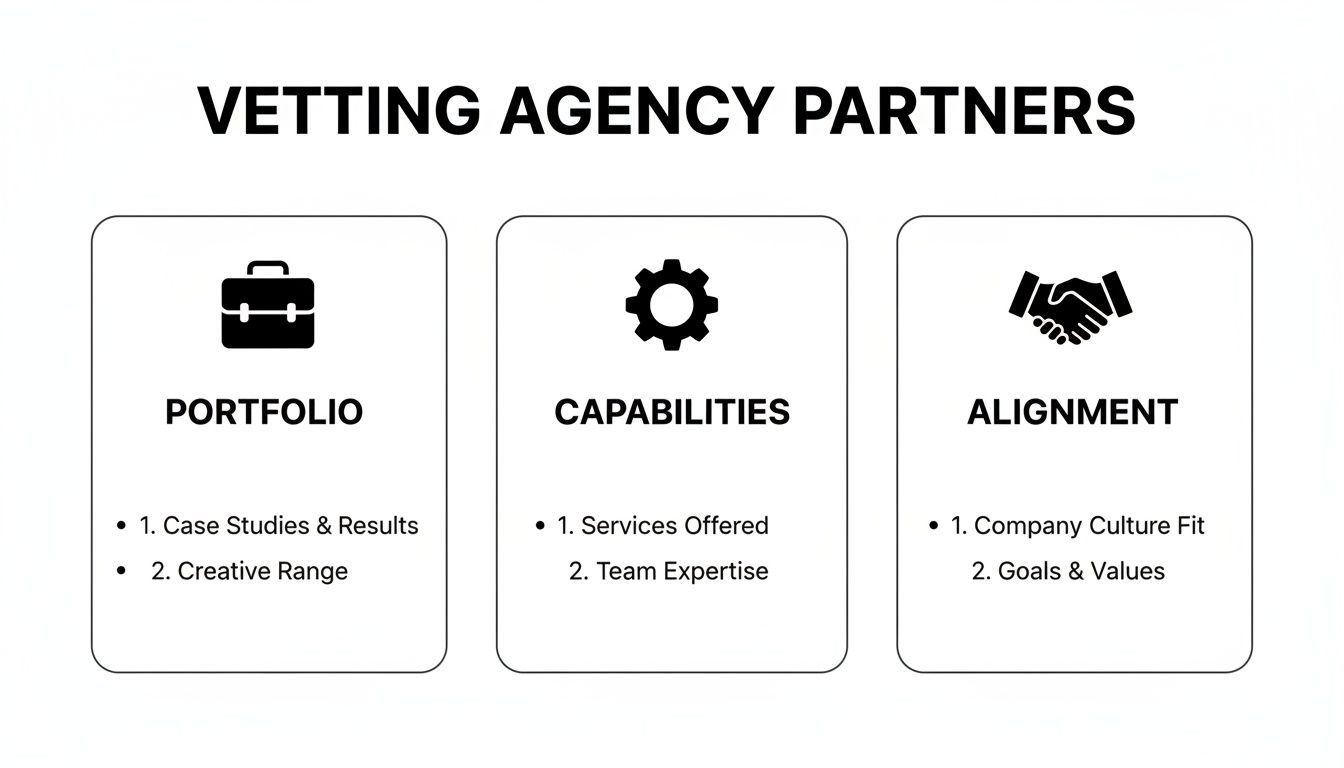
Looking at these three things together gives you a much clearer picture than a sales pitch ever could.
Non-Obvious Questions to Ask in Initial Calls
Once you're on a call, your job is to get past the agency's polished pitch. You need to understand how they truly operate, especially when things get tricky. Generic questions lead to generic, rehearsed answers.
Instead, try asking questions that peel back the curtain. Here are a few of my go-to’s:
"Tell me about a time a client's initial idea was wrong. How did you navigate that conversation and steer the project in the right direction?" This tells you if they’re just order-takers or true strategic partners who aren’t afraid of a tough conversation.
"How do you handle scope creep when a client asks for 'just one more little thing'?" Their answer reveals everything about their project management discipline and how they protect your budget and timeline.
"Who on your team will I be working with day-to-day? Can I meet the project lead during this vetting process?" You need to make sure the A-team that pitches you is the same A-team that will actually build your product.
"Walk me through your process for giving and receiving feedback." This is a great way to see if their communication style will mesh with yours, whether you prefer async updates in Slack or more structured weekly check-ins.
Asking these kinds of questions will help you quickly tell the difference between a simple vendor and a real partner. For a deeper dive, our guide on how to choose the right web design agency offers even more specifics. Ultimately, this approach helps ensure you find a team that will not only deliver a fantastic product but also make the entire journey a collaborative and rewarding one.
Making Sense of Agency Pricing and Contracts
Alright, let's talk about the part that often feels the most intimidating: the money and the paperwork. After the initial pitch calls, you'll start seeing proposals and contracts land in your inbox. These aren't just documents; they're commitments of serious time and money. Getting this part right is what separates a successful partnership from a costly mistake.
When you're looking to hire a top-tier web development agency, remember you're not just buying hours on a clock—you're investing in a strategic partner. The price tag reflects that. For a full product design and MVP build, it's not uncommon to see proposals in the $150,000 to $500,000 range.
Hourly rates can also be a good benchmark. Premium U.S.-based agencies often bill between $200 and $400 per hour. You might find that leading studios in Europe can deliver similar quality for $100 to $200 per hour, but it's a reminder that this isn't just about visuals anymore; it's about business integration.
Decoding Common Pricing Models
Most agencies stick to one of three pricing structures. There's no single "best" one—the right choice really depends on how well-defined your project is and how much flexibility you need.
Here’s a quick breakdown to help you decide which engagement model fits your needs.
Agency Pricing Model Breakdown
Model | Best For | Pros | Cons |
|---|---|---|---|
Fixed-Price | Projects with a crystal-clear scope, like a marketing site or a single feature build. | Budget predictability—you know the total cost upfront. | Inflexible. Any change, big or small, will likely require a change order and more budget. |
Time & Materials (T&M) | Complex or evolving projects, such as early-stage product discovery or iterating on an existing app. | Maximum flexibility to pivot and adapt as you learn. | Requires high trust and transparent tracking to avoid budget surprises. |
Retainer | Long-term, ongoing needs like continuous feature development, UX maintenance, or dedicated support. | Fosters a deep, collaborative partnership. The agency becomes an extension of your team. | Can be less cost-effective for short, one-off projects. |
Ultimately, the model you choose sets the tone for the entire relationship. It's not just a financial decision.
A pricing model isn’t just about the money. It defines the working relationship. A fixed-price project can feel transactional, while a retainer cultivates a collaborative partnership where the agency is deeply invested in your success.
What to Look for in a Strong Proposal
A proposal is your first real glimpse into how an agency thinks. A good one should read less like a sales pitch and more like a strategic plan for your business. It’s proof that they were actually listening.
Here’s what I always check for:
Did they understand the mission? The proposal should open by replaying your goals and the specific problems you're trying to solve. This shows they get the "why" behind the work.
A painfully detailed scope. I want to see a clear list of every single deliverable, from research and wireframes all the way to final code. Vague language here is a huge red flag.
A realistic timeline with milestones. A simple end date isn't enough. Look for a phased approach that breaks the project into manageable chunks. This is how you'll track progress.
Who’s on the team? The proposal should name names and define roles. You need to know if you're getting the A-team they showed you in the pitch or a junior team you've never met.
Crystal-clear costs. All fees should be broken down. The payment schedule—whether it’s 50/50, milestone-based, or monthly—needs to be spelled out with no room for interpretation.
Your Non-Negotiable Contract Essentials
Now for the fine print—the contract. While you should always have a lawyer give it a final review, you need to understand these key clauses yourself before signing anything.
Scope of Work (SOW): This should be attached to the contract and be incredibly specific, often referencing the proposal. It's your best defense against scope creep.
Intellectual Property (IP) Ownership: This is non-negotiable. The contract must state that you own 100% of the work product and IP upon final payment. No ifs, ands, or buts.
Payment Terms: Make sure it details exactly when payments are due, how you'll be invoiced, and what happens if a payment is late.
Termination Clause: Things can go sideways. The contract needs to outline how either party can end the agreement, both "for cause" (if someone isn't holding up their end of the bargain) and "for convenience" (if your business priorities change).
Confidentiality (NDA): A standard non-disclosure agreement is crucial for protecting your business strategy and any sensitive information you share.
Taking the time to really dig into these documents isn't just bureaucratic box-ticking. It’s about starting your new partnership on a foundation of clarity and mutual respect.
Setting Your Partnership Up for Success
Signing the contract isn't the finish line; it’s the starting gun. The real work of building a great partnership with your new design and development agency begins now. How you kick things off in the first two weeks sets the tone for the entire project, creating momentum that will carry you through to the end.
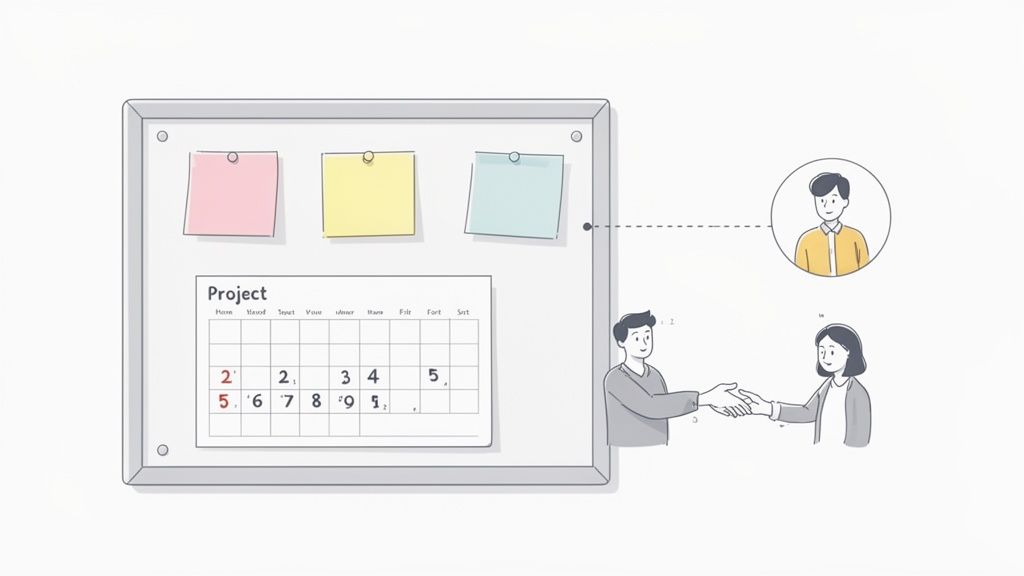
Think of this onboarding period as setting the ground rules for how you’ll play the game together. It’s where you shift from high-level talks to concrete action. I’ve seen too many projects stumble later on because of a sloppy start—leading to communication gaps, missed deadlines, and that sinking feeling of being disconnected.
Your Kickoff and Communication Playbook
The project kickoff meeting is your first official huddle. This isn't just a formality. It’s a strategic session to get both teams aligned on the mission, clarify everyone’s roles, and establish the rhythm of your collaboration.
Your main goal here is simple: get everyone on the same page. Reiterate the core business objectives, the target audience you’re building for, and the key metrics that will define success. Everyone in that room—from your internal stakeholders to the agency’s junior designer—needs to understand the why behind the work.
From there, it’s all about building your communication infrastructure. You need a central hub for everything related to the project.
Shared Communication Channel: A dedicated Slack or Microsoft Teams channel is non-negotiable. This is your command center for quick questions, daily check-ins, and celebrating small wins.
Central Project Board: Whether it’s Notion, Asana, or Jira, you need a single source of truth for tasks, timelines, and progress. This kind of transparency is what keeps everyone accountable.
Don’t underestimate the power of a well-organized project board. It's so much more than a to-do list; it’s a living document that keeps the entire team aligned on priorities and prevents crucial details from getting lost in endless email threads.
This initial setup builds a foundation of clarity and trust. It also signals to the agency that you're an organized and engaged partner. Getting organized here can also help with your own internal processes. If you need a starting point, check out our guide on how to create a product roadmap for a structured approach.
Establishing a Rhythm That Works
One of the biggest challenges in any client-agency relationship is striking the right balance. You want to stay informed without falling into the trap of meeting fatigue. Back-to-back meetings kill productivity, but radio silence creates anxiety and misalignment.
The solution is a blended approach that focuses on valuable, efficient interactions. Here’s a simple cadence that works for most of our projects:
Daily Asynchronous Updates: The agency’s project lead should post a brief summary in your shared Slack channel at the end of each day. It should cover what was worked on, any blockers they hit, and the plan for tomorrow. This keeps you in the loop without needing a formal meeting.
Weekly Tactical Check-in: Schedule one 30–45 minute meeting each week. This is your time to review progress against milestones, see demos of new work, and make key decisions. Keep it sharp and action-oriented.
Bi-Weekly or Monthly Strategic Review: For longer projects, it’s smart to have a separate, less frequent meeting with key decision-makers. Use this time to discuss higher-level strategy, budget, and long-term goals.
This kind of structure respects everyone's time while making sure communication is constant and meaningful. It helps you move from a reactive, "Is it done yet?" dynamic to a proactive, truly collaborative flow.
Give Them the Keys to the Kingdom
Your new agency can only be as effective as the information you give them. If you want them to get up to speed quickly and operate like a true extension of your team, you have to grant them access.
This means providing them with:
Direct access to key stakeholders: Your product manager, head of marketing, or even a customer support lead should be available to answer questions. Funneling all communication through a single person is a recipe for slowdowns.
Access to internal documentation: Hand over your existing market research, user personas, brand guidelines, and any previous design files. The more context they have, the faster they can start delivering value.
Access to analytics and user data: Giving the agency read-only access to your Google Analytics, session recording tools, or customer feedback platforms provides them with priceless, firsthand insights.
This level of transparency can feel a bit uncomfortable at first, but it's the fastest way to build trust and empower the agency to do its best work. When they have the full picture, they can challenge your assumptions, spot opportunities you might have missed, and ultimately deliver a final product that truly hits the mark.
Measuring Success and Building for the Long Term
So, you’ve launched. The new site is live, the app is in the store. It’s easy to feel like you’ve crossed the finish line, but really, you've just started the race. Your investment only starts paying you back when you begin to measure its actual impact on your business.
This is the moment of truth. It's time to ignore the vanity metrics—like a temporary spike in traffic—and zero in on the key performance indicators (KPIs) you set out to improve from day one. Did you want higher-quality leads? More engaged users? Lower customer support costs? Now we find out.
Moving Beyond Launch Day
A great agency knows that a project’s success isn't determined on launch day. It's determined in the weeks and months that follow. The best teams treat the launch as the first step in a cycle of learning and improving. This is why a post-launch retrospective is non-negotiable.
Get a meeting on the calendar for a few weeks after go-live to talk about what worked and what didn't. This isn't a time for finger-pointing; it's a candid debrief to make the next project even smoother.
Some questions to get the conversation started:
Did we communicate well? Was our meeting schedule effective?
Where were our initial assumptions just plain wrong?
How can we get feedback to the right people faster?
This kind of honest review is how you create a culture of improvement. It turns every project into a lesson that sharpens the process for both your team and the agency, making your collaboration stronger for whatever comes next.
A project launch isn't a final delivery; it's the first data point. The true value of a great design and development agency emerges in how they use post-launch data to inform, iterate, and drive even better results over time.
From Project Vendor to Strategic Partner
A purely transactional relationship with an agency pretty much ends at launch. But a strategic partnership is just getting warmed up. You’ll know you have a real partner when they start acting less like a vendor and more like an extension of your own team.
They stop waiting for your next set of instructions. Instead, they start bringing you ideas. They’ll dig into the user data and come to you suggesting a new feature to curb churn or an A/B test on a critical flow that could lift conversion rates.
That's the sign of an agency that’s genuinely invested in your success. They see themselves as co-pilots, not just hired builders. When your agency starts sending you data-backed ideas that perfectly align with your business goals, you haven’t just found a good vendor—you’ve found a true partner. This is how you turn a one-off project into a long-term engine for growth.
A Few Common Questions We Hear
Choosing the right partner agency can feel like a big decision, and it’s natural to have questions. Here are a few things that come up often in our conversations with founders and product leaders.
What’s the Difference Between a Design Agency and a Design & Development Agency?
This is a great question, and the answer really depends on what you need to get done.
A pure design agency is your go-to for strategy, branding, and user experience (UX/UI). They’ll hand you beautifully crafted mockups, user flows, and interactive prototypes. This is a perfect fit if you already have an engineering team ready to build.
A full-service design and development agency takes it all the way. They cover the entire journey—from initial research and design to the front-end and back-end code that makes it all work. You end up with a complete, ready-to-launch digital product.
How Much Should We Budget for a Project?
Ah, the million-dollar question (sometimes literally). The honest answer is: it depends entirely on the scope and complexity.
That said, we can talk about some typical ranges. A top-notch marketing website usually lands somewhere between $25,000 to $75,000+. For a more complex new product or MVP, you're often looking at a budget in the $150,000 to $500,000+ range.
The best agencies won't just give you a number; they'll provide a detailed proposal that connects every dollar back to your business goals.
A retainer model is fantastic for long-term partnerships where you're constantly iterating on a product. If you have a project with a very clear start and finish, like a new website launch, a fixed-price contract often makes more sense.
At Shalev Agency, we help you turn that great idea into a real, high-quality product that gets results. We blend deep research, clean design, and practical engineering to ship better and faster.