
Learn how to choose a web design agency that will accelerate your growth. This founder's guide covers everything from vetting portfolios to spotting red flags.
Jan 11, 2026
Finding the right web design agency starts long before you ever type a single search query. The most important work is the prep you do internally—defining what success looks like, what you can spend, and what you absolutely need.
This groundwork is what separates a frustrating, expensive project from one that truly moves the needle for your business. It's how you find a real partner, not just a hired gun.
Laying the Groundwork for Your Agency Search
Jumping into calls with agencies without a clear plan is a classic mistake. It almost always leads to confusing proposals, blown budgets, and a final product that doesn't quite hit the mark. Think of this initial phase as building the foundation for your project; without it, everything that comes next is wobbly.
You need to get your own house in order first. This way, you can clearly communicate your needs and accurately judge whether an agency is the right fit.
Crystallize Your Project's Purpose
First things first: what are you actually trying to accomplish? "We need a new website" isn't a business goal. A real goal is something you can measure.
Are you aiming to increase qualified leads by 30% in the next six months? Maybe you need to cut down your user onboarding time or boost e-commerce conversion rates. The primary goal will shape every single decision that follows.
For instance:
A lead-gen site lives and dies by clear calls-to-action, trust signals like case studies, and dead-simple contact forms.
An e-commerce platform has to be all about smooth navigation, beautiful product photos, and a checkout process so easy you don't even think about it.
A SaaS marketing site needs to explain complex ideas simply, show off customer love, and drive people to book a demo or start a trial.
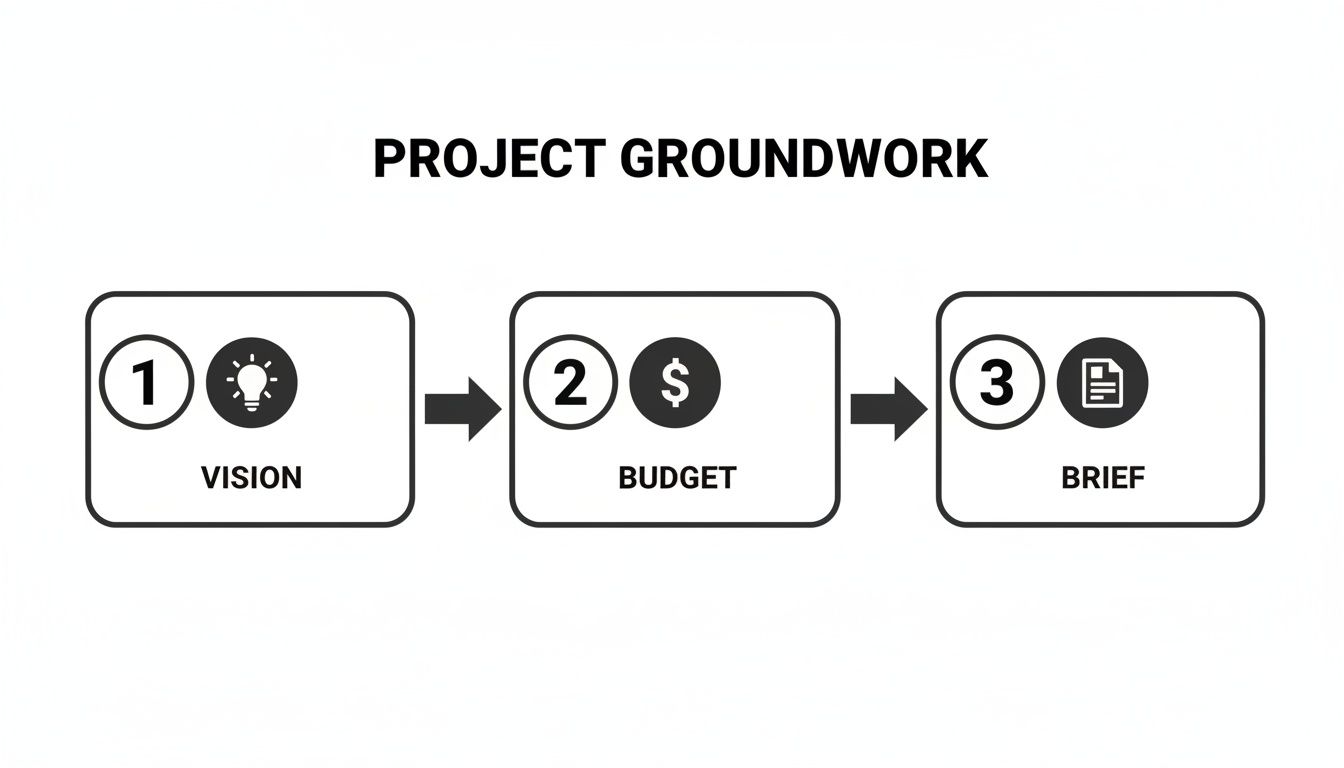
This process shows that you can't write a useful project brief for an agency until you've locked in your vision and budget.
Define Your Technical Needs and Constraints
Once you know why you're building it, you can start thinking about what it needs to do. You don't have to be an engineer, but you need a basic handle on the technical side of things. For example, knowing you need specific WordPress website design services from the get-go helps narrow your search considerably.
Ask yourself a few key questions:
Does this site need to talk to other software we use, like our CRM, analytics platform, or payment gateway?
Do we need a content management system (CMS) so our marketing team can make updates without calling a developer?
Are there any non-negotiable security or compliance rules we have to follow, like GDPR or HIPAA?
Key Takeaway: Your project brief is the single most important document you'll create. It's your North Star. A great brief includes your business goals, target audience, must-have features, technical constraints, budget, and timeline. It's what gets you clear, comparable proposals from top-tier agencies.
Finally, you have to talk about money. Web design projects can cost a few thousand dollars or well into the six figures. Outsourcing typically runs from $5,000 to over $50,000, depending on how complex the job is.
Be upfront about your budget. A good agency won't run for the hills; they'll tell you what’s realistic and help you prioritize where to spend your money for the biggest impact. If you want to get a better handle on the numbers, check out our guide on what to expect when hiring a https://shalev.agency/blog/web-development-agency. Getting these pieces in place first ensures your search for the right agency starts on solid ground.
Look Beyond the Polish in Portfolios and Case Studies
A slick portfolio is table stakes. Just about every web design agency has one, packed with eye-catching projects and a carousel of happy client logos. But your job is to look past the surface-level polish and hunt for proof of actual business impact.
It’s surprisingly easy to get wowed by a beautiful design that ultimately accomplished nothing for the business. The best partners, however, build websites that don't just look good—they perform. They solve real business problems, whether that’s generating qualified leads, boosting user sign-ups, or slashing bounce rates. Your task is to learn how to spot the difference.
You need to analyze their work like an investor, not just an admirer. A portfolio should tell a story of strategic thinking, smart problem-solving, and most importantly, measurable results.
Dig Deeper Than Screenshots to Find the Story
A grid of homepage screenshots isn't a portfolio; it's an art gallery. A real case study walks you through the entire journey, from the initial problem to the final outcome, giving you the context you need to make an informed decision.
When you're sifting through an agency's past work, look for a clear narrative that includes these four key elements:
The Challenge: What specific pain point was the client facing? Was it a clunky checkout process tanking sales? A confusing user journey? A brand that felt dated and wasn't connecting with its audience?
The Process: How did the agency actually tackle the problem? Look for behind-the-scenes evidence of user research, competitive analysis, wireframing, and user testing. A great agency is always proud to show their work.
The Solution: What did they end up building, and why did they make those specific design choices? The solution should be a direct, logical answer to the initial challenge.
The Results: This is the make-or-break part. Did the new design lead to a tangible improvement? You're looking for hard numbers here, like a 25% increase in conversions or a 40% reduction in bounce rate.
If a case study is missing any of these pieces, that's a red flag. It might mean the agency is more focused on aesthetics than on delivering outcomes.
Look for Results, Not Just Activities
Saying "we redesigned the user interface" is an activity. Saying "we redesigned the user interface, which led to a 15% increase in user sign-ups within the first month" is a result. Your goal is to find an agency that talks about results.
A great portfolio doesn't just show you what an agency built; it tells you why they built it and proves that it worked. Vague claims without data are a warning sign that the agency may not track the business impact of their designs.
To get a better feel for what a strong, results-focused case study looks like, it can be helpful to explore a range of case studies from different types of agencies. This helps you benchmark what to expect and what questions to ask.
Evaluate Relevance to Your Own Project
An agency might have an amazing portfolio filled with stunning e-commerce sites, but if you're trying to build a complex SaaS application, their experience might not translate. You need to find work that aligns with your industry, business model, and overall project complexity.
For instance, a B2B tech company needs an agency that knows how to design for a technical audience and drive demo requests, not just online sales. If you need some inspiration on what's possible, browsing through some modern design websites can help sharpen your eye for quality and current trends.
Remember, this is critical when 73% of companies are investing in design specifically to make their brand stand out. For founders building an MVP, it's even more important to find a partner who understands the goal is business traction, especially when 27% of small businesses still don't even have a website.
As you review portfolios, keep these questions in mind:
Is there a clear line between the design and the business goals? The case study should spell out the objective and show exactly how the design solution hit the mark.
Does the work show real strategic thinking? Or does it feel like they're just chasing the latest design trends without a clear purpose?
Are the results specific and quantifiable? Don't settle for fuzzy terms like "improved user engagement." Ask for the numbers.
To help you stay objective, use a simple scoring system. This forces you to evaluate each agency on the same criteria, moving beyond a gut feeling.
Portfolio & Case Study Scoring Rubric
Evaluation Criteria | What to Look For | Score (1-5) |
|---|---|---|
Relevance | Work in a similar industry, business model (SaaS, e-commerce), or project complexity. | |
Business Impact | Clear, quantifiable results (e.g., "Increased conversions by 25%"). Avoids vague claims. | |
Strategic Thinking | The "why" behind the design is explained. Evidence of research, user testing, and a goal-oriented process. | |
Storytelling | The case study clearly outlines the Challenge, Process, Solution, and Results. | |
Design Quality | Aesthetics, usability, and execution align with modern standards and your brand's desired feel. |
This rubric isn't about finding a "perfect" score, but about creating a consistent way to compare your options. It keeps you focused on what truly matters: finding a partner who can deliver a powerful business asset, not just a pretty picture.
Finding the Right Process and People
A stunning portfolio might get an agency on your shortlist, but their process and people are what will make or break the project. I've seen it happen time and again: the most talented designers in the world can't rescue a project that's being crushed by a rigid workflow, terrible communication, or a clunky feedback loop.
When you hire an agency, you're not just buying a website. You're investing in a relationship.
The real goal is to find a team that feels like a natural extension of your own. They should adapt to your needs, communicate clearly, and operate with a level of transparency that builds trust from day one. This human element is often the single biggest predictor of a project’s success.
Assess Their Communication and Project Management Style
How an agency actually runs a project tells you everything you need to know about their efficiency and whether they genuinely care about their clients' experience. Do they force you into their complicated, rigid system, or do they offer a lightweight, flexible approach? The last thing a fast-moving startup needs is to get bogged down by someone else's bureaucracy.
Get into the specifics of their communication cadence and tooling. Here are some green flags I always look for:
A dedicated communication channel: A shared Slack or Teams channel is a must for quick, daily questions. It keeps everything fluid and, most importantly, out of your inbox.
A transparent task management system: You should get direct access to their project board (like Notion, Asana, or Trello). This lets you see what’s being worked on, what's next, and who’s doing what at a glance.
A rhythm of regular, asynchronous updates: Good agencies lean on weekly priority lists or quick video check-ins instead of endless meetings. They keep you in the loop without destroying your calendar.
These aren't just nice-to-haves; they are the foundation of a smooth, collaborative partnership. For a deeper look, check out our guide on what a modern product design process looks like in action.
Question Their Approach to Discovery and Feedback
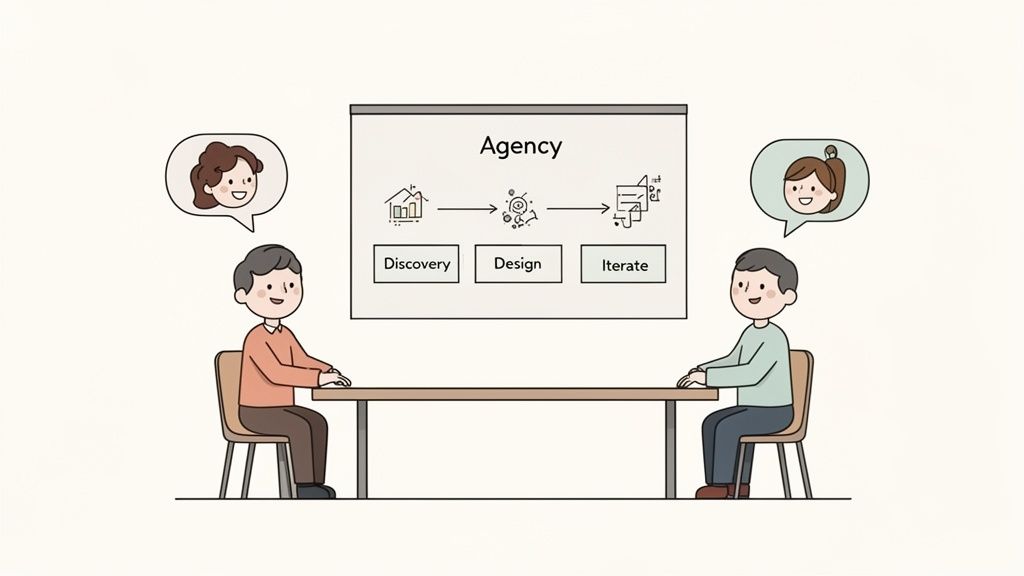
A great agency always starts with deep curiosity. They should be asking more questions about your business, your customers, and your goals than they are talking about themselves. Their discovery process should feel less like they're taking your order and more like a strategic workshop.
A one-size-fits-all proposal is a massive red flag. If it feels like a template they could send to any company, it means they haven't been listening. A true partner invests the time upfront to really understand the nuances of your market and what will make this project a genuine win.
Equally important is how they handle feedback and changes. Your project will evolve—it’s inevitable. You need a partner who can roll with the punches. Ask them directly:
How do you collect and consolidate feedback from our team?
What does your revision process look like? How many rounds are included?
Can you share an example of when project requirements changed mid-stream and how you handled it?
Their answers will reveal if they see feedback as a tool for improvement or just an inconvenient obstacle.
A top-tier agency's process isn't just about delivering a website; it's about delivering business outcomes. A proven track record here is crucial, as websites that take over two seconds to load lose up to 60% of visitors, and even a one-second delay can slash conversions by 7%. Learn more about how performance impacts business results from these web design statistics.
Look for Signs of a True Partnership
Ultimately, this all comes down to finding the right cultural fit. Are they proactive problem-solvers, or do they sit back and wait for you to tell them what to do? Do they push back with thoughtful suggestions, or do they just nod and agree to every single request?
The best partners challenge you. They bring their own expertise to the table and aren't afraid to suggest a better way to hit your goals, even if it’s different from what you first had in mind.
During your calls, pay attention to the little things. Did they show up prepared? Do they listen more than they talk? Does the conversation feel energized and collaborative? These intangibles often say more about the future of the relationship than any polished slide deck ever could. Trust your gut—it's usually right.
Decoding Pricing Models and Contract Terms
When an agency proposal lands in your inbox, it can feel like you're trying to crack a secret code. But understanding the pricing models and key contract terms is non-negotiable—the structure of your deal impacts everything from budget predictability to your ability to pivot mid-project.
Getting this part right is how you build a partnership that actually protects your startup from day one. The numbers and the legal jargon are where the costliest mistakes hide, but a solid agency will be an open book, walking you through the options to find a model that truly fits.
Common Agency Engagement Models
Most web design agencies price their work in a few standard ways. There's no single "best" option; the right choice comes down to the nature of your project and how you need to work.
Fixed-Scope Project: This is as straightforward as it gets. You agree on a very specific set of deliverables for a single, all-in price. It’s perfect for well-defined projects where the scope isn't going to change, like a new marketing site or a product MVP. The biggest win here is cost predictability.
Monthly Retainer: With a retainer, you pay a set fee each month for access to the agency's team. This gives you a block of hours or a flexible scope of work you can direct as needed. It’s the ideal setup for ongoing needs—think product iteration, adding new features, or continuous optimization where priorities are guaranteed to shift.
Value-Based Pricing: This one is less common, but you'll see it occasionally. Here, the agency prices its work based on the direct business value it creates for you, like a percentage of increased revenue. It’s a true partnership model but can get complicated when it comes to defining and measuring that "value."
For most startups, the choice comes down to a fixed-scope project or a monthly retainer. Let's break down how they compare.
Agency Engagement Models Compared
This table gives you a quick side-by-side look to help you decide which model makes more sense for your current needs.
Feature | Fixed-Scope Project | Monthly Retainer |
|---|---|---|
Best For | Clearly defined projects (e.g., MVP launch) | Ongoing, evolving work (e.g., product iteration) |
Budget | Predictable, one-time cost | Consistent, recurring monthly expense |
Flexibility | Low; changes often require a new contract | High; priorities can shift as needed |
Risk | Scope creep can lead to budget overruns | Can be inefficient if work slows down |
So, what’s the takeaway? If your project is a known quantity with a clear finish line, a fixed-scope agreement gives you peace of mind. But if you’re building a product that will evolve, a retainer gives you the adaptable design horsepower you'll need.
Key Contract Clauses to Scrutinize
A contract isn't just a formality; it's the rulebook for your entire relationship. Before you sign on the dotted line, you absolutely have to zoom in on a few critical clauses that protect your company and define the terms of play.
A good contract is clear, fair, and leaves zero room for misinterpretation. Never feel shy about asking for clarification or pushing back on terms that don't sit right with you.
Here are the clauses I always look for first:
Intellectual Property (IP) Ownership: This is the big one. The contract must state, without any ambiguity, that you own 100% of the final work product upon final payment. That includes every design file, all the source code, and any other assets created for you. Never, ever agree to a deal where the agency keeps ownership or just licenses the work back to you.
Payment Schedule: Look for a clear breakdown of when payments are due. A common structure is 50% upfront and 50% on completion, but this can vary. The crucial detail is making sure each payment is tied to a specific, tangible deliverable—not just the calendar flipping over.
Termination Clause: What’s the escape hatch if things go south? A fair termination clause lets either side end the agreement with written notice. It should also spell out exactly how outstanding work will be handled and what payments are due for the work that’s already been completed.
Final Check: A trustworthy agency will welcome questions about their contract and be open to reasonable adjustments. If they get defensive or push back on standard terms like full IP ownership, that’s a massive red flag. Your website is a core business asset—you need to own it, full stop.
Spotting Red Flags Before You Sign
Picking the wrong web design agency is a mistake that costs way more than just money—it burns through your most valuable resource: time. After vetting hundreds of potential partners over the years, I can tell you the warning signs are almost always there if you know what to look for before any ink dries on a contract. It's all about separating the talkers from the doers.
A great partner invests real time in understanding your business from the inside out. Their curiosity should be one of the first things you notice. If an agency jumps straight to solutions without digging into your customer profiles, revenue goals, and operational headaches, they’re probably just selling a pre-packaged service, not a custom solution.
Communication Breakdowns and Vague Proposals
How an agency communicates during the sales process is a direct preview of what you can expect once the project kicks off. Are their responses slow? Do their answers feel canned or generic? These are classic signs of a team that's either disorganized or, frankly, just not that invested in your success.
Another massive red flag is the one-size-fits-all proposal. A quality proposal should feel like it was written specifically for you, directly addressing the goals and challenges you talked about in your calls.
Look for these tell-tale signs:
Generic Language: The proposal is packed with marketing fluff but lacks specific details about your project.
No Clear Process: It doesn't outline a clear, step-by-step plan from discovery to launch. If you can't see the road ahead, that's a problem.
They Had No Questions: A great agency will almost always come back with clarifying questions before sending a proposal. Silence is not golden here.
The best agencies blend human expertise with modern tools. A red flag is an over-reliance on AI for core strategy, but a green flag is using it to work faster. Over 65% of businesses now use AI tools to accelerate design workflows and prototyping. Discover more insights about web design statistics and learn how agencies using AI for personalization and automation are boosting revenue 15-20% faster than their competition.
An Obsession with Trends Over Strategy
Chasing the latest design trend is a fool's errand. While a modern look is important, it should never come at the expense of clear communication and a smooth user experience.
Be wary of any agency that talks more about flashy animations and slick layouts than they do about conversion rates and user journeys. Your website is a business tool first and a piece of art second.
The right partner gets this. They'll ground every single design decision in your strategic goals, prioritizing clarity, speed, and usability—the things that actually drive results—over whatever is currently trending on design blogs. Their portfolio should reflect this strategic mindset, showing a history of solving real business problems, not just creating pretty pictures.
Answering the Tough Questions Before You Hire an Agency
You've made it through the discovery calls, you've reviewed the portfolios, and you've found a couple of agencies you really like. This is where the rubber meets the road, and the really practical, make-or-break questions start to surface.
Getting clear answers now is non-negotiable. It’s what separates a smooth, successful partnership from one filled with frustrating surprises. Let's walk through the questions I hear most often from founders and product leaders right before they sign on the dotted line.
How Much Should I Actually Budget for This?
This is always the first question, and the honest-to-goodness answer is: it depends. A website isn't a SKU on a shelf with a fixed price. The cost is a direct reflection of the scope, the complexity of the problem you're solving, and the level of strategic thinking you're getting.
That said, you need a ballpark. Here are some realistic numbers based on my experience:
A high-quality marketing website: Plan for a range of $15,000 to $50,000. This gets you a custom-designed site, a proper content management system (CMS), and the core features a business needs to generate leads and build a brand.
A custom web application or SaaS MVP: These are much deeper projects. They typically start around $75,000 and can easily run into six figures. This price tag accounts for in-depth user experience (UX) research, custom development, and often complex third-party integrations.
Be skeptical of bids that seem too good to be true. An agency promising a fully custom site for a few thousand dollars is almost certainly using a template. That might be fine for a basic brochure site, but it won't solve the unique business challenges a growing startup faces. The best partners anchor their pricing in the value and ROI they deliver, not just the hours they log.
Is a Fixed-Scope Project or a Monthly Retainer Better?
The right engagement model really comes down to aligning the contract with the reality of your project. One isn't inherently "better" than the other; it’s all about fit.
A fixed-scope project is perfect when you have a very clear picture of the final deliverable and a firm deadline. Think of a V1 product launch or a full website redesign. The biggest win here is predictability—you know exactly what you’re getting and precisely what it will cost.
A monthly retainer, on the other hand, is designed for evolution. It’s the right model for iterating on an existing product, running continuous A/B tests to improve conversion, or rolling out new features over time. You get a dedicated team that can pivot with you as your priorities change.
My two cents: For a 0-to-1 product launch, a fixed-scope project is usually the way to go. It contains the initial investment and keeps everyone focused on a clear launch goal. Once you're live and gathering user feedback, shifting to a retainer for ongoing improvements is a smart, agile move.
How Long Is This Going to Take?
Like cost, the timeline is tied directly to complexity. But here’s the one thing most founders don't realize: they are the single biggest variable in the project timeline. An agency can have the most streamlined process in the world, but it all grinds to a halt if they're waiting on you for feedback.
Here are some realistic timeframes you can expect:
A well-defined marketing website usually takes 8-12 weeks from kickoff to launch.
A more complex web application or SaaS product is a bigger lift, often taking 4-6 months or even longer, depending on the feature set and technical challenges.
Good agencies are built for speed. They use tools like shared Slack channels and Notion boards to keep communication flowing and avoid endless meetings. But the partnership is a two-way street. If you can provide decisive, consolidated feedback quickly, you’ll keep the momentum going.
Who Owns the Website and the Code When We're Done?
The answer to this should be short, sweet, and absolute: You do.
Any reputable agency will make it crystal clear in the contract that 100% of the intellectual property (IP)—the design files, the source code, all of it—is transferred to you upon final payment. There should be zero gray area here.
This is a deal-breaker. Double-check your contract for this clause. Run from any agency that suggests a licensing model where they retain ownership, or one that builds your site on a proprietary, closed-source platform you can't migrate. You are paying for a foundational business asset; you need to own it, full stop.
At Shalev Agency, we help growing teams ship faster by building high-quality websites and products that convert, scale, and save time. If you're looking for a design and development partner who can bring clarity and speed to your project, visit shalev.agency.