
Uncover the critical differences in customer experience vs user experience and learn how to leverage both to drive conversions, retention, and business growth.
Jan 11, 2026
The simplest way to think about the difference is this: User Experience (UX) is all about a person's interaction with a single thing—your app, your website, a specific software feature. Customer Experience (CX), on the other hand, is the big picture. It’s how that person feels about your entire brand based on every single interaction they have with you over time.
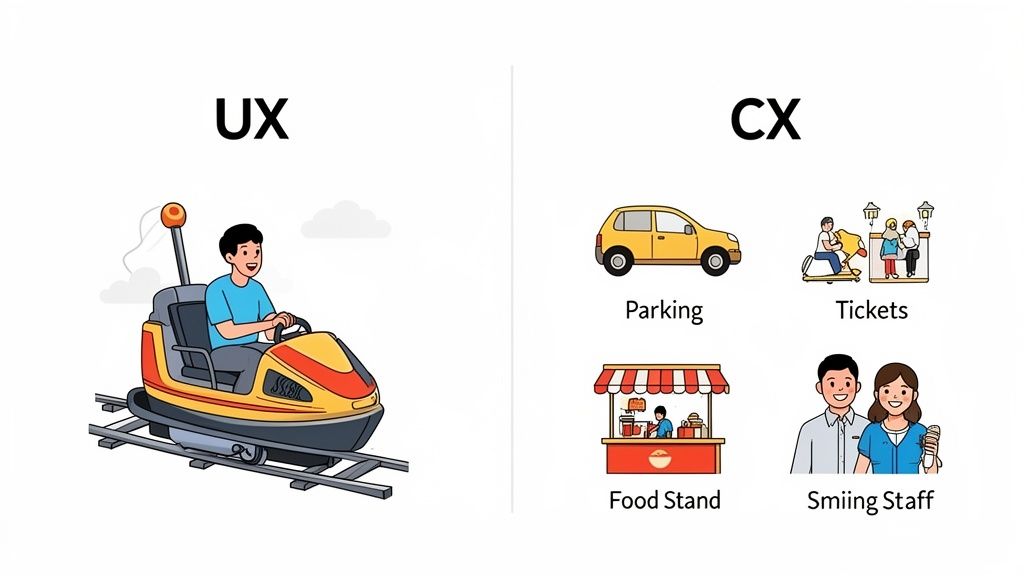
Think of it like an amusement park. The UX is how fun and easy it is to ride the bumper cars. The CX is the whole day: finding a parking spot, the price of the tickets, the friendliness of the staff, and the quality of the food.
Understanding the Core Difference Between CX and UX
People often use CX and UX interchangeably, but they are fundamentally different disciplines, and knowing that difference is what separates good companies from great ones. It shapes how you spend your money, what goals you set, and even how you build your teams.
User Experience is tactical. It's the nitty-gritty of making a product usable, efficient, and even enjoyable. A UX designer is obsessed with questions like:
Is our checkout process completely frictionless?
Can a new user figure out our mobile app's navigation without a tutorial?
How fast can someone find what they're looking for on this page?
Customer Experience is strategic. It’s the sum of all parts, a holistic view of the customer's entire journey with your brand. This includes everything from the tone of your social media posts and the helpfulness of your support agents to your pricing strategy and brand reputation.
The Bigger Picture
Here’s where it gets real. A customer might love using your SaaS platform because its interface is brilliant (that’s great UX). But if their sales demo was rushed, their invoices are always wrong, and they can never get a human on the phone for support, their overall customer experience is in the gutter.
That one distinction is the key to keeping customers for the long haul.
UX is a huge piece of the CX puzzle, but it’s not the whole picture. An amazing product experience can be completely torpedoed by terrible customer service or a confusing onboarding process.
This difference shows up clearly in how we measure success. UX is measured with product-specific metrics like task completion rates and user error rates. CX, however, relies on broader business indicators like Net Promoter Score (NPS) and customer retention.
For startups and SaaS companies, this isn't just theory—it's your roadmap. It tells you how to design products people can actually use (UX) while building a brand that earns trust and loyalty (CX). To get a deeper feel for the product-focused side of things, digging into topics like UX and UI design can provide a lot of clarity.
For a quick reference, here’s a breakdown of the key differences between Customer Experience and User Experience.
Quick Comparison Customer Experience (CX) vs User Experience (UX)
Attribute | User Experience (UX) | Customer Experience (CX) |
|---|---|---|
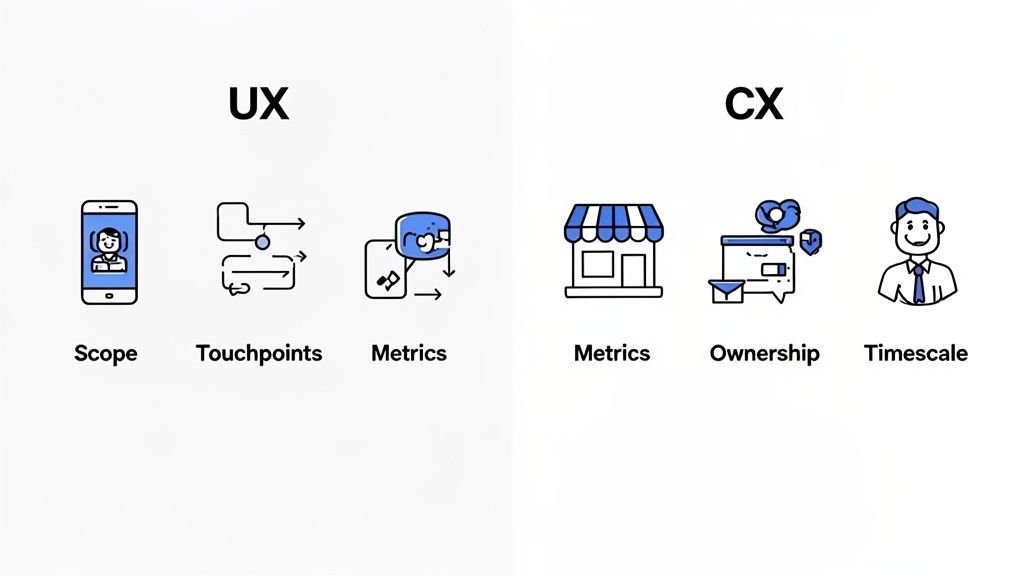
Scope | A specific product, website, or app | The entire brand and all its touchpoints |
Focus | Usability, efficiency, and ease of use | Overall perception, satisfaction, and loyalty |
Touchpoints | Digital interface interactions | Every interaction (sales, support, product, marketing) |
Timescale | A single session or task | The entire customer lifecycle |
Metrics | Task success rate, error rate, time-on-task | Net Promoter Score (NPS), CSAT, retention |
Ultimately, this table shows how UX focuses on the how of a specific interaction, while CX is concerned with the overall feeling across the entire relationship.
A Detailed Comparison of CX and UX Dimensions
So, let's move past the theme park analogy and get down to brass tacks. To really understand the difference between customer experience and user experience, we need to break them down by how they function inside a business. Figuring out how they differ in day-to-day operations is key to putting your money, people, and effort in the right place to get real results.
This side-by-side comparison will show you exactly where one discipline’s job ends and the other’s begins. Let's dig into the five areas where they really diverge.
H3: Scope: Where The Experience Takes Place
The biggest and most important difference between UX and CX is simply their scope.
User Experience is tightly focused. It’s all about a person's direct interaction with a single product or service—your website, your mobile app, or a specific piece of software. The entire world of UX lives within that digital interface.
On the other hand, Customer Experience is the big picture. It’s the sum total of every single interaction someone has with your brand, from their first Google search to their last customer support call. CX covers everything: product usability, how your sales team behaves, the tone of your marketing emails, and even how easy it is to pay an invoice.
UX Scope in Action: A SaaS company’s UX team is laser-focused on making sure the new analytics dashboard is intuitive and loads fast. Their goal is to help users pull reports without getting frustrated.
CX Scope in Action: The same company’s CX strategy looks at the whole journey. It considers how that user first found them (marketing), the sales demo, the onboarding process, their experience with the dashboard (UX), and the help they get from support three months down the line.
H3: Touchpoints: How Customers Interact
Because their scopes are so different, the touchpoints for UX and CX naturally are, too. UX touchpoints are confined to the product itself. A UX designer obsesses over buttons, navigation, forms, and the overall flow within the digital product.
CX touchpoints are everywhere. They show up in every channel and department a customer might bump into, creating a complex, multi-channel map of the entire brand relationship.
A brilliant user experience inside your app can be completely wiped out by one bad customer service call. That’s because UX happens at one touchpoint, but CX is the feeling you get from all of them combined.
To get a clearer view of the different touchpoints for CX vs UX, this quick table breaks down the typical interaction points for each discipline.
Detailed Breakdown CX vs UX Dimensions
Dimension | User Experience (UX) | Customer Experience (CX) |
|---|---|---|
Scope | Narrow and specific: a single product or service | Broad and holistic: the entire brand |
Touchpoints | Digital interfaces: website, app, software | All channels: social media, phone, email, in-person |
Metrics | Tactical & performance-based: task success, error rate | Strategic & relationship-based: NPS, CSAT, churn |
Ownership | Product & design teams | The entire company (led by CX/CCO) |
Timescale | Short-term: a single session or task | Long-term: the entire customer lifecycle |
This breakdown really highlights that while UX is a vital piece of the puzzle, it's just one part of the much larger CX journey.
H3: Metrics: How Success Is Measured
You can't fix what you don't measure. The metrics used for UX and CX clearly show what each one is trying to achieve.
UX metrics are very tactical, focusing on efficiency and ease of use. A 73% task completion rate is a classic UX metric. In contrast, CX metrics are strategic and measure the overall health of the customer relationship. A Net Promoter Score of +45 is a classic CX metric.
Common UX Metrics:
Task Success Rate: What percentage of users can actually finish what they set out to do?
Time on Task: How long does it take someone to complete that task?
Error Rate: How many mistakes do people make along the way?
System Usability Scale (SUS): A quick, 10-question survey that gives you a score on perceived ease of use.
Common CX Metrics:
Net Promoter Score (NPS): The "how likely are you to recommend us" question that measures loyalty.
Customer Satisfaction (CSAT): A quick check-in on how happy a customer is with a specific interaction.
Customer Effort Score (CES): Measures how easy it was for a customer to get their problem solved.
Customer Churn Rate: The percentage of customers who leave you over a certain period.
H3: Ownership: Who Is Responsible
Another clear dividing line is who owns it. UX is almost always owned by the product and design teams. These are the specialists—UX designers, researchers, and product managers—who are paid to sweat the small stuff within the product.
But CX is everybody's job. You might have a Chief Customer Officer leading the charge, but a great customer experience only happens when every single department is on board. Marketing sets the promise, sales builds the first bridge, product delivers the value, and support is there to help when things go wrong.
H3: Timescale: How Long The Interaction Lasts
Finally, the two disciplines operate on completely different timelines.
UX is often concerned with a single, short-term interaction. The goal is to make a specific session—whether it’s 30 seconds or 30 minutes—as smooth as possible.
CX plays the long game. It looks at the entire customer lifecycle, from the first time someone hears about your brand to the point where they become a vocal advocate, which could be a relationship that lasts for years. A solid CX strategy makes sure that relationship stays healthy and positive over time, not just during one visit to your website.
Why Investing In UX Delivers Massive ROI
All the talk about customer experience versus user experience eventually boils down to one simple question: what’s the financial return? Let’s be clear: a strategic investment in UX isn’t a cost center. It’s a powerful revenue generator. When you move past the theory, the data paints a very clear picture of why thoughtful, research-backed UX is a financial game-changer.
When founders and investors kick the tires on a business, they’re looking for measurable results. Good UX has a direct line to the key metrics that signal a company's health and growth potential. Think of it as the invisible engine that drives conversions, cuts operational drag, and helps you sidestep costly mistakes.
The financial upside of great UX has become impossible to ignore. For every $1 put into UX, companies can expect a return of $100. That’s a staggering 9,900% ROI. A number like that is precisely why user experience has graduated from a "nice-to-have" design flourish to a core business driver.
Higher Conversion Rates Through Less Friction
At its heart, great UX is about getting obstacles out of the user's way. Every unnecessary click, confusing bit of copy, or slow-loading page is a friction point—an excuse for a potential customer to give up and leave. A well-designed user experience, on the other hand, gently guides people toward their goal, making the next step feel easy and obvious.
For a SaaS company, this could be as simple as redesigning a clunky signup form to get more people into a free trial. For an e-commerce store, it might be a streamlined checkout process that slashes cart abandonment rates. Each small improvement is a deliberate move to clear the path to conversion.
SaaS Sign-Up Flow: Imagine a startup cuts its sign-up form from eleven fields down to six and adds social login buttons. It wouldn't be surprising to see a 25% jump in completed sign-ups.
E-commerce Checkout: Implementing a one-page checkout and showing shipping costs upfront can make a huge difference in how many people actually complete their purchase.
Lower Customer Support Costs
When a product is intuitive, it requires less hand-holding. People who can easily find what they need, figure out how features work, and solve minor problems on their own have no reason to contact your support team. The impact on your operational costs is direct and measurable.
Every support ticket, email, and phone call has a price tag attached in terms of employee time and resources. A smart UX investment acts as a preventative measure, answering questions before they’re even asked. Things like clear navigation, helpful tooltips, and a logical information architecture all help create a more self-sufficient user base.
A high volume of support tickets often points directly to a flaw in the user experience. If users are constantly asking the same question about a feature, that's not a user problem—it's a design problem. Fixing the root cause in the interface is far more scalable than hiring more support agents to handle the fallout.
Reduced Development Waste
Finally, a research-backed UX process saves you from one of the most expensive blunders in product development: building the wrong thing. Without proper user research, usability testing, and prototyping, teams are often just building on assumptions. When those assumptions are off the mark, countless hours of engineering and design time are flushed down the drain on features nobody wants or can figure out how to use.
Investing in UX upfront means validating ideas with real users before a single line of code is written. This loop of testing and refining ensures your development resources are spent building features that solve genuine problems. This approach doesn't just save money; it gets a better product to market faster—a product that's already proven to be effective and desirable. For SaaS companies especially, a user-centric design focus is a major competitive edge. You can learn more in our guide on UX design for SaaS.
Where CX and UX Really Meet
It’s easy to draw lines between customer experience and user experience, but the magic happens where they overlap. They aren't separate functions working in isolation; they're constantly influencing each other. Think of it this way: a frustrating user experience will almost certainly tank your entire customer experience.
UX is like the foundation of a house. If that foundation is cracked—if your app is buggy, your website is a maze, or your checkout process is a nightmare—the whole structure is at risk. No amount of friendly support reps or clever marketing can truly make up for a product that’s just plain hard to use.
But here’s the twist many companies miss: the reverse isn't always true. A phenomenal user experience doesn't automatically create a great customer experience.
The "Great UX Trap"
I see this all the time. A company pours a ton of resources into building a gorgeous, intuitive product but completely ignores everything around it. The result? A user who loves the software but can't stand the company. This disconnect is a massive, and often hidden, driver of churn.
Picture a SaaS platform with a brilliant interface. The dashboards are clean, the features make sense, and getting work done feels effortless. That’s world-class UX. But what happens when that user needs help with something outside the app itself?
Billing Nightmares: They get an incorrect invoice, and trying to get it fixed involves a soul-crushing vortex of support tickets and phone transfers.
Support Black Holes: A key feature breaks, and the support team takes 48 hours to send back a generic, unhelpful template response.
Botched Onboarding: The initial setup was so poorly managed that the user is stuck with a broken version of an otherwise amazing product.
In every one of these cases, the fantastic UX of the product gets completely overshadowed. The customer's overall feeling about the brand—their customer experience—is now defined by frustration, not by the slick software.
A seamless product interface cannot save a broken customer journey. The user's memory of waiting on hold for 45 minutes will always overshadow their appreciation for a well-designed button.
This is exactly why the handoffs between your teams are so critical. The entire journey, from seeing a marketing ad to talking to sales, getting onboarded, and receiving long-term support, needs to feel like one continuous, helpful conversation.
Creating Seamless Handoffs
Getting teams aligned isn't just about departments doing their own jobs well; it's about making sure the transitions between them are absolutely frictionless. A solid onboarding process is usually the first major stress test of this alignment. To nail this, it's worth reviewing some key SaaS onboarding best practices that connect that initial signup (UX) to long-term customer success (CX).
Here’s how different teams can work together to build a truly unified experience:
Marketing and Product Alignment Your marketing team sets the stage. If an ad campaign promises a feature is "effortless," the product's UX had better deliver. When there's a mismatch, you create a gap between expectation and reality, starting the customer relationship off on the wrong foot. Regular check-ins between these teams are crucial to ensure the messaging is always honest.
Sales and Onboarding Synergy A good salesperson builds a relationship and understands what the customer is trying to achieve. A seamless handoff means the onboarding team gets all of that context. They should know the customer’s goals from day one, so the initial product experience (UX) is tailored to deliver value immediately. This reinforces the promises made during the sales cycle (CX).
Product and Support Feedback Loops Customer support is on the front lines, hearing exactly what’s working and what’s not. When a user reports a confusing feature, it’s not just another support ticket—it’s priceless UX feedback. A smart process funnels this information directly to the product team so they can fix the root cause. This turns a negative CX moment (having to contact support) into a positive UX improvement for everyone.
At the end of the day, UX happens inside your product, but CX happens in your customer's mind. To make sure that memory is a good one, every single team needs to understand they own a piece of that one, singular customer experience.
A Practical Framework for SaaS Teams
Knowing the difference between customer experience and user experience is a great start, but the real magic happens when you know which one to focus on and when. For SaaS teams and startups, where every resource counts, making the right call can mean the difference between finding your audience and running out of runway. This framework is designed to help you decide where to put your energy based on where your company is right now.
The core idea is simple: your priorities have to change as your business grows. What works for an early-stage startup is completely different from what a scaling SaaS company needs. Getting this wrong is a common and incredibly expensive mistake.
Prioritizing Based on Business Stage
The best place to start is by looking at your company’s maturity. Your journey from a pre-launch idea to a market leader requires a smart shift in how you approach the entire experience.
Early-Stage Startups (Pre-Product-Market Fit) When you're just starting out, you have one job: prove your idea works. This is the time to be absolutely obsessed with User Experience. You have to show that your product solves a real problem in a way that’s not just functional but also easy and even enjoyable to use.
Your main goals should be:
Validating the Minimum Viable Product (MVP): Can people actually complete the core tasks your product was built for?
Gathering Actionable Feedback: Is the interface intuitive enough that early adopters don’t need a manual to figure it out?
Reducing Initial Friction: Is signing up and getting started as painless as possible?
At this point, worrying about brand-wide CX initiatives like building a community or perfecting your support channels is just a distraction. If the core UX is broken, nothing else you do will matter. You can get a better sense of how to structure this early work by looking into a solid product design process.
Scaling Companies (Post-Product-Market Fit) Once you've confirmed that people want and can actually use your product, the game completely changes. Now you have customers you need to keep happy, not just users you need to attract. This is where your focus has to broaden from UX to the entire Customer Experience. The goal is no longer just building a great product, but building a sustainable business around it.
Your new priorities will look more like this:
Improving Customer Onboarding: How can you get new customers to that "aha!" moment faster and reduce the chance they'll leave early?
Streamlining Customer Support: Are you offering quick, helpful, and empathetic support wherever your customers are?
Building Brand Loyalty: What can you do to build a real relationship, like starting a customer community or being proactive with your communication?
Great UX is still absolutely essential, but it’s now just one piece of your much larger CX strategy. A scaling company that keeps adding slick new features (UX) but ignores its clunky billing system (CX) will eventually start losing customers out the back door. For SaaS teams thinking about growth, understanding the practical steps of transitioning from website to mobile app is a perfect example of maintaining consistent CX and UX across platforms.
Decision-Making for Specific Business Goals
Beyond your company’s stage, your immediate goals should guide your focus. Here's a quick checklist to help you decide what to work on for common SaaS initiatives.
When to Prioritize UX:
You’re launching a brand-new feature or product.
You’re redesigning a core part of your app’s interface.
Your analytics show users are abandoning a specific workflow (like checkout or report generation).
You’re building an internal tool to make your team more productive.
Your main goal is to increase the task completion rate for a key action.
When to Prioritize CX:
You're trying to reduce customer churn and improve retention.
Your goal is to increase Customer Lifetime Value (CLV).
You're getting negative feedback about your support team or billing process.
You want to build a community and turn customers into advocates.
Your Net Promoter Score (NPS) is low or hasn't budged in a while.
This decision tree shows why a great product alone isn't enough to create a winning customer experience.
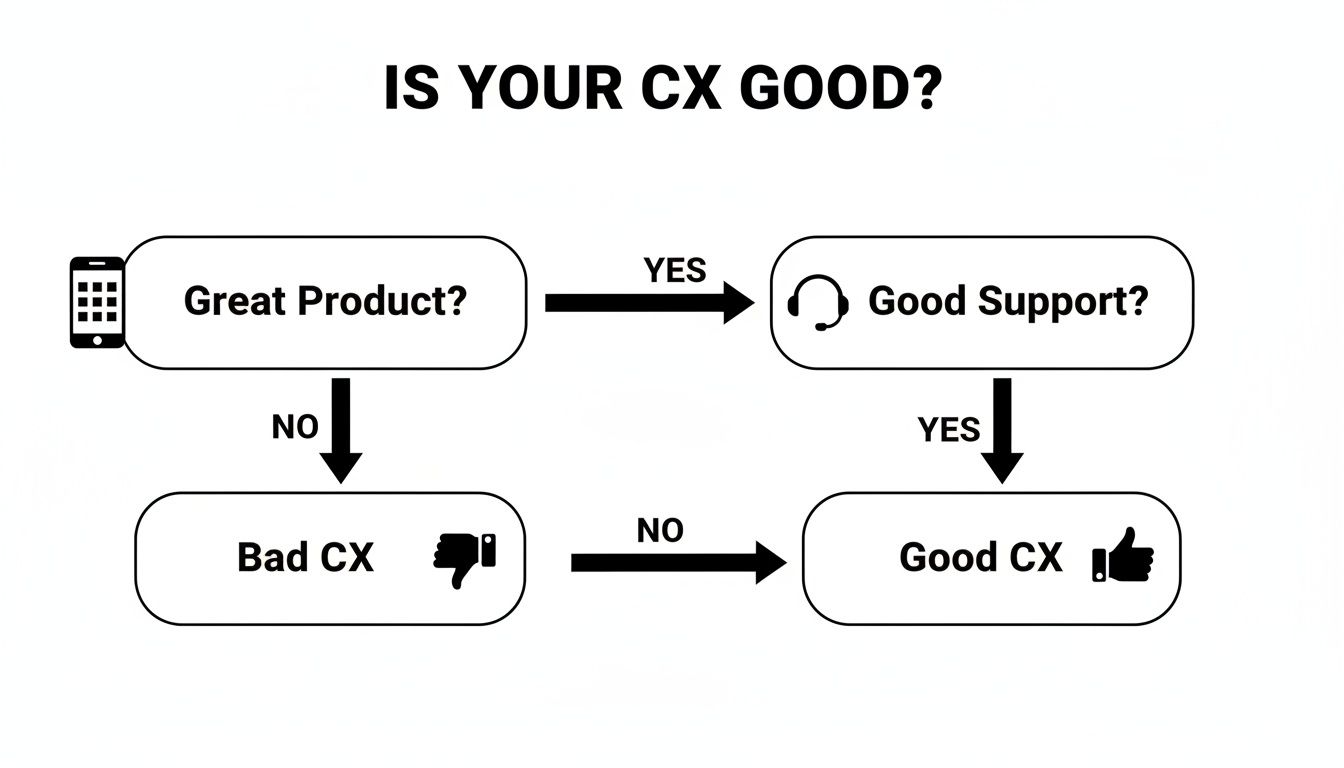
As the flowchart shows, a great product (UX) is the first critical step, but poor support can still sink the entire perception of your brand (CX).
A flawless user interface is the entry ticket, not the grand prize. True loyalty is won in the moments that happen outside the product—in the support calls, the onboarding sessions, and the billing resolutions.
Ultimately, this isn't about choosing one over the other forever. It's about a constant balancing act, where you strategically shift your focus to meet the most important needs of your business and your customers, wherever they are in their journey.
A Few Common Questions About CX and UX
Even with clear definitions, people—especially founders, marketers, and product managers—still get tangled up trying to separate customer experience from user experience in the real world. Let's tackle some of the most common questions head-on to clear things up.
Can You Have Good CX With Bad UX?
It's a nice thought, but almost impossible in reality. A clunky app or a confusing website is more than just an annoyance; it’s a major point of friction that sours the customer's entire view of your brand.
Think of it this way: UX is a huge piece of the overall CX puzzle. If that piece is jagged and doesn't fit, the whole picture is ruined. No matter how friendly your support team is or how great your marketing is, you can't fully make up for a product that’s a pain to use.
A frustrating product experience sticks in a customer's mind. It directly poisons the well for the entire relationship, making it nearly impossible to deliver a positive CX.
So, while a great UX doesn't single-handedly guarantee a great CX, a bad UX almost certainly guarantees a bad one.
Which Is More Important For A Startup To Focus On First?
For any early-stage startup, the answer is clear: User Experience. Your first and most critical job is to find product-market fit. Before you have a crowd of customers, you need to prove that your core product actually works, solves a real problem, and isn't a headache to use.
Pouring your limited time and money into broad CX efforts like multi-channel support or big branding campaigns is putting the cart way before the horse. Your initial resources should be zeroed in on:
Nailing the Core Workflow: Can users actually do the main thing your product promises?
Removing Friction: Make signing up, getting started, and seeing that first bit of value as smooth as silk.
Gathering Product Feedback: Use every early interaction to learn and rapidly make the product better.
Once you have a solid UX and you start to scale, then your focus has to widen to the entire customer journey. That's when great CX becomes your moat, helping you keep the customers you worked so hard to win.
Who Should Own CX And UX Within A Company?
This is where the difference in scope really becomes clear. Ownership for these two areas is, and should be, quite different.
User Experience (UX) is squarely in the hands of the product and design teams. We're talking about UX designers, UI designers, researchers, and product managers. Their world is the product itself—how it works, how it feels, and how it looks.
Customer Experience (CX) is a different beast. It's really everyone's job, though it's often spearheaded by a Head of Customer Experience or a Chief Customer Officer. Because CX touches every single interaction a customer has with your company, it demands a team effort:
Marketing shapes what customers expect.
Sales builds the first human connection.
Product delivers the core value through the UX.
Support is there to help when things go wrong.
A truly great CX only happens when every department knows its part and works in concert to create a seamless, positive journey for the customer.
How Do You Measure The ROI Of Each Discipline?
Measuring the return on investment for UX and CX means looking at different sets of numbers that reflect their unique goals.
For User Experience, ROI is all about product performance and efficiency. You can see the impact pretty directly with metrics like:
Higher Conversion Rates: A clearer signup form or checkout process immediately boosts this.
Lower Support Ticket Volume: When a product is intuitive, people don't need to ask for help as often.
Increased Task Success Rates: This proves users are actually accomplishing what they came to do.
For Customer Experience, the ROI is measured by the overall health of your customer relationships and their long-term value to the business. These metrics are more strategic:
Higher Customer Lifetime Value (CLV): Happy customers simply stick around longer and spend more money.
Lower Customer Churn: A fantastic end-to-end experience is one of the biggest reasons people stay loyal.
Increased Net Promoter Score (NPS): This is a powerful signal of loyalty and whether customers will recommend you.
The ROI from UX work often shows up quickly on a tactical level, while CX ROI is the long-term, cumulative result of building a strong brand that people trust and love.
At Shalev Agency, we specialize in turning complex ideas into polished, high-converting digital experiences. Whether you need a research-backed UX/UI for your SaaS product or an internal tool to boost profitability, our team delivers results that save time and drive growth. Ship faster with a dedicated design and development partner.