Learn how custom ecommerce website development drives growth. This guide covers the process, costs, and benefits over template solutions for higher revenue.
Jan 11, 2026
When we talk about custom e‑commerce website development, we’re talking about building an online store from the ground up. It’s designed and engineered specifically for your brand, your operational needs, and your customers.
Think of it like this: you could buy a house in a planned community, or you could hire an architect to design your dream home. The pre-built house is convenient and gets you moved in quickly, but the custom home is built exactly to your specifications—no compromises on the layout, features, or materials. That’s the difference between a template and a custom build.
Why Choose Custom Ecommerce Development
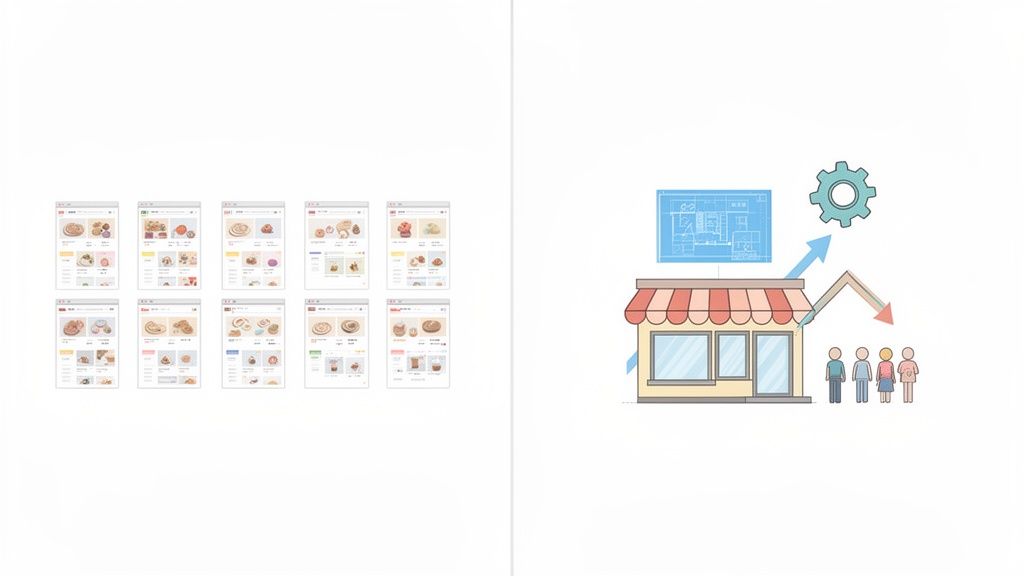
As soon as you decide to sell online, you face a critical choice: do you use a ready-made platform like Shopify or BigCommerce, or do you opt for a custom e‑commerce website development project?
Template-based platforms are excellent for getting a store up and running fast. They come with pre-designed themes and built-in tools that are perfect for many startups and small businesses. It’s a bit like leasing a retail spot in a bustling mall—the location is solid, the basics are covered, and you can open for business almost immediately.
But as your business scales, those convenient, one-size-fits-all solutions can start to feel more restrictive than helpful.
Moving Beyond Templates
Sooner or later, you might hit a wall. Maybe you need to connect your online store to a specific inventory management system your warehouse already relies on, but the platform has no integration for it. Or perhaps you’ve pinpointed a way to create a unique checkout flow to slash cart abandonment, but the template’s code is locked, and you can't make the changes you need.
This is the exact point where custom e‑commerce website development shifts from a "nice-to-have" to a strategic necessity. It’s about creating a digital flagship store that’s built to solve your specific business challenges and truly express your brand.
A custom solution moves the conversation from "What can the platform do?" to "What does our business need to succeed?" It puts your strategy, not the software's limitations, in the driver's seat.
Instead of finding creative workarounds for a template’s limitations, a custom-built site is designed to fit your operations like a glove. This unlocks some serious advantages:
A Unique Customer Journey: You can guide shoppers through a buying experience designed precisely for your products and target audience, which helps maximize engagement and drive sales.
Seamless Integrations: Your store can connect directly to your CRM, ERP, and other critical business software, automating workflows and getting rid of tedious manual data entry.
Unmatched Scalability: You're building on a foundation that can handle surges in traffic, new product lines, and future features without slowing down or crashing.
Total Brand Control: You can create a design that is 100% authentic to your brand identity, helping you stand out in a sea of competitors using the same handful of popular themes.
To give you a clearer picture, here’s a quick comparison of the two approaches.
Custom Development vs. Platform Templates at a Glance
Feature | Custom Ecommerce Development | Template-Based Platforms (e.g., Shopify) |
|---|---|---|
Flexibility & Customization | Virtually limitless. Every feature and design element is built to your exact needs. | Limited by the platform's features, available apps, and theme capabilities. |
Scalability | High. Architected from the start to handle future growth and complexity. | Can be limited. Performance may degrade with high traffic or many apps. |
Upfront Cost | Higher. Involves significant investment in design, development, and project management. | Lower. Monthly subscription fees and more affordable initial setup. |
Time to Market | Slower. A custom build takes months of planning, development, and testing. | Faster. Can launch in a matter of days or weeks using pre-built tools. |
Integrations | Unlimited. Can build custom APIs to connect with any third-party system. | Restricted to the platform’s app marketplace and existing integrations. |
Ownership & Control | You own the code and have complete control over the entire platform. | You are licensing the software; you don't own the underlying platform. |
Ultimately, the right choice depends on your business goals, but for ambitious brands, the limitations of templates often become a barrier to growth.
The demand for these tailored solutions is surging. The global web development market is on track to hit USD 82.4 billion by 2026, driven by an e-commerce boom where online sales are projected to leap from $3.3 trillion to $5.4 trillion. This incredible growth underscores why businesses are investing in custom sites—where better product pages can lift conversions by 35% and a faster checkout can cut cart abandonment by 20%. If you're curious, you can dive deeper into the web development statistics shaping the industry.
At the end of the day, choosing custom development isn't just about looks. It’s a strategic investment in a high-performance business asset built for long-term growth, giving you the freedom to innovate and create an experience no template can ever match.
The Real Advantages of a Bespoke Online Store
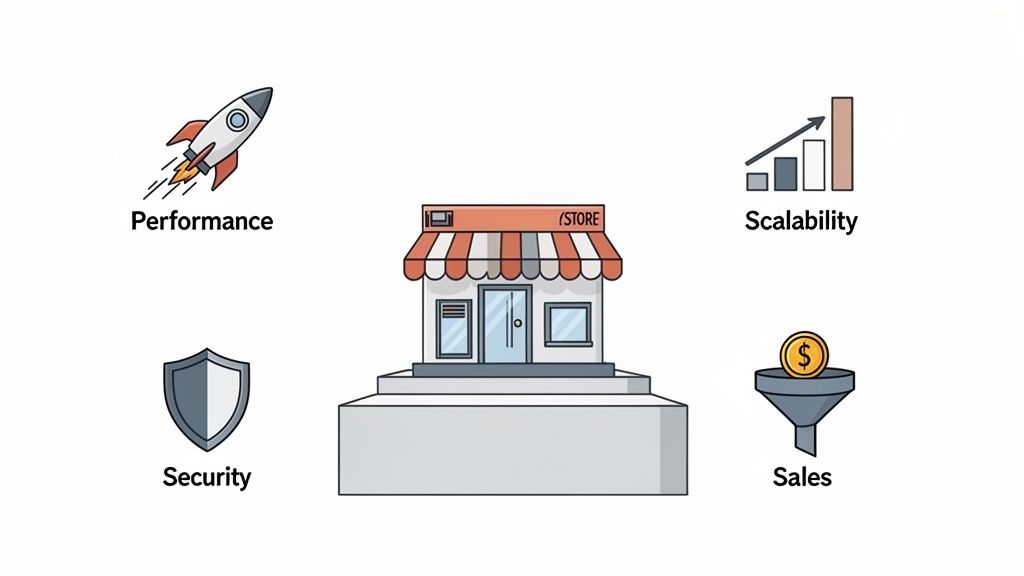
While template platforms like Shopify or BigCommerce are great for getting a store online quickly, they have their limits. Think of them as a pre-built house in a subdivision—it’s functional, but you're stuck with the layout, the fixtures, and the neighbors.
Going with custom ecommerce website development is like hiring an architect to design and build your dream home. Every detail is crafted just for you. It's an investment that pays off with real, measurable advantages in growth, security, and long-term brand equity.
Unforgettable User Experiences and Blazing Speed
A custom design is so much more than just a pretty face. It’s about creating a shopping journey that feels intuitive and effortless for your specific customers. You get to control every pixel, from the navigation flow down to the checkout process, building a user experience (UX) that’s a perfect fit for your brand.
This kind of intentional design directly impacts your bottom line. A well-crafted UX can boost conversion rates by up to 400%, which is a huge deal when you consider the average e-commerce site converts at just 2.5-3%. Speed is just as critical. Sites that load in under two seconds retain 60% more visitors, helping you avoid contributing to the $2.6 billion retailers lose annually from slow-loading pages. You can dig into more of these crucial web design stats to see how they affect sales.
A custom store doesn't force your brand into a pre-existing box. It builds the box around your brand, your customers, and your unique operational needs, creating a competitive advantage that's impossible to replicate with a template.
Performance is where custom builds really shine. The code is written specifically for your site, and nothing else. There's no bloated theme code or a mess of conflicting plugins slowing things down. The result is a lean, mean, fast-loading machine that customers love and search engines like Google reward with better rankings.
Built to Scale and Secure Your Future
One of the most common headaches we see with off-the-shelf platforms is businesses hitting a growth ceiling. As your traffic spikes or your product catalog gets more complex, the platform starts to struggle. Performance tanks, and you find yourself boxed in by its limitations.
A custom site, on the other hand, is built from day one with your future in mind. The architecture is designed to handle massive traffic and can be easily extended with new features or international storefronts without needing a total overhaul. Your tech can finally keep pace with your ambition.
Here are a few of the long-term benefits:
Future-Proof Flexibility: Ready to add a subscription service, a B2B ordering portal, or a complex product customizer? With a custom build, these features are entirely possible, unlike on many template sites.
Enhanced Security: You get a security setup tailored to your specific business needs, protecting your customer data far beyond the one-size-fits-all security of a shared platform.
Complete Ownership and Freedom: You own 100% of the code. That means no more monthly platform fees, no surprise policy changes, and no risk of your platform shutting down. You're in the driver's seat.
Choosing custom ecommerce website development is an investment in a powerful, lasting asset for your business. It gives you the control to build a superior customer experience and a platform that will support your growth for years to come, without limitations.
Understanding Your Ecommerce Tech Stack
Building a custom ecommerce store is a lot like building a high-performance car. The sleek design is what everyone sees, but the real power comes from the engine under the hood. In ecommerce, that engine is your tech stack—the collection of technologies that work together to run your site, manage operations, and give your customers a fantastic experience.
When you go custom, you get to hand-pick every part of that engine. This is a huge advantage over template-based platforms, where the technology is already chosen for you. With a custom ecommerce website development project, you can select the best tools for each specific job, creating a system that’s perfectly tuned to your business goals.
The Rise of Headless Commerce
One of the biggest shifts in modern ecommerce is the move to headless commerce. To get your head around it, think of a traditional website as an old-school TV set. The screen and all the internal electronics are fused together in one big box. You can’t just swap out the screen for a better one; you have to replace the whole thing.
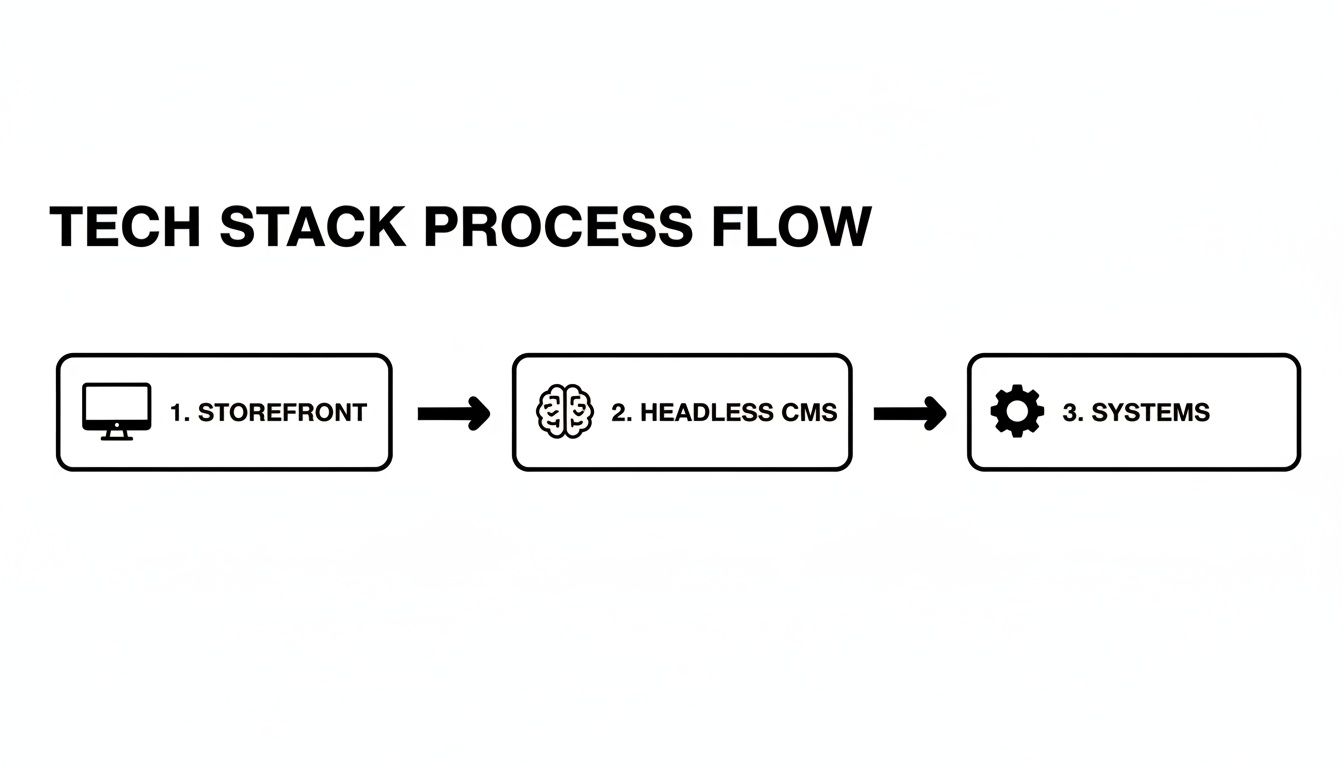
A headless setup, on the other hand, separates the "head" (the front-end or storefront your customers see) from the "body" (the back-end systems that manage content, orders, and data).
Analogy: A headless system is like having a universal remote for your entire brand. The back-end is the remote, and it can control multiple screens—your website, a mobile app, an in-store kiosk, or even a smart mirror—all from one central place. This gives you incredible flexibility to create unique customer experiences on any channel.
With this approach, your content management system (CMS) becomes the central hub. From there, you can push product details, blog posts, and promotions to any customer touchpoint without having to rebuild your back-end every single time. It's a game-changer for brands that want a truly consistent presence everywhere they sell.
Connecting Your Business Operations
The real magic of a custom tech stack is how it can seamlessly integrate all the other tools that run your business. Instead of wrestling with clunky, third-party apps that don't always play nice together, you can build direct, reliable connections between your store and your essential systems.
This creates a central nervous system for your operations, where data flows automatically and instantly between different parts of your company.
Payment Gateways: You're not stuck with limited options. You can integrate directly with processors like Stripe or Braintree, creating a frictionless and secure checkout experience designed specifically for your customers.
Customer Relationship Management (CRM): Link your store directly to systems like Salesforce or HubSpot. This automatically syncs customer data and purchase history, paving the way for powerful, personalized marketing campaigns.
Enterprise Resource Planning (ERP): Connect to your ERP for real-time inventory updates, automated order fulfillment, and simplified accounting. This gets rid of manual data entry and cuts down on costly human errors.
Analytics and Business Intelligence: Feed sales and user behavior data straight into your analytics platforms. A solid analytics setup is non-negotiable for a custom store; it’s worth looking into the top ecommerce analytics tools to find what will give you the deepest insights into your performance.
Choosing the Right Technologies
Picking the right technologies for your custom ecommerce website development project comes down to your specific needs for speed, scale, and features. A good development partner will walk you through these choices, but here are some of the go-to options we see today:
Technology Category | Popular Choices & Their Role |
|---|---|
Front-End Frameworks | React, Vue.js, Svelte: These JavaScript libraries are used to build the fast, interactive, and beautiful user interfaces that shoppers love. |
Back-End Languages | Node.js, Python, PHP: These languages power all the server-side logic, from handling database requests to processing payments. |
Headless CMS Platforms | Contentful, Sanity, Strapi: These platforms act as your central content hub, making it easy for your team to manage products and marketing materials. |
Databases | PostgreSQL, MySQL, MongoDB: These systems are the vaults that store all your critical data, from customer accounts to order histories. |
By carefully choosing and integrating these components, you’re doing more than just building a website. You’re creating a powerful, automated business engine that saves time, reduces operational headaches, and gives you a scalable foundation for long-term growth. That’s the ultimate payoff of a custom approach.
The Custom Development Process From Start to Finish
Jumping into a custom ecommerce website development project can feel a little daunting, but it's really a clear, step-by-step journey when you have a solid plan. Think of it less like a frantic sprint and more like a carefully planned expedition. Each phase logically builds on the one before it, making sure the final website is exactly what your business needs. This methodical approach takes the guesswork out of the equation and leads to reliable, high-quality results.
We break the whole process down into a few distinct phases, moving from big-picture strategy all the way to the tiny details of design and code. This ensures every decision has a purpose and the project stays on track, on budget, and true to your vision from day one.
Phase 1: Discovery and Strategy
The Discovery phase is, without a doubt, the most important part of the entire project. Before anyone even thinks about writing code or designing a single pixel, we have to get to know your business inside and out. This is where we figure out what "success" actually looks like by mapping out your goals, understanding your customers, and digging into your daily operations.
This stage is all about collaboration. We run workshops and do deep research to answer some key questions:
Business Objectives: What are we trying to achieve? Is the main goal to boost conversion rates by 20%? Or maybe you need to simplify a clunky B2B ordering system or launch in a new country.
User Needs: Who are your customers, really? We create detailed user personas and map out their ideal journey on your site, pinpointing frustrations we can solve with a better experience.
Technical Requirements: What other software does your website need to talk to? We'll need to know about your ERP, CRM, payment gateways, and any other systems that are crucial for your business to run smoothly.
By the end of this phase, we'll have a complete project blueprint. This document details the full scope of work, lists out all the key features, and sets a clear timeline. It becomes our north star for everything that follows.
Phase 2: UX and UI Design
With a solid strategy locked in, we can start shaping the actual experience. This is where we turn that blueprint into something your customers can see and interact with. We split this into two connected parts: User Experience (UX) and User Interface (UI).
First up is UX design. We start by creating wireframes, which are basically the architectural blueprints for your website. These simple, low-fidelity layouts focus purely on structure and flow. We figure out the most logical and intuitive way for a user to get from point A to point B, without getting distracted by colors or logos just yet.
Once the UX is set in stone, our UI designers take over to bring the site to life visually. They'll apply your brand’s personality—your colors, fonts, and style—to the wireframes. The result is a set of high-fidelity mockups that show exactly what the final site will look and feel like. Every design choice is made not just to look good, but to gently guide users toward making a purchase.
Phase 3: Development and Testing
This is where the magic happens and the vision becomes a functional website. Our engineering team takes the approved UI designs and starts building. We typically work on two tracks at the same time:
Front-End Development: This is all about building the parts of the website that your customers see and interact with. We turn the static mockups into a responsive, dynamic experience that works perfectly on any device.
Back-End Development: This is the engine under the hood. Our back-end developers build the server, database, and custom integrations that connect your site to all your other business systems.
After development wraps up, the site enters a tough testing and quality assurance (QA) phase. We go through every feature with a fine-tooth comb, testing on different browsers and devices to find and squash any bugs. We make sure everything from the checkout flow to your CRM sync works exactly as it should, guaranteeing a rock-solid experience for your customers. To see a more detailed look at these steps, check out our complete guide to the website development process.
Phase 4: Launch and Post-Launch Support
Once all the tests are passed and you’ve given us the final green light, it's go time. We manage the entire deployment, moving the new site to its live server. We have a carefully crafted plan for this to make sure there's little to no downtime.
But our job isn’t done when the site goes live. We keep a close eye on its performance to quickly tackle any unexpected issues that pop up. This is really just the beginning of our partnership. We'll be there to support and improve your platform over the long haul, ensuring it keeps delivering results and growing your business.
How to Budget and Measure Your ROI
Let's talk about the money. Moving from a predictable monthly subscription for a platform like Shopify to a custom ecommerce development project is a big shift. It means a significant upfront investment, so you need to be crystal clear on the costs and, more importantly, the potential payoff. This isn't about finding the cheapest path; it's about building a powerful business asset that will generate value for years to come.
There’s no single price tag for a custom store. The budget is always a range, and it depends entirely on what you want to build. Think of it like building a house. A simple, functional bungalow has a very different price point than a multi-story mansion with a home theater and a custom wine cellar. The same principle applies here.
Key Factors Influencing Your Project Cost
The final bill for your custom build comes down to the details. The more complex your vision, the more hours and specialized skills are needed from designers and developers to bring it to life.
Here’s a quick look at the main cost drivers:
Feature Complexity: A basic shop with product pages and a standard checkout is one thing. But what if you need a "build your own" product customizer, a recurring subscription model, a separate portal for B2B wholesale clients, or support for multiple currencies? Each of these adds layers of complexity and cost.
Design and UX Uniqueness: A highly creative, brand-centric design with slick animations and interactive elements takes a lot more design and front-end development work than a straightforward, clean layout.
Third-Party Integrations: Connecting all your systems is a huge factor. Hooking up a standard payment gateway like Stripe is pretty routine. Building a custom, two-way data sync with an old-school ERP system or a niche CRM, on the other hand, is a much bigger job.
A custom ecommerce site isn't just an expense; it's an investment in a high-performance business engine. The conversation should shift from "How much does it cost?" to "What return can this investment generate?"
This shift to custom isn't just a niche trend. We're seeing it across the board. In fact, 73% of small businesses are now opting for original website designs over templates. This is backed by over 60% of global firms boosting their web development budgets to get a piece of the ecommerce pie, which is expected to hit $7.89 trillion by 2028. You can find more data on this in recent small business web design research.
From Cost to Value: Calculating Your ROI
The true magic of a custom site is its ability to directly impact your bottom line in ways a template just can't. To justify the investment, you need to forecast and track your Return on Investment (ROI). Forget the technical jargon for a minute and focus on three core business metrics.
You can build a simple financial model around these three pillars:
Increased Conversion Rate: A faster, smoother, and more intuitive user experience directly translates to more sales. If your current site converts at 2% and a custom build gets you to 3%, that’s a 50% jump in revenue from the exact same traffic. You can learn more about how to improve website conversion rates with focused design and UX.
Higher Average Order Value (AOV): With a custom build, you can implement smart upselling and cross-selling features that actually feel helpful to the customer, not just pushy. If you can bump your AOV by just 15% with better product recommendations, the impact on your total revenue is massive.
Operational Savings: Think about all the time your team wastes on manual work—syncing inventory, processing complicated orders, or manually exporting data. A custom site with tight integrations can automate these workflows, literally saving you thousands of dollars in labor costs every single year.
When you start projecting the gains from these three areas over a year, it becomes obvious how a custom site can pay for itself and then some. This data-driven approach changes the conversation from "Can we afford this?" to "How can we afford not to do this?"
Choosing the Right Development Partner
The technology powering your store is a huge piece of the puzzle, but the team you choose to build it is just as critical. The right partner for your custom ecommerce website development project isn't just a contractor; they become a strategic part of your own team. They should be as invested in your business goals as you are.
Finding that kind of partner means looking past a simple list of technical skills. You need a team that blends solid engineering with research-backed design to deliver real business results, like better conversion rates and more qualified leads. It’s all about finding someone who gets the "why" behind every feature, not just the "how."
Evaluating Potential Partners
When you start looking at different agencies, it's easy to get wowed by slick portfolios. While their past work definitely matters, the real test of a good fit is their process. A great partner is transparent, collaborative, and focused on tangible outcomes from the very beginning.
Start by asking the right questions to see how they think strategically:
How do you define and measure success for a project like ours? Their answer should be about more than just "launching the website." Look for them to mention things like a lift in conversion or savings in operational costs.
Can you walk me through your discovery process? A solid agency will have a clear, structured way of understanding your users, business logic, and technical requirements before a single line of code is written.
How do you handle project management and communication? You're looking for clear, straightforward processes. Things like a shared task board, regular check-ins, and direct lines of communication are all good signs of an efficient, modern workflow.
The best development partners don't just build what you ask for. They challenge your assumptions and bring fresh ideas to the table, making sure the final product actually solves your most important business problems.
Spotting a Results-Focused Agency
A results-driven agency will always connect their work back to your bottom line. They spend less time talking about flashy features and more time explaining how specific design and development choices will influence user behavior and, ultimately, drive revenue. This strategic mindset is what separates a simple vendor from a true growth partner.
The success of your project really hinges on getting the right expertise on board. A great resource for this is a guide on how to hire ecommerce developers, which can help you assemble a winning team. It's also smart to understand the full evaluation process. For a much deeper look, check out our own guide on how to choose a web design agency. Finding the right fit is what ensures your investment turns into a powerful, scalable asset that grows right alongside your business.
Common Questions About Custom Ecommerce Development
Stepping into the world of custom ecommerce development naturally brings up a lot of questions. We get it. To help you get a clear picture, we’ve put together some straight-talk answers to the things business owners ask us most. Think of this as clearing the air about what it really means to build a store from the ground up.
Concerns about timelines, day-to-day management, and knowing when to finally ditch a template are always top of mind. Let’s jump right in.
How Long Does It Take to Build a Custom Website?
The honest answer? It depends entirely on what you need. A focused site with all the core features needed to sell effectively can be up and running in as little as 2 to 4 months. This "essentials-first" approach gets you to market quickly so you can start seeing a return.
If you're dreaming bigger—think complex B2B portals, custom product builders, or deep integrations with your inventory system—the timeline will likely stretch to 4 to 8 months. A good development partner keeps the project moving with clear, consistent milestones, so you're never left wondering what's happening.
Is a Custom Website Harder to Manage Than Shopify?
Not at all—in fact, it's often much easier. A well-designed custom site comes with a content management system (CMS) built specifically for your business and your team. This means updating products, managing orders, or posting a new blog entry is intuitive because the dashboard is designed around your actual workflow. No more wrestling with a generic interface.
While custom sites do need regular maintenance for security and performance, you’re in the driver’s seat. You decide when updates happen. That’s a huge plus compared to platforms like Shopify where a forced update can sometimes break a key feature on your site without any warning.
A custom CMS isn't about adding complexity; it's about removing it. It’s built to fit your business like a glove, eliminating the friction you feel in a one-size-fits-all backend.
When Should My Business Switch to a Custom Website?
You’ll feel it. The time is right when your current platform feels less like a tool for growth and more like a set of handcuffs. The signs are usually obvious and often tied to frustrating workarounds or missed opportunities.
Here are the classic tell-tale signs it’s time to move:
Performance is tanking: Your site gets sluggish as traffic and product numbers grow, costing you sales and frustrating shoppers.
Your brand feels generic: You can't create the unique, memorable customer journey you know would set you apart from the competition.
Workarounds are wasting time: Your team is bogged down with manual tasks because your site won’t talk to your other essential business systems.
You can't innovate: You have brilliant ideas for new features or customer perks, but your platform’s rigid structure won’t let you build them.
If any of this sounds painfully familiar, it’s a clear signal that you’ve pushed your template-based store as far as it can go.
At Shalev Agency, we turn these exact growth pains into powerful advantages. We build high-performance custom e-commerce sites designed to streamline your operations and deliver measurable results. Let's discuss how we can build your new digital flagship.