Discover how the ai automation agency for workflow optimization can boost efficiency. Identify key tasks, vet partners, and prove ROI.
Jan 11, 2026
If you're part of a growing team, you know the feeling. The very processes that got you here are now the ones holding you back. An AI automation agency helps you break that cycle of manual, repetitive tasks that inevitably starts to stifle growth.
They step in to design and build smarter systems that handle all that busywork. This frees up your team to stop drowning in data entry and administrative chores and start focusing on the work that actually matters.
Why Your Team Feels Buried in Busywork
Every startup or growing company eventually hits a wall. The clever spreadsheets and manual workflows that were brilliant when you were a team of five become a massive bottleneck when you're a team of fifteen. It's not a sign that your team is failing; it's a sign that you've outgrown your systems.
You see it in the little things first. The marketing team is spending half their week manually qualifying leads and pasting data into the CRM instead of building campaigns that bring in new business. Your operations people are stuck in a constant loop, trying to sync info between your project management software and your invoicing platform, which always leads to mistakes.
The Hidden Costs of Inefficiency
This kind of operational drag isn't just annoying; it has real, tangible costs that sap your company's momentum. The fallout is often bigger than you think:
Lost Opportunities: While your sales team is tied up with admin, they're not on the phone with prospects. Simple as that.
Employee Burnout: You hired smart, talented people. They didn't sign up for mind-numbing, repetitive work, and burnout is a serious risk.
Slower Growth: Every manual process acts like a brake on your ability to scale. You can't bring on new clients or launch new products if your internal engine can't keep up.
To really get a handle on this, understanding the fundamentals of AI automation is key, as it provides a clear path forward. A good AI automation agency doesn't just build a few bots; they fundamentally rethink how your work gets done.
The real issue is that your processes were designed for an earlier version of your company. What was once a good-enough solution is now a liability holding you back from that next level of growth.
Once you start spotting these bottlenecks, you can see where smart automation will make the biggest difference. If you're looking to explore the basics further, our guide on what workflow automation is is a great place to start. Ultimately, the goal is to build systems that fuel your growth, not fight it.
Pinpointing Your First Automation Wins
It’s tempting to jump headfirst into AI automation, but diving in without a plan is a surefire way to burn through your budget with little to show for it. Before you even think about hiring an agency, the first and most critical step happens internally. You need to build your own data-backed roadmap.
The best place to start is with a simple 'workflow audit'. Get your team in a room (or on a call) and walk through your day-to-day operations. What you're hunting for are the tasks that make everyone groan—the repetitive, rule-based, and high-volume chores that eat up time and mental energy. These are your prime candidates for automation.
When you rely on manual work for too long, a domino effect of inefficiency kicks in. It starts with tedious tasks, leads to a mess of disjointed tools, and ultimately puts the brakes on growth.
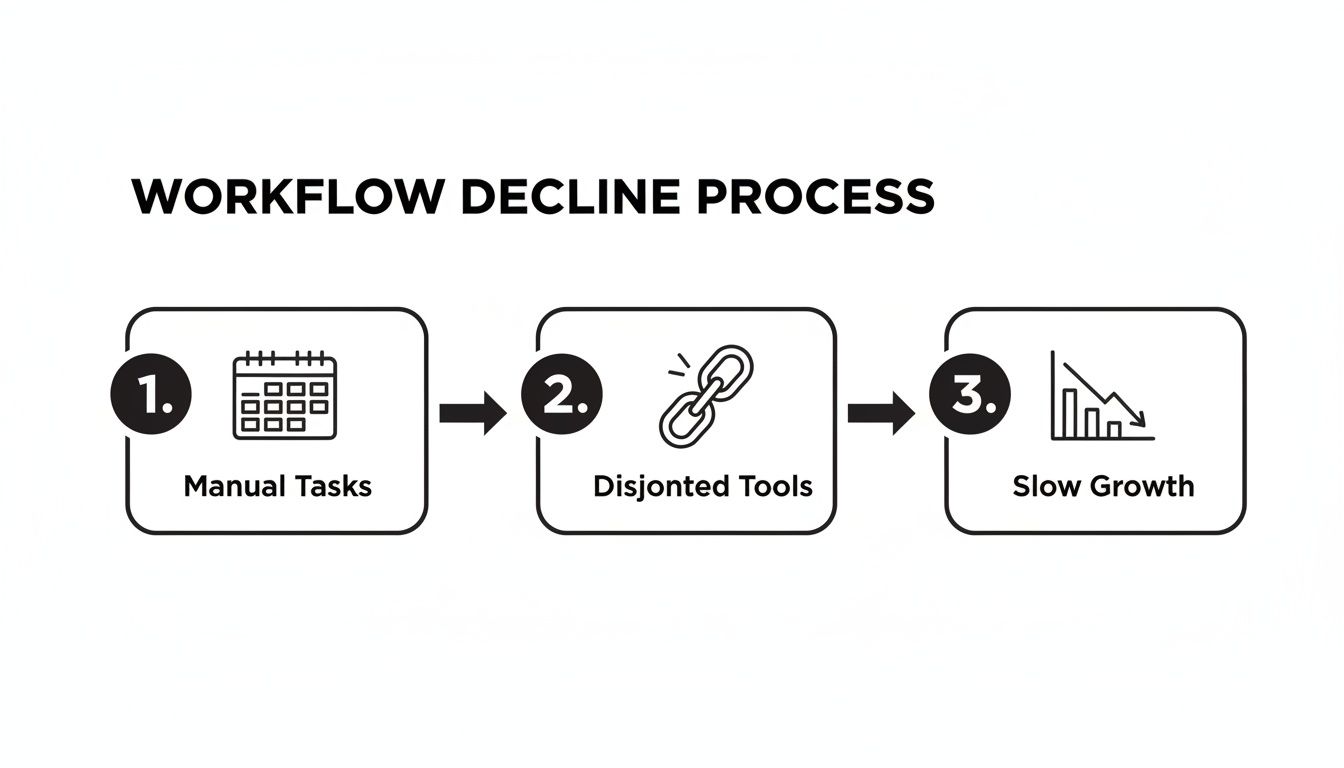
This cycle is all too common. Manual friction creates systemic problems that actively hold your business back.
Find Your Low-Hanging Fruit
Once you’ve got a list of potential automation targets, it's time to get strategic. Not all automations are created equal. The trick is to balance the potential reward against the effort it’ll take to get it done.
A perfect example of low-hanging fruit is automating customer support ticket routing. It’s a classic high-impact, low-effort win. You can save your team hours every single week and slash response times, which directly boosts customer satisfaction. On the other hand, automating something like social media scheduling might save a little time, but its impact on the bottom line is often much smaller.
The goal isn't just to automate for the sake of it. It’s about targeting the bottlenecks that, once removed, will have the greatest positive impact on your team's productivity and your business's bottom line.
Ask yourself this: which broken process, if fixed, would free up your best people to do the work they were actually hired for? That’s where you should start.
A Simple Framework for Prioritization
To bring some objectivity to this process, I always recommend creating a simple scoring matrix. You don't need fancy software; a basic spreadsheet will do the trick. It’s a straightforward way to evaluate each automation idea and give it a priority score.
This framework helps you move from a vague "to-do" list to a clear, actionable plan. Here is a simple table you can adapt to evaluate your own opportunities.
Automation Opportunity Scoring Matrix
Automation Idea | Weekly Hours Saved (Est.) | Error Reduction (Low/Med/High) | Implementation Effort (Low/Med/High) | Priority Score |
|---|---|---|---|---|
Onboard new clients | 10 | High | Medium | 9/10 |
Route support tickets | 8 | Medium | Low | 8/10 |
Process sales invoices | 15 | High | High | 7/10 |
Schedule social media | 3 | Low | Low | 4/10 |
By scoring each potential project, you create a logical hierarchy of your best automation opportunities. You’ll walk into your first conversation with an agency like Shalev not with a vague problem, but with a clear, prioritized list of initial wins. This preparation is the foundation for a project that delivers immediate, measurable results.
Picking the Right Agency to Be Your Automation Partner
Finding the right AI automation agency isn't just about hiring a team that can sling code. You're looking for a true partner, someone who gets that building an internal tool is as much about the user experience as it is about the engineering behind it. After all, what’s the point of a brilliant automation if your team hates using it?
The best partners wear a product manager's hat, not just a developer's. They’ll push back, ask the hard questions about your actual goals, and stay laser-focused on the business outcome. This is worlds away from a typical vendor who just takes your order and builds what you ask for. You need a team that helps you figure out what you should be building in the first place.

Look for an agency that can show you real, tangible business tools they've built, not just pretty slide decks. It’s this history of practical application that separates the great agencies from the merely good ones.
Look Past the Glossy Homepage
To find a real partner, you have to dig deeper than their sales pitch. Look for proof of a transparent, agile process. Do they have client testimonials that talk about collaboration? Can they show you how they use shared task boards or send regular, async updates to keep you looped in without booking your calendar solid with meetings?
The global workflow automation market is massive—it’s on track to hit USD 40.77 billion by 2031. This explosive growth is happening because AI and business processes are a perfect match, helping startups and SaaS companies scale without having to hire an army. You can discover more insights about the automation market's growth to see just how critical finding the right partner has become.
A huge part of this is their technical skill set. You need to get specific about their core abilities:
No-Code/Low-Code Skills: Are they wizards with tools like Zapier or Make for building fast, affordable integrations?
Custom AI Agents: Can they go beyond off-the-shelf solutions and build custom AI agents for the complex, multi-step tasks that are unique to your business?
Specific Integrations: Have they actually worked with the CRM, project management, or accounting software you rely on every day?
You’re not looking for an agency that claims to do everything. You’re looking for the one with the right skills for your specific problems. For a deeper look, check out our guide on AI automation for small business to see how different approaches solve different problems.
Key Questions to Ask Any Potential Agency
When you start talking to a potential ai automation agency for workflow optimization, a solid list of questions is your best friend. These questions are designed to cut through the fluff and show you how they really work.
Don’t just ask what they can build. Ask them how they make sure it actually delivers value. The process is every bit as important as the finished product.
Here are a few essential questions to have ready for your first call:
How do you measure the ROI on your projects? You want to hear them talk about more than just "time saved." Good answers will include things like reduced error rates, higher team throughput, and even employee morale.
What does your project management and communication actually look like? The right answer involves agile methods, a single point of contact, and shared tools that give you a clear window into their progress.
Who owns the final solution and the intellectual property? This is a simple one. The answer should be "you do." Make sure you get full ownership and admin access to everything once the final invoice is paid.
How do you handle it when we have a new idea or need to change scope mid-project? A great partner won’t panic. They’ll have a clear, flexible process for adapting to new ideas without blowing up the timeline or budget.
Launching Your Pilot Project and Measuring Success
Alright, you’ve mapped out your best automation ideas and picked an agency you trust. Now comes the fun part: making it real. A pilot project is your chance to prove this whole thing works—not just in theory, but with real, hard numbers.
This first project isn’t just about getting a task done. Think of it as a controlled experiment. The goal is to create a crystal-clear "before and after" snapshot that leaves no doubt about the value you're creating. My advice? Start small, aim for a quick win, and pick something that has a noticeable impact.
Scoping Your First Initiative
A successful pilot is laser-focused. It doesn't try to boil the ocean. Instead, you'll want to grab one of those high-priority, low-effort workflows you identified earlier and build your experiment around that.
A classic example we see all the time is building a simple AI agent to sort and categorize incoming support tickets. The goal is straightforward and easy to measure: slash manual triage time by 75% and get every ticket to the right person in under five minutes. This gives your ai automation agency for workflow optimization a clear target to aim for. We've actually written about how to integrate an AI agent with your CRM system if you want to dig deeper into that.
The collaboration itself should be just as focused:
Kickoff Call: Get everyone in a room (virtual or otherwise) to agree on the exact problem, the desired outcome, and the metrics for success.
Deep Dive: The agency should sit down with your team to really understand the nitty-gritty of the current manual process.
Weekly Updates: Keep things moving with brief, asynchronous check-ins that don't bog down everyone's calendar.
The pilot projects that knock it out of the park are surgical. They solve a single, nagging problem so well that everyone immediately asks, "Okay, what can we automate next?"
Tracking KPIs and Proving ROI
This is the most critical part: measuring success isn't something you figure out at the end. It's the entire point. Before a single line of code is written, you need to benchmark your current state. How long does this task take right now? How many errors slip through each week? What's the real cost of this inefficiency?
With those baseline numbers in hand, you have a yardstick to measure against. Once the new automated workflow goes live, you track the exact same KPIs. The difference between the "before" and "after" tells the whole story. Did you hit that 75% time reduction? Are data entry errors a thing of the past? That data is your ROI, plain and simple.
Beyond just one task, companies using AI for broader workflow monitoring are seeing massive gains. These tools give you a bird's-eye view of how all your automations are performing, helping you spot bottlenecks and prevent failures before they happen. The result is consistently lower operational costs and much smarter, more efficient systems.
Scaling Automation Across Your Organization
That first successful pilot project feels great, doesn't it? It's a fantastic proof point, but it's really just the starting line. The real magic happens when you turn that initial win into a full-blown strategy for continuous improvement across the company.
This is the moment you shift from simply patching a single leaky process to building an entirely new operational backbone—one that scales as fast as you do.
The data from your pilot is your treasure map. Take everything you learned—the hours saved, the errors stamped out, the team morale boost—and use it to build a practical automation roadmap. You're not guessing anymore. You're using real results to decide which workflows to tackle next.
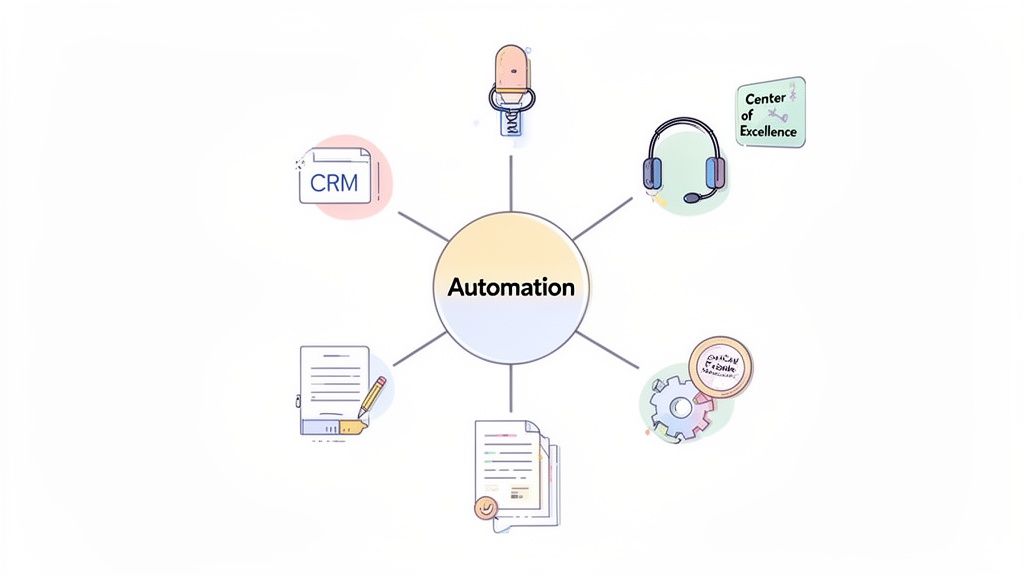
This kind of strategic thinking is what stops your automations from becoming a messy drawer of disconnected tools. Instead, they evolve into a cohesive, integrated system that grows right alongside your business.
Establish Your Integration Patterns
As you start rolling out more automations, you'll quickly realize they need a consistent way to talk to each other and to your core software, like your CRM or project management tools. A good ai automation agency for workflow optimization will help you establish these integration patterns from the get-go.
Think of it as creating a set of universal adapters for your tech stack. Once you've defined a standard way to connect a new automation to Salesforce, for instance, you don't have to reinvent the wheel every single time. This makes building and launching new workflows faster, cheaper, and way less likely to cause technical migraines down the road.
Plan for Handoff and Maintenance
Let’s be honest: an automation is only as good as the team's ability to use and manage it. This is where so many projects fall apart. Without a solid plan for handoff and ongoing maintenance, your shiny new tool can quickly become a piece of technical debt that everyone is afraid to touch.
Any handoff from your agency partner worth its salt must include:
Clear Documentation: Simple, no-jargon guides that explain what the automation does, how it works, and how to fix common hiccups.
Team Training: Real, hands-on sessions to get your team comfortable using and overseeing their new automated workflow.
A Defined Support Model: A clear agreement on who handles what. Will your internal team manage minor tweaks? Or will you keep the agency on a small retainer for bigger issues?
An automation without clear ownership is just a future problem waiting to happen. The goal is to build systems that empower your team, not create a permanent dependency on outside help for every little thing.
Getting this right ensures your investment pays dividends for years, not just a few months. And the impact is huge. Companies that go all-in on AI workflow optimization see major gains. Some have reported inventory costs dropping by 32% and massive cuts to delivery times.
You can read the full research on AI's impact on workflows to see just how deep these benefits run. It's not just about saving a few hours here and there; it’s about fundamentally building a more resilient and efficient organization.
Common Questions About AI Automation Agencies
Jumping into automation can feel like a big leap, especially when you're responsible for your team's productivity and the company's bottom line. It’s totally normal to have a ton of questions. Getting straight answers is the only way to feel confident you're making the right move.
Let's walk through the questions we hear most often from founders and ops leaders who are thinking about partnering with an ai automation agency for workflow optimization. Our goal here is to cut through the noise and give you the clarity you need.
What Kind of Workflows Are Best for AI Automation?
The best place to start is with the tasks that are draining your team’s energy. You know the ones—they’re repetitive, rule-based, and usually involve shuffling data from one app to another.
Think about your day-to-day operations. Where are the bottlenecks? Good candidates for automation often look like this:
Lead Qualification: Instead of a sales rep manually sifting through new leads, an AI can score them, tag them, and assign them to the right person in seconds.
Customer Support Routing: An AI can instantly read and categorize incoming support tickets, sending them directly to the specialist who can solve the problem fastest.
Employee Onboarding: A single "new hire" entry can kick off a whole sequence of tasks—creating accounts in IT, setting up payroll in finance, and scheduling orientation with HR.
Financial Reconciliation: No more line-by-line manual matching. Automation can handle matching invoices to payments and flag anything that looks off for a human to review.
Basically, if you see someone on your team copying and pasting information or making the same simple decision over and over, you've found a perfect opportunity for automation. That’s how you free them up for work that actually moves the needle.
How Much Does Hiring an Agency Cost?
This is usually the first thing people ask, and the honest-to-goodness answer is, "it depends." The cost is tied directly to the scope and complexity of the work.
For instance, connecting two apps with a simple, linear workflow might be a small, one-off project. On the other hand, designing a complex system with multiple custom AI agents to run a core part of your business is a much larger investment. Look for an agency that’s flexible. They should be able to offer fixed-price projects for clear-cut tasks or a monthly retainer if you need ongoing support and development.
The real question isn't about the upfront cost, but the return you'll get. A smart automation often pays for itself surprisingly fast by saving hundreds of hours, eliminating costly errors, and letting your team get more done.
Will AI Automation Replace Jobs on My Team?
This concern comes up a lot, but our goal is always to make your team better, not smaller. Think of automation as a powerful assistant for every employee, taking the tedious, low-value work off their plate so they can focus on what they were hired to do.
It's about empowering your people to focus on the things that humans are uniquely good at—thinking strategically, solving complex problems, and building real relationships with customers. For example, your support team shouldn't be manually sorting tickets; they should be solving tough customer issues. AI handles the sorting so they can jump straight to the high-impact work. This helps you scale your operations without having to scale your headcount at the same rate. It’s about doing more with the great team you already have.
How Are Automations Maintained After the Project?
A project isn't a success just because the tool is built. The handoff is one of the most critical parts of any engagement with an ai automation agency for workflow optimization.
A great partner will make sure you have complete ownership and control of everything they build for you. That means delivering clean documentation, training your team on how the new system works, and setting up a clear process for support. Many agencies, including us, offer ongoing retainers. This gives you a dedicated expert to call on for updates, troubleshooting, or expanding your automations as your business grows. This way, your investment keeps delivering value for years to come.
Ready to stop wrestling with inefficient workflows and start building a more scalable operation? At Shalev Agency, we design and build custom internal tools and AI automations that save you time and drive real business outcomes. Schedule a call with us today to discover your first automation win.