
A practical guide to hiring an AI automation agency for lawyers. Learn how to identify needs, vet partners, and measure the real ROI for your law firm.
Jan 11, 2026

An AI automation agency for lawyers is a specialized firm that helps you weave artificial intelligence into the fabric of your practice. Think of them as a strategic partner who translates complex tech into practical solutions for handling repetitive tasks, slashing non-billable hours, and boosting your firm's overall efficiency. They're the experts who turn AI from a buzzword into a real asset that helps you win in a crowded market.
Why Your Law Firm Needs an AI Partner

The legal world isn't just talking about AI anymore—it's putting it to work. Clients today expect faster results and more transparent value for their investment. This shift puts immense pressure on firms to find smarter, more efficient ways to operate beyond the old-school methods.
This isn't about jumping on a technology trend. It's about tackling a very real problem: the constant drain on profitability from administrative overload. Your lawyers and paralegals are likely spending far too many hours on essential but non-billable work. This is exactly where a dedicated AI partner can deliver a noticeable, bottom-line impact.
Moving Beyond Software to Strategy
Buying a new AI tool off the shelf rarely solves the underlying problem. Without a solid strategy, that fancy software quickly becomes expensive "shelfware," collecting dust while your team sticks to what they know. An AI automation agency brings that missing strategic layer to the table.
They're the ones who roll up their sleeves and help you find the best starting points for automation in your specific practice. They help you get clear answers to questions like:
Where are the biggest logjams in our workflows right now?
Can we automate parts of client intake while still keeping it personal?
How do we use AI for document review or contract analysis securely and ethically?
A good partnership is about fundamentally rethinking how your firm works. It’s about creating custom-fit automations that plug right into your current systems, empowering your people instead of frustrating them.
The real value of an AI agency isn't just the code they write; it's the operational clarity they provide. They hold up a mirror to your processes, helping you spot inefficiencies you've probably just accepted as "the way things are done."
The table below highlights some of the most common and high-impact areas where law firms are successfully applying AI automation today.
Key Areas for AI Automation in Law Firms
Automation Area | Common Bottleneck | Potential AI Impact |
|---|---|---|
Document Review & eDiscovery | Manual review of thousands of documents is slow, costly, and prone to human error. | AI can analyze and categorize vast datasets in minutes, identifying relevant documents with high accuracy. |
Contract Analysis & Management | Manually tracking key dates, clauses, and obligations across hundreds of contracts. | AI automatically extracts key terms, flags risks, and sets reminders for critical deadlines. |
Client Intake & Onboarding | Time-consuming data entry, conflict checks, and repetitive client communication. | Automated forms, chatbots, and workflows handle initial data collection and status updates 24/7. |
Legal Research | Sifting through massive case law databases to find relevant precedents. | AI-powered research tools surface the most relevant cases and statutes in a fraction of the time. |
By targeting these areas, firms can achieve significant gains in both efficiency and accuracy, freeing up legal professionals for more strategic work.
Gaining a Sustainable Competitive Edge
The numbers speak for themselves. AI adoption in law firms isn't gradual; it's explosive. Research shows it leaped from 37% to a massive 80% in a single year. Today, 42% of firms are actively using AI, and another 42% have firm plans to expand its use. This isn't a future trend—it's the new standard for modern legal operations.
An AI agency helps you navigate this shift thoughtfully. By automating the routine, you unleash your top legal minds to focus on high-value strategy, complex negotiations, and building lasting client relationships. It's the kind of work that requires uniquely human skills. This change doesn't just make your firm more efficient; it improves morale and makes you a magnet for top talent.
To get a better sense of what's possible, it’s worth exploring some of the top AI tools for lawyers already making waves in the industry.
Pinpointing Your Best Automation Opportunities
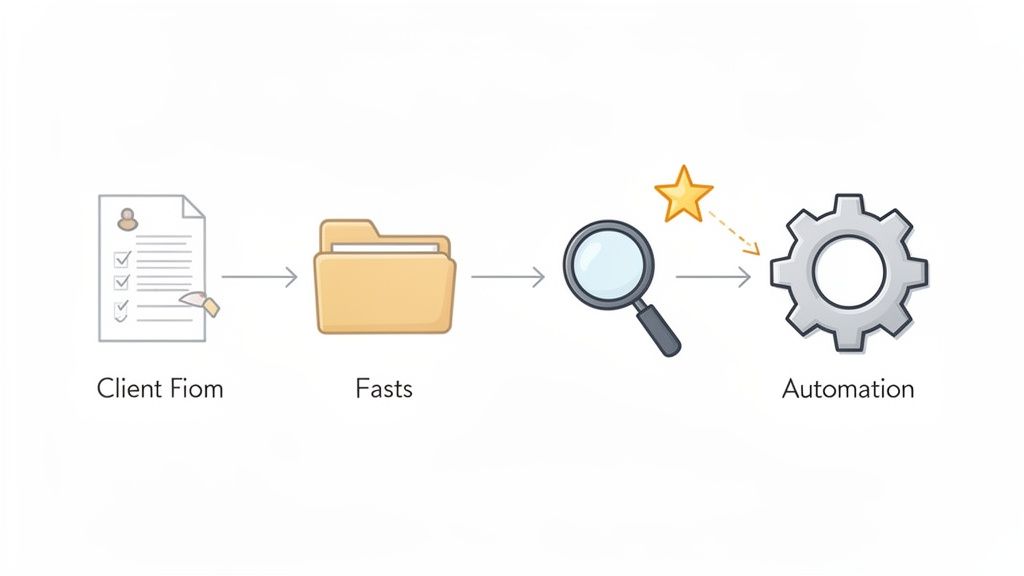
Before you even think about picking up the phone to call an AI automation agency for lawyers, the real work starts inside your own firm. The most successful AI projects I’ve seen didn't begin with flashy tech demos; they started with an honest look at where the team's time is actually going.
Your mission is to find the hidden time sinks—those repetitive, low-value tasks that slowly drain hours from your day and keep your best people from doing their best work.
Sure, document review is the obvious one, but the truly impactful opportunities are often buried in your firm's unique way of doing things. Look for the patterns of manual work that are predictable, rule-based, and happen over and over again.
Uncovering High-Impact Starting Points
First things first, you need to identify the workflows that are genuinely ripe for improvement. Don't try to boil the ocean here. The key is to get specific.
A great way to start is just by talking to your team. Ask them simple questions.
Where do they feel the most friction in their day? What’s that one task they dread doing because it’s so tedious? Their answers will almost always point you directly to the bottlenecks where automation can make a real difference.
Listen for processes that have these traits:
High Volume: Think about tasks that happen dozens, or even hundreds, of times a week. Things like initial client intake or running conflict checks are perfect examples.
Repetitive Steps: This is anything that follows the same script every single time, like prepping standard closing documents or pulling together monthly client reports.
Data Entry: If it involves copying and pasting information from one place to another—like moving client details from an email into your case management software—it’s a prime candidate.
These are your "low-hanging fruit." A focused project in one of these areas can deliver a quick, visible win and build momentum for everything that comes next.
From Vague Pains to a Clear Business Case
Once you have a list of potential pain points, you have to attach real numbers to them. A complaint like "client intake takes too long" is a good start, but it’s not enough to build a business case on.
Start tracking the actual time spent. For example, ask a paralegal to log every minute they spend on a single new client intake, from start to finish, over the course of a week.
Let’s run the numbers for a hypothetical mid-sized firm that onboards 20 new clients per week. The manual process probably looks something like this:
Send a welcome email with an intake form.
Manually type the form data into the CRM.
Create a new matter in the case management system.
Run a conflict check.
Draft an engagement letter from a template.
If this whole sequence takes a paralegal 45 minutes per client, you’re looking at 15 hours of administrative work every single week. That’s almost a full-time employee dedicated to one repetitive workflow. This is the kind of hard data an agency can sink its teeth into to scope a project with a clear ROI. If you want to dive deeper into this, you can learn more about what workflow automation is and how it works in practice.
Pinpointing your firm's best automation opportunities is less about finding complex legal problems for AI to solve and more about identifying the simple, recurring administrative burdens that hold your legal talent back.
Prioritizing Your First AI Project
With a list of quantified opportunities in hand, you can start to prioritize. It's tempting to just pick the task that eats up the most time, but you should also consider the strategic impact.
A great first project has a clear beginning and end, doesn't involve too many stakeholders, and has a high chance of being a visible success. This is how you build momentum and get your team excited for more ambitious projects down the line.
Here’s a real-world example I've seen play out: a corporate practice was drowning in Non-Disclosure Agreement (NDA) reviews. Junior associates were spending countless non-billable hours redlining standard agreements. They partnered with an agency to automate the first-pass review.
The AI now flags any non-standard clauses and deviations from the firm’s playbook, cutting the human review time from 60 minutes down to just 15 minutes per NDA. This simple automation freed up hundreds of hours a year, letting those associates focus on more complex, billable work. That's the kind of tangible outcome you should be aiming for.
How to Vet and Choose the Right Agency
Picking the right partner is, without a doubt, the most critical decision you'll make in this entire process. The line between a successful AI rollout and a costly, frustrating experiment often comes down to the expertise of the agency you hire. This isn't just about finding a team that can code; you need a strategic partner who speaks both tech and legal.
Your goal here is to get past the glossy sales presentations and really understand how an agency operates. A slick website is one thing, but a deep-seated understanding of attorney-client privilege, data security, and the ethical nuances of legal practice is another entirely. You're looking for a true collaborator, not just another vendor.
Custom Solutions vs. Off-the-Shelf Integrations
One of the first things to clarify is an agency’s core approach. Do they build custom AI solutions from the ground up, or do they mostly integrate existing, third-party software? There's no single "right" answer, but the distinction is crucial for your firm.
Integrators: These agencies are experts at connecting best-in-class tools (think a leading contract analysis platform) with your existing systems. This route can be faster and more cost-effective for standard, well-defined tasks.
Custom Builders: These teams write proprietary code to create bespoke AI agents and workflows designed precisely for your firm's unique processes. This is perfect for those complex, specialized needs where no off-the-shelf tool quite fits the bill.
For most law firms, a hybrid approach is often the sweet spot. An agency that can recommend a proven third-party tool where it makes sense, but also has the engineering chops to build a custom solution when needed, offers the most flexibility. It's worth exploring the full spectrum of what a top-tier AI automation agency can offer to understand the possibilities.
Assessing Their Legal Industry Acumen
This is a non-negotiable. An AI automation agency for lawyers absolutely must show they get the legal world. They don’t need to be lawyers themselves, but they have to be fluent in concepts like client confidentiality, data governance, and the regulatory pressures your firm is under every day.
Ask them direct questions about their experience with sensitive legal data. Have they worked with firms that handle PII, PHI, or other confidential information? How, exactly, do they ensure their solutions comply with your firm's internal security policies and external regulations?
A great agency won't just ask what you want to automate. They'll ask why and then challenge your assumptions to make sure the final solution is not only effective but also ethically sound and compliant.
Their project management style should also align with the meticulous nature of legal work. Look for a team that emphasizes clear documentation, regular check-ins, and a transparent process for tracking progress and handling the inevitable scope changes.
Analyzing Case Studies and Past Performance
Any agency worth its salt will have case studies. Your job is to read between the lines. Don’t just get dazzled by the impressive ROI numbers; dig into the problem they were hired to solve. Does it sound familiar? Does it resemble the challenges your firm is grappling with?
Look for details that signal real-world, in-the-trenches experience:
Specific Metrics: Vague claims like "improved efficiency" are red flags. You want concrete numbers, like "reduced document review time by 40%" or "cut client intake processing from 45 minutes to 10 minutes."
Integration Complexity: Did they just set up a simple chatbot, or did they integrate a complex AI model with a clunky, legacy case management system? The latter shows real technical skill.
Client Testimonials: Are the testimonials from managing partners and legal ops leaders at firms similar to yours in size and practice area? Relevance is everything.
When you're ready to start vetting potential partners, checking out lists of the top AI automation companies can give you a solid starting point for your research.
Before you sign any contracts, it's wise to run through a structured checklist of questions. This ensures you're comparing apples to apples and not missing any critical details during your evaluation.
Agency Vetting Checklist: Key Questions to Ask
Evaluation Criteria | Question to Ask | What to Look for in the Answer |
|---|---|---|
Legal Experience | Can you share examples of AI projects you've completed for other law firms or legal departments? | Specifics about the practice area, the problem they solved, and measurable results. Bonus points if they understand the difference between litigation and transactional work. |
Technical Approach | Do you primarily build custom solutions or integrate existing tools? Can you explain your reasoning for a hybrid approach? | A clear, confident answer that shows flexibility. They should be able to justify why a custom build is better (or worse) than an integration for a given scenario. |
Data Security | How do you handle sensitive client data and ensure compliance with regulations like GDPR or CCPA? | A detailed explanation of their security protocols, including encryption (in transit and at rest), access controls, and data residency. They shouldn't hesitate. |
Project Management | What does your project management and communication process look like from kickoff to final delivery? | A structured, transparent process. Look for mentions of a dedicated project manager, regular status updates, and a clear system for feedback and approvals. |
Team Expertise | Who would be working on our project? What is their background in both AI development and the legal industry? | You want to see a blend of skills: data scientists, AI engineers, and project leads who have experience with the unique demands of legal clients. |
Support & Maintenance | What kind of post-launch support and maintenance do you offer? How do you handle bugs or necessary updates? | Clear SLAs (Service Level Agreements), defined support channels, and a plan for ongoing system health monitoring. Vague promises are a no-go. |
Using a checklist like this helps you move beyond the sales pitch and gather the concrete information you need to make a confident decision.
Security and Governance as a Top Priority
In the legal field, security isn't just a feature; it’s the bedrock of your firm’s reputation. A potential agency’s commitment to governance and secure workflows is paramount. This is where disciplined, thoughtful deployment wins out over hype every single time.
The industry is already moving toward formalizing AI policies, with analysts forecasting that 80% of organizations will have them in place soon. New regulations like the EU AI Act—which carries penalties up to a staggering €35 million—only amplify the need for partners who build auditable, secure, and compliant systems from the ground up.
Your vetting process must include a deep dive into their security protocols. How do they handle data encryption? What are their access control policies? They should provide clear, satisfying answers that show they truly understand your obligations to your clients. Choosing a partner who puts security first turns your AI investment into a powerful strategic asset, not a potential liability.
From a Pilot Program to Firm-Wide Adoption
Even the best AI strategy can fail if the rollout is clumsy. Moving from an exciting concept to a fully integrated tool requires a careful, step-by-step approach. The trick is to sidestep the temptation of a "big bang" launch. Instead, you need to start small, prove the value, and build momentum from there.
This all starts with a well-defined pilot project. Think of a pilot as a controlled experiment—it's designed to score a quick win, get your team excited, and teach you valuable lessons before you commit to a firm-wide deployment. It's all about showing real results on a small scale to justify the bigger investment.
Having a structured plan isn't just good practice; it's essential. While a massive 78% of General Counsel see a future where at least half their roles are automated, a staggering 71% of in-house legal teams are stuck in pilot purgatory because of poor execution. You can dig into the full findings on analyst predictions for legal teams to see just how common this challenge is.
Scoping Your First Pilot Project
Your initial project should be a surgical strike, not a full-scale assault. The goal here is to pick a use case that is both meaningful and manageable. A great pilot project has a clear start, a finish line you can measure, and involves a small, motivated group of people.
When you're choosing a use case with your AI automation agency for lawyers, look for processes that are:
Highly Repetitive: Think about tasks like the initial sorting of discovery documents or processing standard client intake forms. These are perfect.
Self-Contained: Pick a workflow that doesn’t rely on a dozen other complex systems or departments to function.
Easily Measurable: You have to be able to track clear metrics. How much time was saved per task? Did manual errors decrease?
For instance, a litigation firm could pilot an AI tool to automate the first draft of deposition summaries. This is a very specific, time-sucking task with a clear deliverable. By tracking the hours saved for a few paralegals over a month, the firm can quickly build a rock-solid business case for a broader rollout.
The success of a pilot isn't just about the technology working. It's about proving to everyone—from managing partners to junior associates—that this new way of working is better, faster, and genuinely makes their jobs easier.
Of course, this all begins with finding the right partner. Vetting and selecting an agency with the right expertise is what makes or breaks this stage.
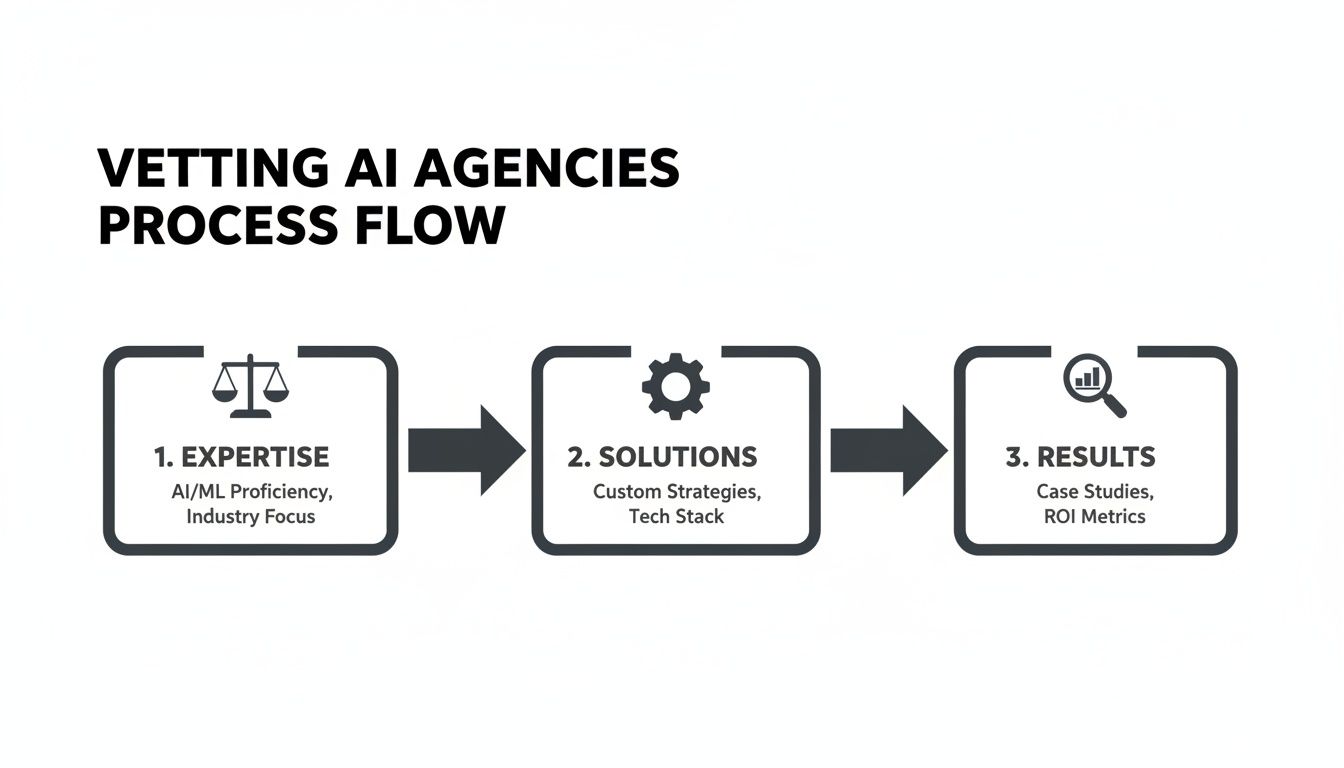
This process flow breaks down how to vet an agency into three critical stages: judging their legal expertise, understanding their tech solutions, and checking their track record.
From a Successful Pilot to Firm-Wide Integration
Once your pilot delivers that clear win, it's time to scale up. This is where the challenge shifts from a technical problem to a people problem—it’s all about change management. Your success now depends on bringing the rest of the firm along for the ride.
Training is everything. Don't just send a memo with a link to a new login page. A good AI agency will help you create hands-on training sessions that show your team exactly how this tool fits into their daily work and solves the headaches they actually have.
A phased rollout is almost always the best bet. Start with the team or practice group most likely to jump on board. Then, use their success stories to build excitement and encourage others to adopt it. Celebrate the wins, share the positive metrics, and turn your early adopters into champions.
Finally, the new tools have to feel like they belong. A powerful AI agent that can’t talk to your case management software or CRM is just creating more work. If you need a starting point, our post on how to integrate an AI agent with your CRM system offers a practical guide. When done right, the new technology becomes a natural, indispensable part of how your firm operates.
Understanding Costs and Measuring Your True ROI
Bringing an AI automation agency for lawyers on board isn't just another expense—it's a strategic investment in your firm's profitability. To make a smart decision, you have to look past the initial price tag and get a firm grip on how to measure the real return you'll get.
Let's cut through the noise on the financial side. Agency pricing is usually straightforward, but what you ultimately pay hinges on the complexity of what you need. A simple workflow to automate a single task is one thing; building a custom AI agent that hooks directly into your case management system is another entirely.
The real goal is to shift the conversation from "How much does it cost?" to "What value will this create?" A good agency partner will help you build that business case from the very first call.
Breaking Down Agency Pricing Models
Once you start talking to agencies, you'll run into a few common ways they structure their fees. Each one makes sense in different situations, depending on what you're trying to accomplish.
Knowing these models helps you match the financial commitment to your firm's goals and cash flow.
Fixed-Scope Projects: This is the go-to for well-defined pilot programs or smaller automations. The agency gives you a single, all-in price to deliver a specific result, like automating your client intake process. The beauty of this model is its predictability, which makes it perfect for budgeting your first foray into AI.
Monthly Retainers: If you're looking at ongoing development, support, and optimization, a retainer model is more common. You pay a set fee each month for dedicated access to the agency's team. This works best for larger, more intricate projects or when you want a long-term partner to keep finding new ways to automate.
The right choice really depends on your immediate needs. A fixed-scope project is a fantastic way to test the waters. A retainer, on the other hand, signals a deeper, more strategic partnership.
Your investment in AI is much more than a tech purchase. Think of it as reallocating capital from inefficient manual labor to a scalable, automated asset that works for you 24/7. It's a fundamental shift in how your firm generates value.
Key Performance Indicators Beyond Cost Savings
The most obvious win is cutting down on labor costs, but that’s just the tip of the iceberg. The real value is buried in the second- and third-order benefits that AI automation unlocks across your firm.
If you track these KPIs, you'll get a complete picture of your investment's impact.
Increased Lawyer Productivity: It's simple: measure how many more billable hours your lawyers can log now that they aren't stuck on administrative busywork. This directly boosts your firm's revenue-generating power.
Faster Case Resolution Times: Look at the average time it takes to get a matter from open to closed. AI-powered document review and research can slash these cycles, freeing you up to take on more cases.
Improved Client Satisfaction: Use simple surveys to see how happy your clients are. Automation leads to faster responses, quicker turnarounds, and clearer communication—all things that result in happier clients who send more business your way.
The legal industry is already putting serious money behind this shift. Law firms' tech investments are surging, with spending on technology jumping by nearly 11% and on knowledge management by 10%—both far outpacing inflation. This isn't random spending; it’s a clear strategy to invest in tech that drives real efficiency and profit. You can dig deeper into this trend in the latest legal market report by Thomson Reuters.
Building Your Business Case for AI
To get the partners on board, you need a business case that's clear and compelling. Forget the tech jargon; this is about dollars and sense.
Start with a simple framework. Pick one specific, high-friction workflow—something like prepping for depositions. Calculate the total non-billable hours your team sinks into that task every month. Then, work with your agency to estimate the time savings their proposed automation will deliver.
Present that data plainly. Show the "before" cost in wasted hours and the "after" projection. Make sure to highlight not just the money saved but the new capacity you’ve unlocked. When you frame AI as a direct path to greater profitability and client value, it becomes an easy decision for anyone to make.
Answering the Tough Questions About AI in Legal
Even with the best strategy, pulling the trigger on a partnership with an AI agency can feel like a leap of faith. It's completely normal to have questions about the practical side of things—how much will this cost, is our data safe, and what does this mean for our team?
Let's cut through the noise and tackle these common concerns head-on. These aren't just details; they're the make-or-break issues that decide if an AI project becomes a game-changer or just another headache. Getting clear, honest answers is the most important part of your vetting process.
How Much Does an AI Automation Agency for a Law Firm Typically Cost?
This is always the first question, and the honest answer is: it really depends on what you're trying to accomplish. There's no standard price list for this kind of work.
A simple, well-defined project—like automating your client intake workflow—could land in the low five-figure range. This is a fantastic way to get started because you have a predictable budget for a very clear, measurable outcome.
For bigger, more intricate projects, like building a custom AI agent that talks directly to your case management system, you're likely looking at a monthly retainer. This model gives you ongoing access to the agency’s experts for continuous development, support, and fine-tuning.
The biggest mental hurdle is shifting your focus from the price tag to the ROI. A good ai automation agency for lawyers won't just quote you a price; they'll help you build a business case that shows exactly how the investment pays for itself through massive efficiency gains and freeing up your team for more billable work.
What Security and Confidentiality Measures Should We Expect?
In the legal world, security and confidentiality are non-negotiable. Period. This is where you need to be incredibly rigorous in your vetting. Your AI partner must have a deep, practical understanding of attorney-client privilege and the enormous responsibility of handling sensitive legal data.
At an absolute minimum, you should expect them to:
Sign a comprehensive Non-Disclosure Agreement (NDA) without any hesitation.
Adhere to industry-best security practices, like end-to-end data encryption.
Use strict access controls, ensuring only essential personnel can ever view sensitive information.
Ask them point-blank about their experience with confidential legal data. A confident, detailed answer is a great sign. They need to be able to work seamlessly within your firm's existing security protocols and respect your internal governance policies. Your clients' trust and your firm's reputation are on the line.
Will AI Replace Our Paralegals and Junior Associates?
This is a very common fear, but it comes from a misunderstanding of what AI actually does best. The goal here is augmentation, not replacement.
AI is brilliant at handling the high-volume, repetitive, and frankly, soul-crushing tasks that lead to burnout. Think about tasks like the initial sorting of discovery documents, pulling specific data points from hundreds of contracts, or transcribing deposition audio. These jobs are essential, but they don't require deep legal judgment.
By handing these tasks over to an AI, you free up your paralegals and junior associates to focus on higher-value work that truly requires their training and critical thinking. Instead of spending hours hunting for a single clause in a document, they can spend that time helping draft a more persuasive brief or preparing a key witness for testimony.
Done right, AI elevates your team. It makes their jobs more engaging and makes your entire firm run more effectively. It’s about empowering your people, not making them obsolete.
How Long Until We See Results from an AI Project?
You shouldn't have to wait a year to know if your AI investment is paying off. The timeline for seeing a real return is directly tied to the project's scope.
A smart, well-defined pilot project focused on a single, high-friction problem can deliver measurable results in as little as 4 to 8 weeks. For instance, automating your conflict check process can immediately slash administrative drag and get new clients onboarded faster, showing a clear win from day one.
Of course, bigger projects will have longer timelines. But a good agency will build the project in phases to deliver value iteratively. They’ll set clear milestones and roll out functional pieces along the way, so you’re not just waiting for some distant launch date. The best approach is to start small, prove the concept, and then use that early success to build momentum for more ambitious projects across the firm.
Ready to transform your firm's efficiency and unlock new levels of profitability? The team at Shalev Agency specializes in creating custom AI agents and automations that save time and drive measurable outcomes for legal teams. Schedule a discovery call to find out how we can build a solution for you.