Discover how AI automation agency services transform businesses. This guide covers core offerings, ROI, choosing the right partner, and real-world examples.
Jan 11, 2026
Think of an AI automation agency as a specialized team you bring in to build a crew of digital workers for your business. These aren't just bits of software; they're custom-built AI agents and automated workflows designed to handle the tedious, repetitive tasks that drain your team's time and energy—things like data entry, customer support triage, lead qualification, and even financial reporting.
The whole point is to free up your human experts to focus on what they do best: strategy, creativity, and building customer relationships.
What Are AI Automation Agency Services
Imagine having a team of super-efficient assistants who work 24/7. They never need a coffee break, don't make typos, and can juggle thousands of tasks at once. That's the reality an AI automation agency brings to the table. They’re more than just tech consultants; they're operational architects who fundamentally rethink and rebuild how work gets done in your company.
It starts with a deep dive into your current processes. The agency's job is to spot the bottlenecks, the manual drudgery, and the repetitive tasks that are holding you back. From there, they build custom AI solutions to take over. This might be a simple AI that sorts and replies to basic customer emails, or it could be a sophisticated internal tool that crunches sales data to forecast next quarter's trends.
Beyond Simple Task Management
But this is about so much more than just ticking boxes on a to-do list. It’s about creating intelligent systems that can learn, adapt, and run with little to no human oversight. This shift allows a business to scale up its operations without having to scale up its payroll in lockstep.
Here’s a classic example: a marketing team might burn hours every single week pulling data from different places just to build a simple performance report. An AI automation agency could build a workflow that does this automatically.
It connects to Google Analytics, your CRM, and social media accounts.
It pulls all the relevant data and organizes it into one clean, easy-to-read dashboard.
It then emails a summary to the leadership team first thing every Monday morning.
That one automation saves countless hours, eliminates the risk of copy-paste errors, and gives the team back precious time for actual marketing. To see how these systems are built, check out our guide on what is workflow automation.
An AI automation agency essentially builds a digital nervous system for your business. It connects all your different tools and automates the flow of information, helping your company react faster, make smarter decisions, and just plain run better.
Who Benefits From These Services
It's easy to think this is just for huge corporations with massive budgets, but that’s a misconception. Startups and growing businesses are often the ones who see the biggest impact. By putting AI automation in place early on, smaller companies can achieve the kind of operational efficiency that used to be reserved for their largest competitors.
Whether you're a startup struggling to keep up with new leads or an established business trying to optimize your supply chain, these services are all about delivering a real, measurable return. The focus is always on tangible outcomes like cutting operational costs, boosting team productivity, and driving revenue growth.
You're not just offloading tasks; you're empowering your people to do their best work.
To make it clearer, here's a breakdown of the core services you can typically expect from an AI automation agency.
Core Offerings of an AI Automation Agency
Service Offering | What It Is | Primary Business Benefit |
|---|---|---|
AI Agents | Custom-built "digital workers" that can perform complex, multi-step tasks independently, like handling customer service inquiries or qualifying sales leads. | Drastically reduces manual labor, provides 24/7 operational capacity, and ensures consistent, high-quality execution of tasks. |
Workflow Automation | The design and implementation of automated processes that connect different apps and systems (like your CRM, email, and project management tools) to move data and trigger actions without human intervention. | Eliminates bottlenecks, reduces human error, and accelerates core business processes like sales, marketing, and operations. |
Internal Tooling | The creation of custom AI-powered software and dashboards built specifically for your team's internal needs, such as a tool that analyzes customer feedback or a dashboard that predicts inventory needs. | Provides your team with unique capabilities your competitors don't have, enabling smarter, data-driven decisions and boosting productivity. |
Ultimately, these offerings work together to create a more efficient, intelligent, and scalable business operation.
What AI Automation Agencies Actually Build for You
When you bring in an AI automation agency, you’re not just buying some off-the-shelf software. You’re hiring a team of specialists to build a smarter, faster, more efficient engine for your business. Their work generally falls into three key areas: creating AI agents, setting up automated workflows, and building custom internal tools.
Getting a handle on these three pillars is the first step to understanding how an agency can fundamentally change the way you operate.
This diagram shows how these services are layered, starting with individual agents and building up to fully custom solutions.
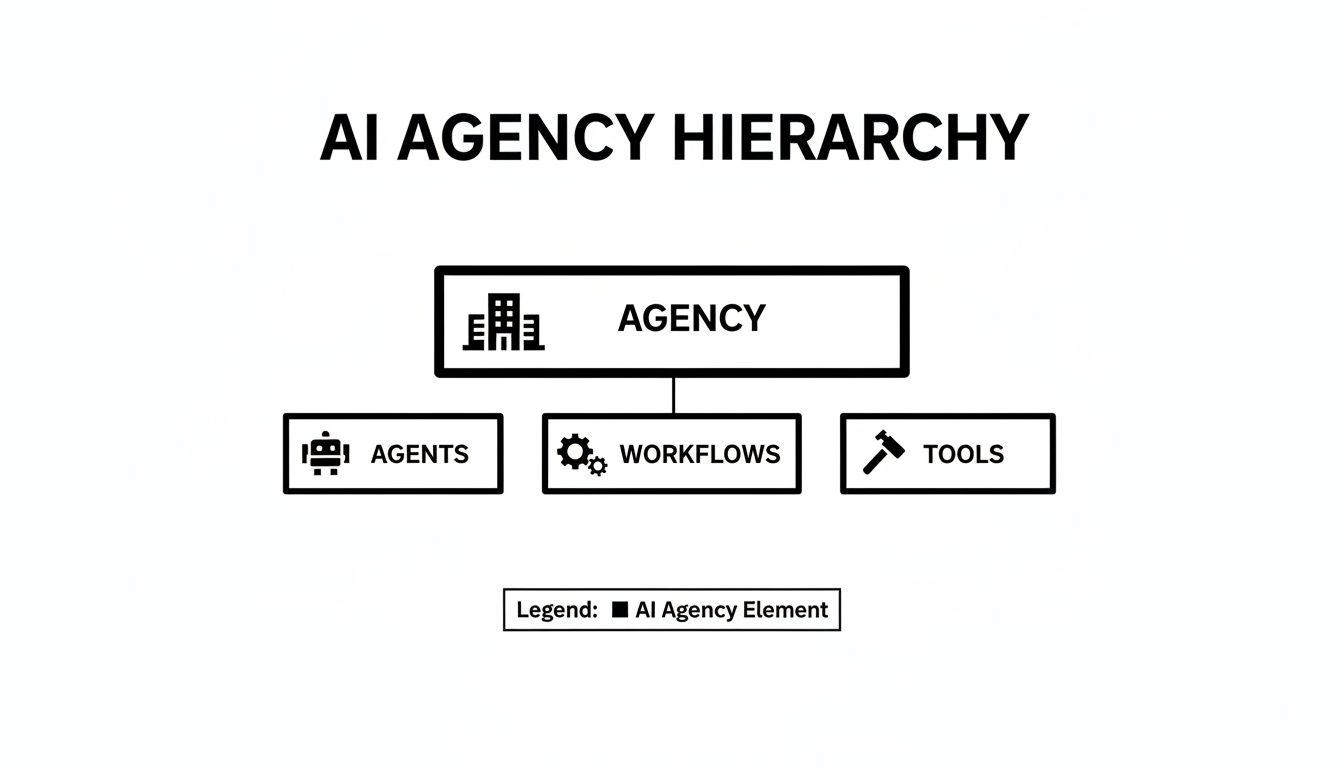
As you can see, each layer builds on the one before it, giving you a scalable way to integrate AI that can grow right alongside your company.
AI Agents: Your New Digital Workforce
Think of an AI agent as a dedicated digital employee trained for a very specific job. These aren't just basic chatbots. They are smart, autonomous systems that can handle complex, multi-step tasks that normally require a person's judgment and expertise.
Let's say you want to supercharge your sales team. An agency could build you a "Lead Qualification Agent."
Here’s what it would do, 24/7:
It would watch all your lead sources—website forms, emails, social media, you name it.
The moment a new lead comes in, it instantly researches the person's company, industry, and role using public data.
Based on your ideal customer profile, it scores the lead and assigns it to the right salesperson.
It can even fire off a personalized welcome email to get a call on the calendar.
Suddenly, your sales team is freed from hours of tedious research and data entry. They can walk in every morning and focus only on talking to the best prospects. This is why the AI agents market is exploding—it’s expected to jump from USD 7.84 billion in 2025 to a massive USD 52.62 billion by 2030. These digital workers are quickly becoming non-negotiable for any business that wants to keep up.
Automated Workflows: The Digital Connective Tissue
If AI agents are your specialized employees, then automated workflows are the communication systems connecting them all. They’re the digital plumbing that ensures information flows seamlessly between all the different apps and platforms you use, breaking down data silos and eliminating manual handoffs.
Picture this: a new customer signs up. A well-built workflow kicks in immediately and could automatically:
Create a new customer record in your CRM (like Salesforce).
Add them to a welcome email series in your marketing tool (like Mailchimp).
Assign a "kick-off call" task to an account manager in Asana.
Post a "New Customer!" notification in your team's Slack channel.
All of this happens in a split second, with zero human input. It’s not just about saving time; it’s about eliminating human error and delivering a flawless, professional experience for every single customer. A great example of this in action is the implementation of advanced AI Customer Service Solutions, which automate customer interactions to provide instant support.
Custom Internal Tools: Your Secret Weapon
Sometimes, the software you can buy off the shelf just doesn’t fit your unique process. That's where the real magic happens, with the third and most powerful service: building custom internal tools. These are bespoke applications, designed from scratch to solve a very specific operational headache that’s unique to your business.
A custom tool is your competitive advantage made real. It’s a solution built for your exact process, giving your team a capability that your competitors simply can’t buy.
For example, an e-commerce brand wrestling with high return rates could have an agency build a custom dashboard. This tool could pull in all return requests, use AI to analyze the reasons, and automatically suggest changes to product descriptions or inventory to fix the root cause. It provides a level of insight and control that no generic Shopify app ever could. We’ve seen this kind of impact firsthand at Shalev Agency, like when we built the Tasq AI quality assurance platform.
How AI Automation Drives Business Growth
It’s one thing to talk about AI automation in theory, but where the rubber really meets the road is seeing its direct impact on your business. This isn't just a buzzword for "efficiency"; it's a practical tool that reshapes how marketing, sales, and operations get things done.
By handing over the repetitive, data-heavy tasks to AI, you give your team back their most valuable resource: time. This isn't about replacing people. It’s about freeing them up to focus on the work that truly requires a human touch—strategy, creative problem-solving, and building genuine customer relationships.
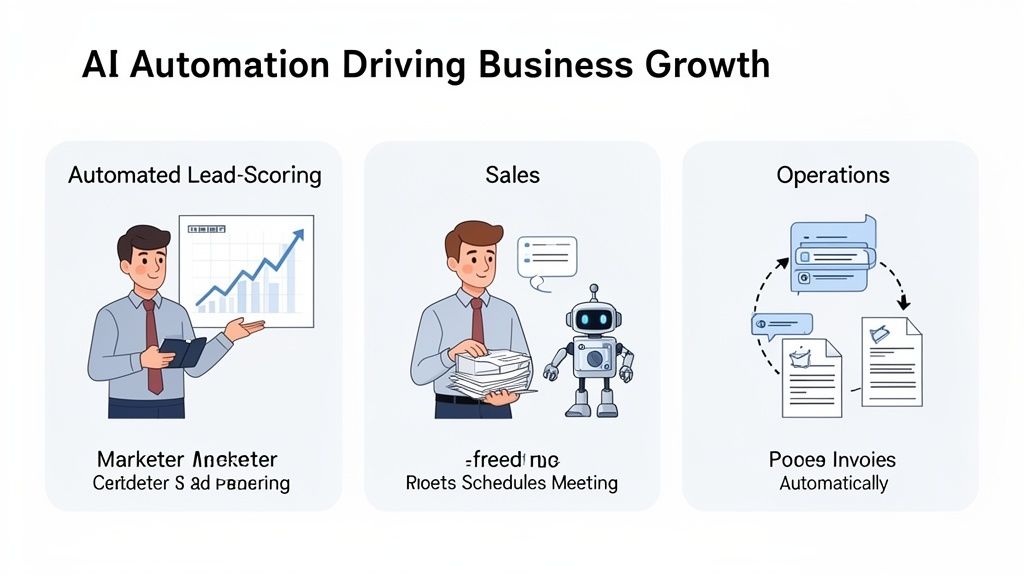
Let's break down how this actually works in different departments, turning abstract potential into real, measurable results.
Transforming Marketing with Intelligent Automation
Marketing teams are drowning in data. Between analyzing metrics, managing leads, and distributing content, there's little time left for big-picture thinking. AI automation steps in to handle the grind, so marketers can get back to creating brilliant campaigns.
A perfect example is automated lead scoring. Imagine an AI agent that constantly monitors every lead source you have—website forms, social media, webinars, you name it. It doesn't just collect names; it goes out and enriches that data, finding company size, industry, and job titles.
Then, using the ideal customer profile you've defined, it assigns a score and instantly alerts the sales team to the hottest prospects. This single workflow stops your reps from wasting time on dead ends and points them directly toward leads who are ready to talk. If you want to see how this works in practice, check out these real-world AI-driven multi-step form examples to boost leads.
Other game-changing marketing automations include:
Personalized Email Campaigns: AI can analyze customer behavior to send the right message at the right time, making your emails feel less like a blast and more like a conversation.
Social Media Management: Systems can schedule posts, flag important brand mentions, and pull together engagement reports automatically.
Supercharging Sales Team Efficiency
Your best salespeople should be selling, not getting bogged down in administrative quicksand. AI automation clears their plate of the tedious tasks that support the sales cycle, giving them more time to actually connect with customers.
Think about Sarah, a top sales rep who used to burn the first two hours of her day just updating the CRM with notes from yesterday's calls. Now, an AI workflow listens to her call recordings, transcribes them, and neatly logs the key takeaways and action items under the right contact. It's all done before she even has her morning coffee.
By automating routine administrative work like CRM updates and appointment scheduling, businesses can free up their sales teams to spend up to 50% more time on direct selling activities, directly impacting revenue.
That simple change gives Sarah back ten hours a week. That’s ten more hours she can spend building relationships and closing deals. The impact is direct and easy to measure.
Key automations for sales teams:
Automated Appointment Scheduling: An AI agent syncs with a prospect's calendar to book a meeting, killing the endless "what time works for you?" email chain.
Sales Proposal Generation: AI pulls customer data from your CRM and product info to instantly draft a personalized sales proposal.
Follow-Up Reminders: Workflows can intelligently track when a prospect has engaged with an email and prompt the sales rep to follow up.
Streamlining Operations for a Smoother Business
Operations is the engine room of a company, and it’s often where manual processes cause the most friction. From finance to HR, AI automation agency services can introduce solutions that make the entire business run more smoothly.
Take the headache of invoice processing. Many companies get hundreds of invoices a month, and someone has to manually enter, check, and approve every single one. An AI workflow can take over completely. It reads the invoice, pulls out the vendor name and amount, matches it to a purchase order, and sends it to the right person for approval—no human data entry required.
This not only gets vendors paid faster but also dramatically cuts down on costly human errors. The same logic applies everywhere else, like employee onboarding. AI can automatically create new user accounts, schedule orientation sessions, and distribute welcome packets. By knocking down these manual hurdles one by one, you build a company that's far more efficient, scalable, and resilient.
Measuring the ROI of AI Automation
Bringing in an AI automation agency is more than just a tech upgrade—it's a financial decision. The whole point is to see a real, tangible return that boosts your bottom line. But how do you actually put a number on the value of automating a tedious process or launching a new AI agent?
The key is to look past the buzz and focus on hard numbers. A good automation project should pay for itself, and then some, by cutting costs, driving new revenue, or making your team dramatically more productive. If you know how to track these key areas, you can build a rock-solid business case for any AI initiative.
The Three Pillars of AI Automation ROI
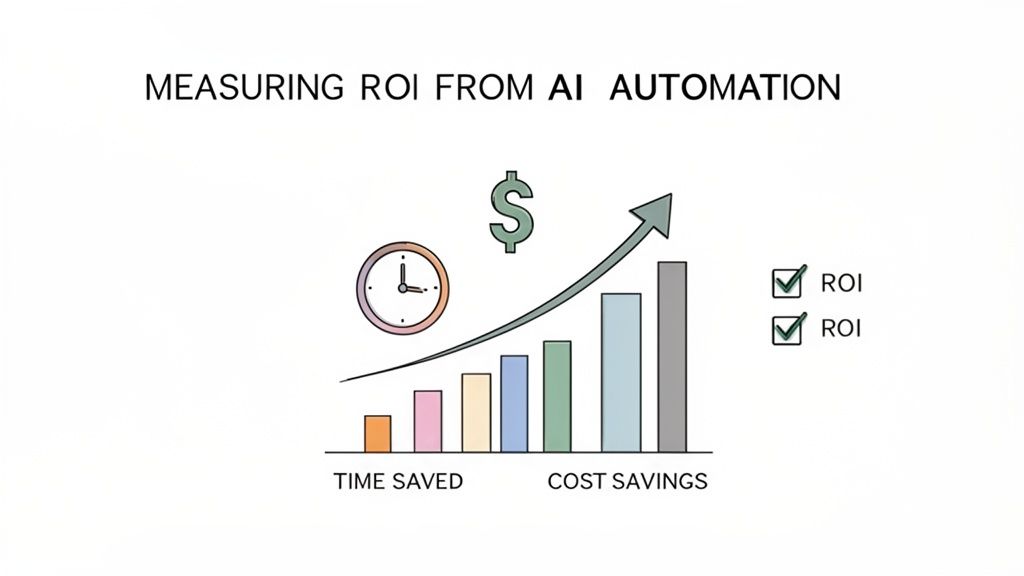
Figuring out the return on automation isn’t always a single, clean formula. It’s usually a mix of direct financial wins and operational improvements that add up over time. I like to think of it as a three-legged stool—each leg is a different source of value.
Direct Cost Savings: This one is the easiest to see. It’s all about the money you save by reducing or eliminating manual work. For instance, if you automate invoice processing that used to take an employee 20 hours per week, you’ve just freed up half a role for more important work. That's a direct labor cost saving.
Increased Revenue Growth: This is about how automation helps you make more money. An AI agent that qualifies leads 24/7 means you never miss a hot prospect, even at 3 AM. Automated follow-ups can bump up sales conversion rates. By tracking the lift in deals closed after an automation goes live, you can see a clear impact on revenue.
Enhanced Productivity Gains: This pillar measures the value of giving your team their time back. When smart, creative people are freed from monotonous tasks, they can finally focus on strategy, innovation, and solving the tough problems. This jump in output per employee is a huge, though sometimes less direct, part of the ROI.
A Simple Framework for Calculating Your Return
You don't need a PhD in finance to get a good sense of the potential ROI. You can start with a simple calculation to estimate the value of automating just one process.
(Value Gained - Cost of Automation) / Cost of Automation x 100 = ROI %
So, what goes into "Value Gained"?
Time Saved: Calculate the hours your team gets back each month and multiply that by their average hourly cost.
Error Reduction: Think about the cost of manual mistakes, like typos in data entry. Estimate how much automation will save you by getting it right every time.
Increased Output: Measure the lift in tasks completed—more leads processed, more customer tickets resolved, more reports generated.
A marketing team, for example, could measure the impact of an automated reporting workflow by seeing how much time it saves compared to their old copy-and-paste method. By learning about things like simple A/B testing for Framer, they can connect those data-driven optimizations directly to new revenue.
The Irresistible ROI of Agentic AI
The financial case for this stuff is becoming impossible to ignore. According to Gartner, agentic AI is on track to autonomously handle 80% of common customer service issues by 2029. That’s a massive amount of human time freed up for more complex, high-value conversations.
The adoption rates tell the same story. A PwC report found that 79% of organizations are already using AI agents in some capacity. The number of pilot projects nearly doubled in a single quarter, jumping from 37% to 65% as business leaders hunt for automation that delivers real results. For a deeper dive, Grandview Research has some great insights on these market trends.
This isn't just hype. It's a movement fueled by clear, measurable wins. By automating common issues, companies don't just cut support costs—they also make customers happier, which creates a powerful cycle of growth.
How to Choose the Right AI Automation Agency
Picking the right AI automation agency isn't like hiring a vendor—it's more like bringing on a strategic partner. Get it wrong, and you're looking at wasted time and money on projects that go nowhere. But get it right, and you’ll have an extension of your own team, laser-focused on moving the needle for your business.
The real goal here is to find a team that sees technology for what it is: a tool to get a job done. The best agencies are just as obsessed with your KPIs as you are. They don't just build what you ask for; they push back, challenge your assumptions, and help you find the biggest automation wins—the ones you might not even see yourself.
Evaluate Their Technical Chops and Industry Smarts
First things first, the agency needs to have serious technical skills. This is about more than just hooking up a few apps with a simple no-code tool. You want to see proof that they can build custom AI agents from scratch, map out complex workflows, and develop internal tools when off-the-shelf software just won't do the trick. A strong portfolio with a variety of projects is a great sign of their versatility.
But technical expertise is only half the battle. The agency needs to "get" your world. If they have experience in your industry or have solved similar operational headaches for other companies, they'll ramp up much faster and deliver solutions that actually work in practice.
Here’s what to look for:
Real-World Case Studies: Don't settle for vague descriptions. Ask for detailed examples of their work that solved problems like yours and, most importantly, delivered measurable results.
Agnostic Approach to Tools: Are they trying to push one specific piece of software on you? A good partner picks the best tool for the job, not the other way around. Their flexibility shows they put your needs first.
Built to Scale: Your business is going to grow, and your automation should grow with it. Ask them how their solutions handle more data, more users, and more complexity down the line.
Look for a Transparent and Collaborative Process
How an agency works is just as crucial as what they build. If they operate like a black box—taking your requirements and disappearing until the project is "done"—you're setting yourself up for disappointment. You need a partner who values open communication and works with you every step of the way.
A modern, agile team like Shalev Agency runs a tight, transparent process built for speed. That usually looks something like this:
A shared project board in a tool like Notion or Asana where you can see progress in real-time.
A direct line of communication via Slack for quick questions and updates.
Regular check-ins and async updates to keep things moving without bogging everyone down in meetings.
A transparent process builds trust. It ensures the final product is exactly what you need. If an agency seems cagey about showing you how they work or won't give you access to a project dashboard, that's a major red flag.
Ask the Tough Questions to Find the Real Value
Once you've got a shortlist, it's time to go deep. The questions you ask now will separate the true strategic thinkers from the order-takers.
Here are a few essential questions to get you started:
How do you define and measure success? The right answer should be all about your business goals—money saved, revenue generated, hours given back to your team—not just technical benchmarks.
Walk me through your typical project timeline. How do you kick things off? This gives you a feel for their efficiency and how quickly you can expect to see a return on your investment.
What’s your process for finding the highest-impact automation opportunities? A great agency won't just start building. They’ll have a discovery process designed to pinpoint the workflows that will deliver the most value, first.
What kind of support do you offer after the project is live? Automation is never "set it and forget it." Things change, and you need a partner who will be there to make sure everything keeps running smoothly.
Choosing the right partner is a big decision, especially as the market for AI automation agency services explodes. This isn't just a passing trend. Deloitte predicts that by 2027, 50% of enterprises using Generative AI will have deployed autonomous agents—a massive leap from just 25% in 2025.
Finding an agency now that can build the custom AI workflows and internal tools you need, like Shalev Agency, puts you way ahead of the curve. To get a better sense of what’s driving this shift, you can explore more about agentic AI adoption rates.
What to Expect When Working with an Agency
Stepping into a partnership with an AI automation agency might feel like a big leap, but a great partner makes the whole process straightforward, quick, and laser-focused on results. This isn't some mysterious, drawn-out affair; it's a structured collaboration designed to get you from a business headache to a working solution as efficiently as possible. It usually unfolds in a few clear, logical stages.
The journey always starts with a discovery call. Think of this less as a sales pitch and more as a deep-dive workshop. The agency's goal is to genuinely understand your operational pains, what you're trying to achieve, and the tools you're already using. They’ll ask smart questions to pinpoint the best opportunities for automation—that "low-hanging fruit" that can deliver a big impact, fast.
From Discovery to Design
After that initial conversation, things move into the design and strategy phase. This is where the agency starts mapping out a solution just for you. It's not a bunch of technical jargon, but a simple blueprint explaining what the AI agent or workflow will do, which systems it will talk to, and what success actually looks like. You'll get a clearly defined scope, a project timeline, and a list of what you can expect to receive.
This part of the process should feel like a true collaboration. A good agency will present their plan, ask for your feedback, and tweak the approach until it fits your team's needs perfectly. Transparency is everything. You should expect to see the entire plan laid out in a shared space, like a Notion board, so you’re always in the loop.
Development and Deployment
Once you give the green light, the building begins. The agency gets to work coding, testing, and refining your custom AI solution. The best ai automation agency services work in quick cycles, often sending regular updates in Slack and holding short check-in meetings to show you what they've built. You won’t be left in the dark for weeks; you'll actually see the solution come together piece by piece.
After it's been thoroughly tested, the solution goes live in your real-world environment. This is always a carefully managed handover to make sure it’s a smooth transition for your team. The agency will also provide the necessary training and documentation so everyone feels comfortable using the new tool right away. After launch, they’ll keep an eye on performance to make sure it’s all running as planned.
A successful agency engagement isn’t just about delivering a piece of technology. It’s about delivering a business outcome. The process should feel like a true partnership, with clear communication and a shared focus on achieving your goals.
Finally, you’ll talk about how the engagement is structured. Some projects are a fixed scope, where you pay one price for a specific outcome. Others might work better on a retainer, which gives you ongoing support, maintenance, and the flexibility to add new automations down the road. The right model really just depends on your immediate needs and long-term goals.
Common Questions About AI Automation Services
Thinking about bringing in an agency? It's smart to have a few questions about how it all works—things like timelines, security, and whether this is even the right fit for your company. Let’s tackle some of the most common ones so you can feel confident about what’s next.
This final section is all about getting those practical concerns out of the way and giving you the clarity you need.
How Long Does It Take to See Results?
This is the big one, right? The time it takes to see a return varies, but a huge advantage of working with a nimble agency is their focus on getting you quick wins. You shouldn't have to wait months for some massive, monolithic project to finish before you feel the impact.
For instance, a straightforward workflow automation—say, one that zips new leads from your website form straight into your CRM and pings the right salesperson—can be up and running in just a few weeks. That’s an immediate time-saver and a direct boost to your lead response speed.
More complex builds, like a custom internal tool that analyzes customer feedback, might take a couple of months. But a good partner will always front-load the work that delivers the highest ROI. This way, you’re not waiting until the end; you’re seeing tangible results and incremental gains early and often.
Is AI Automation Only for Large Companies?
Absolutely not. This is one of the biggest myths out there. While big corporations are definitely all-in on AI, it’s often the startups and growing businesses that see the most dramatic benefits. Automation gives smaller teams the power to operate with the efficiency and scale of their much larger competitors, but without the massive headcount.
AI automation isn't about the size of your company; it's about the size of your ambition. It levels the playing field, enabling smaller, agile businesses to compete and win.
These services are built to scale with you. You can start small with a single, high-impact workflow—like automating invoice processing—and expand your automation footprint as your business grows. The trick is finding an agency that offers flexible ways to work together that fit your current needs and budget.
How Is My Data Kept Secure?
Data security should be a top-of-mind, non-negotiable priority for any agency worth their salt. Your partner needs to be completely transparent about their security protocols and should be ready to sign a Non-Disclosure Agreement (NDA) to protect your sensitive information right from the start.
They should be using secure, encrypted API connections for every integration, making sure your data is locked down while it's in transit. When an agency builds custom tools, your data typically stays within your own systems, which means you keep complete control and ownership. Always ask a potential partner to walk you through their data protection practices before you sign anything.
Ready to see how AI automation can reshape your operations? At Shalev Agency, we specialize in building fast, measurable AI solutions that save time and drive growth for your team.