
Discover how ai automation agency builds custom AI agents and scalable workflows to save time and scale your business. Learn how to hire the right partner.
Jan 11, 2026
An AI automation agency is a specialized firm that helps businesses like yours build and manage custom AI solutions to take over repetitive tasks. Think of them as architects for a digital workforce—crafting intelligent systems to handle operations, qualify leads, and fuel growth without needing someone to watch over them all the time.
What Exactly Does an AI Automation Agency Do?
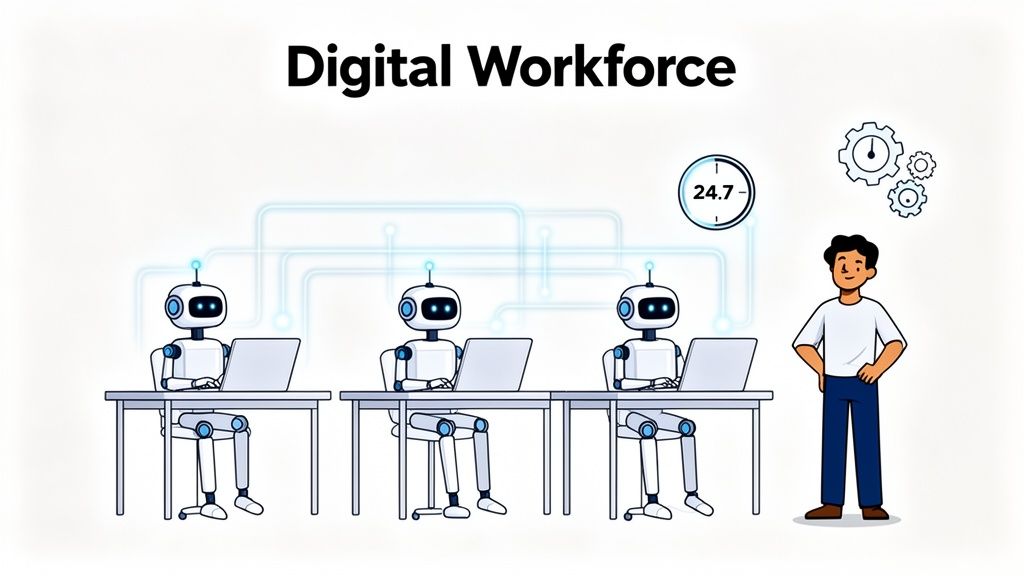
Imagine a team member who works 24/7, never gets tired, and lets your top talent focus on the things that actually matter—like big-picture strategy, creative problem-solving, and building customer relationships. That’s the real promise of an AI automation agency. They’re much more than just tech vendors; they’re strategic partners.
Rather than just selling you off-the-shelf software, these agencies get into the weeds of your business to find the specific bottlenecks holding you back. They map out your current processes to pinpoint exactly where smart automation will make the biggest difference. The whole idea is to build a self-running engine right inside your company.
A Digital Workforce Built Just for You
An AI automation agency doesn’t just plug in one tool and call it a day. They build a whole ecosystem of bots and systems that talk to each other. This “digital workforce” can look like a few different things:
Custom AI Agents: These are specialized programs built to act like a specific employee. For example, you could have an agent that works as a sales rep, qualifying every new lead, or one that acts as an analyst, constantly sifting through customer feedback for you.
Automated Workflows: This is all about connecting the software you already use—like your CRM, email, and project management tools—so they work together seamlessly without manual input.
Intelligent Internal Tools: Sometimes, you need a custom-built solution for a very specific problem. This could be a dashboard that gives you real-time sales insights or a tool that automatically generates reports.
The end result? Your business simply runs faster and smarter. Getting a handle on concepts like effective workflow automation is key to understanding what's possible here. An agency just takes those principles and applies them directly to your biggest headaches.
It’s About More Than Just Saving Time
Sure, getting time back is a huge win, but the real magic is in what it lets your team do. It’s about creating systems that can handle all the predictable, grunt work so your people can focus on the complex, high-value challenges that only humans can solve.
The goal isn't just to automate a few tasks. It's to build a stronger, more productive, and more competitive company from the inside out. When you hand over the manual stuff to a digital workforce, you unlock your team's real potential for innovation.
This shift turns your operations from a simple cost center into a real strategic advantage. For example, an AI agent can score and route thousands of leads in an instant, making sure your sales team only talks to the hottest prospects. That’s a direct line to better conversion rates and more revenue.
At the end of the day, working with an AI automation agency is about giving your business a serious competitive edge.
The Core Services of a Modern AI Automation Agency
So, what does an AI automation agency actually build for you? It's a lot more than just installing some new software. Think of them as efficiency architects. They design and construct custom solutions that weave directly into the fabric of how your company operates.
Generally, their work falls into three main buckets. Each one is designed to tackle a different kind of business problem, whether it's automating a specific role, connecting your entire tech stack, or building a tool from scratch. Understanding these services helps founders and product teams see exactly where the value comes from.
Building Custom AI Agents
Imagine hiring a new digital employee, one that’s been trained to do a very specific, repetitive job inside your company. That's a custom AI agent. These aren't just generic chatbots. They’re smart, autonomous systems built to handle complex tasks, make decisions based on live data, and interact with the software you already use.
Here’s a practical example. An agency could build a "Sales Development Agent" that:
Watches your inbox for new leads, 24/7.
Instantly researches the person's company and role.
Scores the lead against your ideal customer profile.
Drafts and sends a personalized, context-aware first email.
Logs everything in your CRM automatically.
This isn’t a simple script; it's a system that takes over an entire function. It frees up your human sales team to stop prospecting and start focusing on what they do best: closing deals. A big part of what agencies do now involves building custom AI agents designed for exactly this kind of specialized work.
And the demand for these solutions is exploding. The AI agents market, valued at USD 7.84 billion in 2025, is projected to hit an incredible USD 52.62 billion by 2030. That’s a massive 46.3% compound annual growth rate. This boom is all about businesses wanting autonomous copilots to handle everything from writing code to customer service. You can read more about the growth of the AI agent market from MarketsandMarkets.
Designing Automated Workflows
While AI agents are like specialized employees, automated workflows are the nervous system connecting all the tools your business relies on. An AI automation agency is an expert at getting your separate apps—like Slack, your CRM, project management tools, and email—to talk to each other and work in perfect harmony.
Think about your customer support process. A new ticket comes in. Instead of a person juggling three different apps, a well-designed workflow can kick in and automatically:
Read the ticket to figure out what it’s about and how urgent it is (e.g., "billing issue" vs. "critical bug").
If it's a bug, it creates a task right on your engineering team's project board.
If it's urgent, it pings the on-call support lead in the right Slack channel.
It then sends a quick, personalized reply to the customer letting them know you're on it.
This kind of interconnected system makes sure nothing ever falls through the cracks. It gets rid of all the manual copy-pasting between platforms, which doesn't just save a ton of time—it also slashes the risk of human error.
Creating Intelligent Internal Tools
Sometimes, the software you need just doesn't exist on the market. That's where the third core service comes in: building intelligent internal tools. These are custom-made pieces of software designed to solve a unique bottleneck in your operations. They aren't products you can buy; they’re private assets that give you a real competitive edge.
A perfect example is a custom revenue dashboard for a startup’s leadership team. An AI automation agency can build a tool that pulls real-time data from your payment processor (like Stripe), your CRM (like HubSpot), and your marketing analytics into a single, unified view.
But it doesn't stop there. The tool can then use AI to:
Pinpoint which marketing channels are bringing in the most profitable customers.
Forecast your future revenue based on current sales trends and churn rates.
Flag at-risk accounts that are showing early signs of leaving.
A tool like this shifts a team from being reactive to proactive. It gives them real-time, actionable insights to make smarter strategic decisions.
To help you see how these services fit together, here’s a quick overview.
AI Automation Agency Services at a Glance
Service | Primary Purpose | Example Use Case | Key Business Value |
|---|---|---|---|
Custom AI Agents | Automate a specific role or function. | A "Customer Onboarding Agent" that guides new users through setup. | Frees up team members from repetitive tasks for higher-value work. |
Automated Workflows | Connect disparate software systems to work together seamlessly. | A workflow that syncs new leads from a web form to a CRM and Slack. | Eliminates manual data entry, reduces errors, and speeds up processes. |
Intelligent Internal Tools | Build a bespoke solution for a unique operational challenge. | An AI-powered dashboard that predicts customer churn. | Provides a unique competitive advantage with data-driven insights. |
By focusing on these three pillars—agents, workflows, and tools—a good agency can deliver a complete operational upgrade. You can dive deeper into the full scope of AI automation agency services to see what's possible.
Why Your Business Needs an AI Automation Partner
Okay, so we've covered the "what." Now for the more important question: why should you actually partner with an AI automation agency? The simple answer is that they turn your biggest operational headaches into your greatest competitive advantages. In a world where speed is everything, manual processes aren't just slow—they're a dead weight holding your business back.
Bringing in an expert partner isn't about just handing off a few tasks. It's a strategic move to build a more resilient, scalable, and profitable company from the ground up. Think of an agency as a force multiplier for your team, giving them the systems they need to do their best work.
The diagram below breaks down the core services an AI automation agency uses to get these kinds of results.
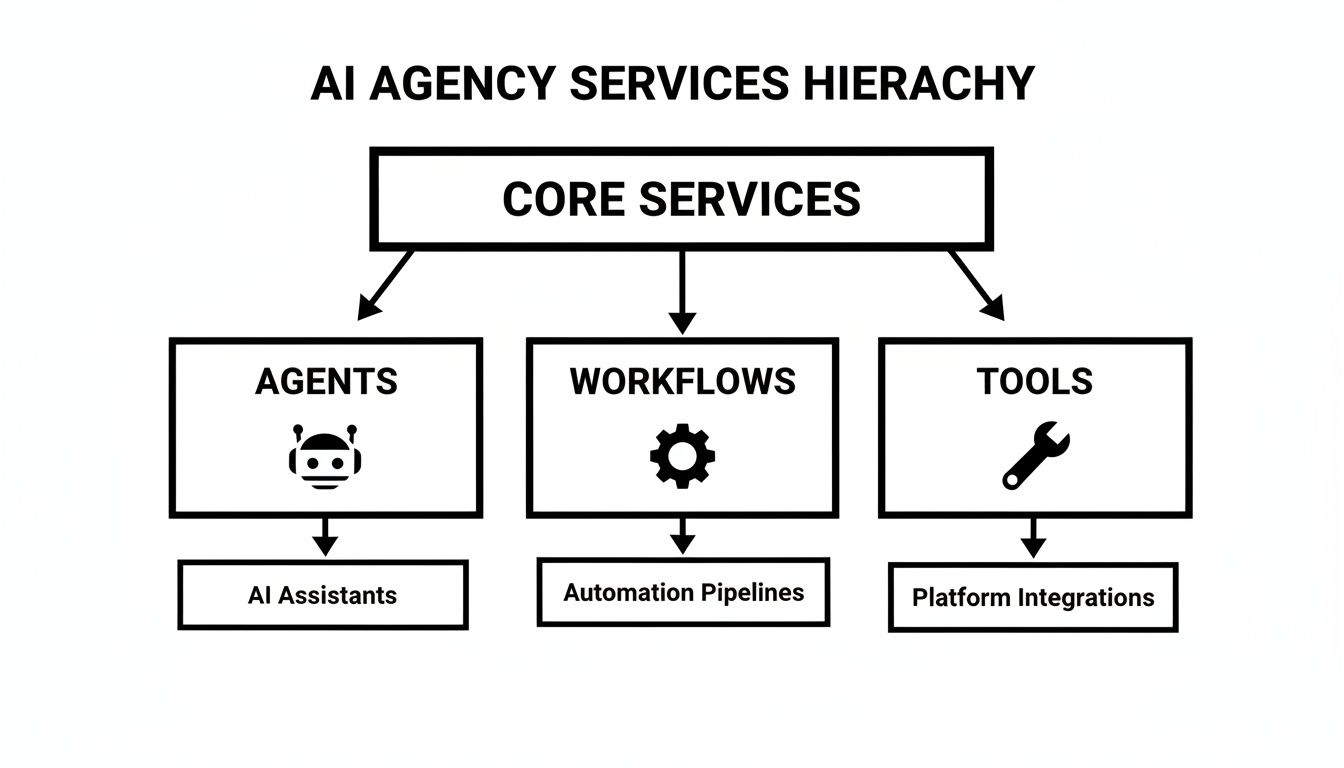
As you can see, it’s about how autonomous agents, integrated workflows, and custom tools all click together to build a powerful automation strategy.
Unlock Radical Efficiency
Every business has them—those repetitive, soul-crushing tasks that eat up hundreds, even thousands, of hours. Manually updating your CRM, processing invoices, or sifting through endless customer feedback forms are perfect examples. An AI automation agency finds these black holes of productivity and builds systems to make them disappear.
This frees up your team to focus on what humans do best: strategy, creative problem-solving, and building real customer relationships. The impact is huge. Studies show that AI implementation can boost productivity by up to 40%. For founders and product leaders, this is exactly why finding a trusted, NDA-secured partner is a top priority. You can learn more about these productivity findings and AI market trends.
Scale Operations Without Scaling Headcount
Growth is great, but it has a nasty habit of breaking your processes. As you bring in more customers and more data, the manual systems that worked for a small team start to fall apart. The old-school solution? Hire more people. But that just drives up your costs and adds complexity.
An AI automation agency gives you a much smarter way to grow. They design systems and workflows that can handle 10x, 100x, or even 1000x the volume without needing an army of people to manage it.
Automated Onboarding: Guide new users through setup seamlessly, no hand-holding required.
Lead Management: Instantly qualify and route thousands of leads to the right person on your sales team.
Customer Support: Use AI to handle the common questions instantly, letting your support agents tackle the tough problems.
This is how you grow revenue without your expenses growing right along with it. It’s the key to building a much healthier, more sustainable business model.
Achieve Flawless Data Accuracy
Let's face it, people make mistakes. While human error is natural, it can be incredibly costly in areas like finance or data analysis. Manual data entry is the biggest offender, leading to wonky reports, bad insights, and ultimately, poor decisions.
Automation takes human error out of the picture. By building direct connections between your tools, an agency ensures data moves from one system to another with perfect accuracy, every single time.
When your data is flawless, you can trust your dashboards, forecasts, and reports completely. This confidence allows you to make faster, smarter strategic decisions that steer the company in the right direction.
Accelerate Your Go-To-Market Speed
In a crowded market, being first often means being the winner. AI automation can give you that critical edge in speed. Picture a SaaS company getting ready to launch a new feature. Instead of spending weeks manually finding and qualifying beta testers, they deploy an automated system.
An AI agent could identify the perfect users, send them personalized invites, and then analyze all their feedback in real-time to spot bugs and popular feature requests. This doesn't just shave days off the development cycle—it shortens it dramatically. The sales team gets a fresh, automated stream of qualified leads, and the product team gets the insights they need in a fraction of the time. This is how automation becomes a real competitive weapon.
AI Automation Use Cases in the Real World
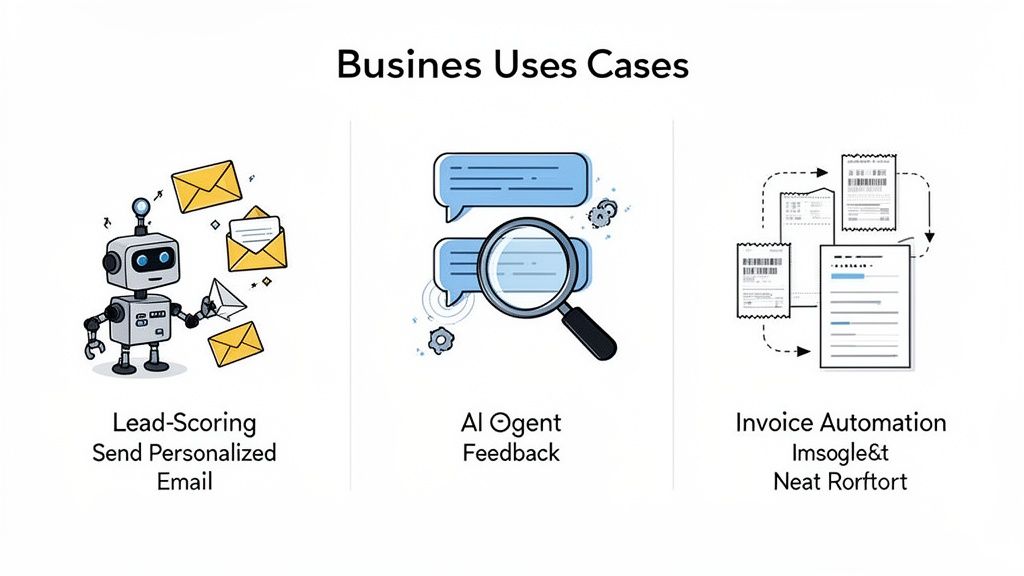
It’s one thing to talk about the theory, but seeing automation solve real problems is where the lightbulb really goes on. The true value of an AI automation agency comes from building practical solutions that fix the specific, nagging issues businesses face every day. Whether in marketing or operations, these systems quickly become an essential part of the team.
To show you what I mean, let’s walk through three quick examples. Each one paints a clear picture of a common business headache and how a custom AI solution provided the cure.
Use Case 1: Fixing a Leaky Sales Funnel for a Marketing Team
The Problem: A B2B SaaS company was getting a decent flow of new leads, but their small sales team was completely swamped. They were burning hours manually digging through sign-ups to guess who was a good prospect. By the time they reached out, many of the hottest leads had already gone cold.
The Solution: We helped them build an intelligent lead scoring and outreach system. The new workflow connected their website forms, CRM, and email marketing platform, letting them all talk to each other automatically.
Instant Enrichment: The moment a new lead comes in, the system instantly pulls in key data like company size, industry, and the person's job title.
AI-Powered Scoring: A custom AI model then scores the lead from 1 to 100 based on how closely they match the company's ideal customer profile.
Smart Routing: Leads scoring over 80 are instantly routed to a sales rep’s CRM dashboard and flagged in a dedicated Slack channel. No more waiting.
Personalized Nurturing: Anyone with a lower score is automatically added to a tailored email sequence designed to warm them up until they show stronger buying signals.
The Result: The sales team went from taking hours to respond to top-tier leads to under five minutes. This speed led directly to a 30% jump in sales meetings booked in the first quarter alone. Best of all, the team could stop wasting their energy on tire-kickers and focus 100% on closing deals.
Use Case 2: Taming User Feedback for a Product Team
The Problem: A mobile app company was growing fast, but they were drowning in user feedback. Great ideas and critical bug reports were scattered across Intercom, App Store reviews, support tickets, and social media. The product team was spending days every month just trying to piece it all together, making it nearly impossible to spot urgent issues or popular feature requests in time.
The Solution: We built them a custom AI agent that acts as a dedicated "User Feedback Analyst." This agent was plugged into all their feedback channels and got to work.
It used natural language processing (NLP) to read and understand every single piece of feedback as it came in.
It automatically tagged each comment by theme, like "UI Bug," "Feature Request," or "Billing Issue."
It even analyzed the sentiment—positive, negative, or neutral—to help the team gauge user frustration or happiness.
The Result: The product team got a real-time dashboard that summarized everything. They could see trending issues at a glance, know which feature requests were most popular, and catch critical bugs before they snowballed. This meant they could build their roadmap with actual data, not just guesswork. The app became more user-focused, and they saw a 15% increase in user retention.
This is a perfect example of augmenting a team. The AI agent handled the tedious data collection, freeing the product managers to focus on the high-level strategy of what to build next.
Use Case 3: Eliminating Invoice Headaches for an Operations Team
The Problem: A consulting firm was getting buried under a mountain of invoices. Their finance team was manually downloading PDFs from emails, typing the data into their accounting software, and then chasing down managers for approvals. The whole process was slow, riddled with typos, and ate up nearly 20 hours of administrative work every single week.
The Solution: An AI automation agency set up an intelligent document processing workflow that took over the entire task.
First, a dedicated inbox was created to catch all incoming vendor invoices.
An AI model then read each PDF, accurately pulling out key details like the invoice number, due date, and line-item costs.
That data was then used to automatically create a draft bill in their accounting software.
Finally, the system pinged the right manager on Slack with the invoice attached, asking for a quick approval.
The Result: The time it took to process an invoice went from days to minutes. Manual data entry was gone, leading to 100% accuracy and freeing up the finance team for more strategic work. The company saved over 80 hours a month, a clear and immediate return on their investment. For smaller companies, these kinds of operational wins are huge. You can read more about this in our guide on AI automation for small business.
How to Choose the Right AI Automation Agency
Picking the right AI automation agency is one of the most important calls you’ll make for the future of your business operations. The market is packed with firms that all claim to be AI experts, but their methods and quality can be all over the map. The goal isn't just to hire a vendor who sells a generic product; it's to find a true partner who will get in the trenches with you.
A great agency won't start by pitching their pre-built software. They'll start by asking you a ton of questions—deep, insightful questions about your business. They want to understand your real bottlenecks, your team’s biggest headaches, and the exact outcomes you’re trying to drive. That consultative approach is the number one sign of a partner who builds custom solutions, not just sells a service.
The AI space is exploding, but that rapid growth comes with a catch. While the market for AI agents is projected to rocket up by 45.8% annually through 2030, there's a sobering flip side: some analysts predict that 95% of AI agencies could fail by 2026. Why? Because they're chasing generic, one-size-fits-all models that don't deliver real value.
The agencies that will stick around are the ones focused on deep integration and tangible business results—combining solid user experience research with polished AI agents to actually move the needle on things like lead qualification. This makes your choice of partner absolutely critical. You can explore detailed AI agent statistics on Boterview.com to get a better sense of the market.
Your Agency Evaluation Checklist
Finding the right agency means you need a structured way to evaluate them. You have to look past the slick marketing and get to the heart of how they work, what they've actually built, and how they define success. A top-tier ai automation agency will be an open book, ready to show you the proof.
A solid evaluation process helps you cut through the noise and identify a partner who can truly deliver. This checklist covers the essentials, from their portfolio to their project management style, ensuring you cover all your bases before signing a contract.
Agency Evaluation Checklist
A checklist to help businesses assess and compare different AI automation agencies based on key criteria for a successful partnership.
Evaluation Criteria | What to Look For | Red Flags to Avoid |
|---|---|---|
Portfolio & Case Studies | Custom-built solutions for diverse problems. Clear evidence of solving specific business challenges, not just deploying generic chatbots. | A portfolio where every project looks the same. Vague case studies that lack specific metrics or client testimonials. |
Focus on Business ROI | Conversations are centered on your goals (e.g., revenue growth, cost reduction). They have a clear framework for measuring success. | They only talk about the technology they use (e.g., "We use GPT-4"). They can't explain how their work will impact your bottom line. |
Process & Collaboration | A transparent process using shared tools like Notion or Slack. Regular, scheduled updates and a collaborative, team-like feel. | A "black box" process where you have no visibility. Poor communication or a rigid, inflexible project management style. |
Technical Expertise | Deep knowledge of APIs and a proven ability to integrate with your existing tech stack (CRM, ERP, etc.). | Hesitation or vague answers when asked about complex integrations. A history of working with only one or two platforms. |
Handover & Support | A clear plan for training your team. They provide comprehensive documentation and offer ongoing support options. | They have no plan for handover, creating long-term dependency. The training process seems like an afterthought. |
Ultimately, a thorough checklist-driven approach ensures you’re not just hiring a vendor, but onboarding a strategic partner invested in your long-term success.
A truly valuable agency acts as a strategic guide. They won't just build what you ask for; they'll challenge your assumptions and suggest better ways to solve your problems, ensuring the final solution delivers the maximum possible impact.
Critical Questions to Ask Potential Agencies
Once you have a shortlist, it's time to dig in with some tough questions. Their answers will tell you everything you need to know about their expertise, their process, and whether they’re truly committed to your success. Don't settle for fluffy, high-level responses.
1. How do you measure the ROI of your automations?
A good agency will have a rock-solid answer for this. They should talk about establishing baseline metrics before they even start—things like "time spent on task X" or "lead response time"—and then show you how they'll track those same metrics after the solution goes live. The answer should be all about business impact, not just technical fluff.
2. Can you walk me through your process for integrating with our existing tech stack?
This question is a great test of both their technical chops and their strategic thinking. They should immediately ask what tools you use—your CRM, project management software, marketing platforms—and then explain exactly how they ensure everything connects securely and seamlessly. A vague answer here is a huge red flag that they might not have the experience to handle a complex setup.
3. What does the handover and training process look like?
You need to know how they’ll get your team up to speed. A great partner will provide crystal-clear documentation, run hands-on training sessions, and have a clear plan for ongoing support. The goal is for you to own the solution, not be stuck relying on them for every little thing.
Understanding Common Pricing Models
Finally, you need to get a handle on how an ai automation agency prices its work. This helps you match the investment to your budget and the scope of the project.
Project-Based Pricing: This is a fixed fee for a well-defined project, like building a specific internal tool or automating a single workflow. It's a great fit when you have a specific, one-off need with a clear beginning and end.
Retainer Model: This is a recurring monthly fee that gets you a set number of hours or ongoing support and optimization. This model works best for businesses that need continuous improvement, plan to automate multiple processes over time, or want a partner on call for maintenance.
Choosing the right partner is all about finding an agency whose process, expertise, and values line up with yours. It’s an investment that, when you get it right, will pay for itself many times over in efficiency, growth, and a happier team.
So, What’s Your First Move?
Getting started with automation can feel like a huge undertaking, but it really boils down to taking one small, practical step. We've walked through how a dedicated AI automation agency can act as your technical co-pilot, building a digital workforce that lets your team focus on what matters. The real goal isn't just offloading tasks; it's about making your entire operation smarter, stronger, and more competitive.
This isn't about some massive, disruptive project that turns your company upside down. Real progress starts by picking one bottleneck—that single, repetitive process that just drains your team's time and kills momentum.
Find That First domino
Look at your team's day-to-day work. Where do things always seem to slow down or get stuck? Finding that one point of friction is the perfect place to start.
It might be something as simple as:
Manually sifting through new website leads to figure out who's actually a good fit.
Endlessly copying and pasting information from your CRM into your project management software.
Reading through hundreds of customer support tickets just to spot recurring issues.
Each of these is a prime candidate for your first automation win. By solving just one of these, you'll see a real, tangible return right away. That initial success is what builds the confidence to do more.
Your first automation project doesn't need to reinvent the company. It just needs to fix one real, nagging problem. The ROI and morale boost from that single win paves the way for everything else.
You now have a solid framework for finding a good partner and asking the right questions. The next move is yours.
Look for an agency that can help you pinpoint that first, high-impact opportunity and build something that delivers value from day one. A great AI automation agency doesn't just hand you a tool; they help you lay the first stone in a foundation for more intelligent, efficient growth. It all starts with that one step.
Frequently Asked Questions
Even when the benefits seem clear, it's natural to have some practical questions before bringing in an AI automation agency. Let's tackle some of the most common ones we hear from business leaders. Getting these answers sorted is usually the final step before feeling confident enough to kick off a project.
How Long Does It Take to Build a Custom AI Automation?
The timeline really depends on what we're building. If you're looking for a straightforward workflow—say, connecting two or three of your existing apps—we can often get that designed, built, and running in just two to four weeks. A perfect example is an automation that instantly grabs new leads from your website and funnels them into the right salesperson's pipeline in your CRM.
For bigger, more ambitious projects, you'll need to plan for a bit more time. Building a custom AI agent from scratch to analyze customer feedback or creating a sophisticated internal tool with a unique dashboard is a heavier lift. These projects involve deeper integrations and a lot more testing, so you're typically looking at a timeline of six to twelve weeks, sometimes more. Any good agency will lay this out for you with a clear roadmap and milestones.
Is Hiring an AI Automation Agency a Major Expense?
It's better to think of it as an investment, not just another line-item expense. The final cost comes down to the scope of the project. A simple workflow automation can start in the low thousands, making it a very accessible starting point for smaller teams.
Larger projects, like a custom AI agent or a company-wide internal tool, can range from $10,000 to over $100,000. The key is to get a detailed proposal so you know exactly what you're paying for.
The real question isn't "How much does it cost?" but "What's the return?" An automation that saves your team 20 hours a week or boosts qualified leads by 30% can easily pay for itself in a few short months.
Will AI Automation Replace Our Current Employees?
This is probably the biggest myth out there. A good AI automation agency isn't here to replace your people—we're here to supercharge them. Automation is fantastic at handling the repetitive, mind-numbing tasks that bog people down and lead to burnout.
Think about all the time spent on manual data entry, sorting leads, or answering the same first-level support questions over and over. By handing those jobs to AI, you free up your team to focus on what humans are best at: strategy, creative problem-solving, and building genuine customer relationships. It's like giving everyone on your team a tireless assistant.
What Kind of Ongoing Maintenance Do AI Agents Require?
Most automations are pretty low-maintenance, but they aren't completely "set it and forget it." The most common issue is when one of the software tools in your stack pushes an update—your CRM, for example, or an API you rely on. A smart agency anticipates this and builds your automations to be resilient and easy to tweak. Many offer ongoing support plans to monitor performance, handle any necessary updates, and make sure everything keeps running without a hitch.
Ready to build a more efficient, scalable business? The team at Shalev Agency specializes in creating custom AI agents, automated workflows, and intelligent internal tools that save time and drive real results. Start your project today.