Discover how an AI agent can automate complex tasks and drive business growth. Our guide explains everything you need to know to get started.
Jan 11, 2026
Imagine having a digital team member that doesn't just follow a script but actually thinks, plans, and takes action to get things done. That’s the core idea behind an AI agent. It’s a huge leap from basic automation, moving us away from simple command-followers and toward autonomous problem-solvers.
What Is an AI Agent and Why It Matters Now
To really get what an AI agent is, think about the difference between a simple chatbot and a sharp project manager. A chatbot is reactive. It waits for a specific prompt, like "What are your hours?" and spits out a pre-programmed answer. It's useful, sure, but it’s stuck on a very narrow script.
An AI agent is totally different. It’s proactive and goal-oriented. It can size up its digital environment, make its own decisions, and carry out a whole sequence of actions to hit a complex target. It doesn't just answer questions; it drives results.
An AI agent is less like a calculator that solves one specific problem and more like an accountant who manages your entire financial strategy. It gets the bigger picture and acts on it.
From Simple Scripts to Dynamic Strategy
This jump from reactive tools to proactive partners is precisely why AI agents are such a big deal for businesses right now. Instead of just automating a single, repetitive task, teams can now automate entire complex workflows.
The market is already betting big on this potential. The U.S. AI agents market is expected to explode from USD 2,229.3 billion in 2025 to an incredible USD 46,331.4 billion by 2033, growing at a blistering 46.9% CAGR.
To see how this plays out in the real world, just look at how an agent compares to traditional automation.
AI Agent vs. Traditional Automation at a Glance
This table breaks down the core differences, showing why AI agents are a fundamental step up from the tools most of us are used to.
Capability | Traditional Automation (e.g., Zapier) | AI Agent |
|---|---|---|
Decision-Making | Follows pre-set "if-then" rules. | Makes independent, context-aware decisions. |
Task Execution | Executes a single, linear task. | Manages complex, multi-step workflows. |
Adaptability | Fails or stops if something unexpected happens. | Adapts to new information and unexpected events. |
Goal Orientation | Completes a defined action. | Works autonomously toward a broader objective. |
Example | "If new email in Gmail, add row to Google Sheets." | "Find the best flight from LAX to JFK next Tuesday, book it, and add it to my calendar." |
The difference is clear: one follows instructions, the other achieves goals.
A chatbot can answer a customer’s question.
An AI agent can handle the entire lead qualification process on its own—from the first touchpoint and gathering data to actually scheduling a call with a sales rep.
This ability to manage dynamic processes is a game-changer. As we explore what an AI agent is, it’s also important to understand the distinction between AI assistants and search engines to see where they fit in. Agents are a major evolution from the simple scripts we've relied on for years, a topic we cover in our guide on what is workflow automation. This technology is what will move your business from just getting tasks done to truly achieving strategic goals.
How an AI Agent Actually Works
Let’s peel back the layers and get past the jargon. The easiest way to think about an AI agent is to imagine a self-driving car, but for your digital tasks. Just like a car has to see the road, understand traffic, and physically turn the wheel, an agent needs to perceive its digital world, make a decision, and then take action.
This whole process boils down to three core parts working together in a constant loop.
It all starts with perception. A self-driving car uses cameras and lidar to “see” its surroundings. An AI agent has its own set of digital inputs, which we can call its Sensors. These aren't physical gadgets, but they serve the same purpose: to observe the environment.
The Core Components of an AI Agent
An agent’s ability to operate on its own comes from the interplay of its fundamental parts. Each one has a specific job in what’s often called the perception-decision-action cycle.
Sensors (Perception): This is how the agent takes in information. Think of it as the agent's eyes and ears. It could be watching a specific email inbox for new customer questions, scanning social media for mentions of your brand, or even keeping an eye on a competitor's pricing page. These sensors feed the agent the raw data it needs to know what's going on.
Brain (Decision-Making): At the center of it all is the "brain," which is usually a large language model (LLM) like the GPT models Anthopic's or the Gemini models . This is the thinking part. It takes the data from the sensors, figures out the context, and decides what to do next to move closer to its goal. This is where strategy happens.
Actuators (Action): Once the brain makes a call, the actuators get to work. These are the agent's hands. They’re the tools it uses to interact with the world, like sending a personalized follow-up email, updating a customer's record in your CRM, or posting a reply on social media.
This flowchart shows how we got from simple chatbots, which mostly just react, to a proactive AI agent that actually thinks and acts on its own.
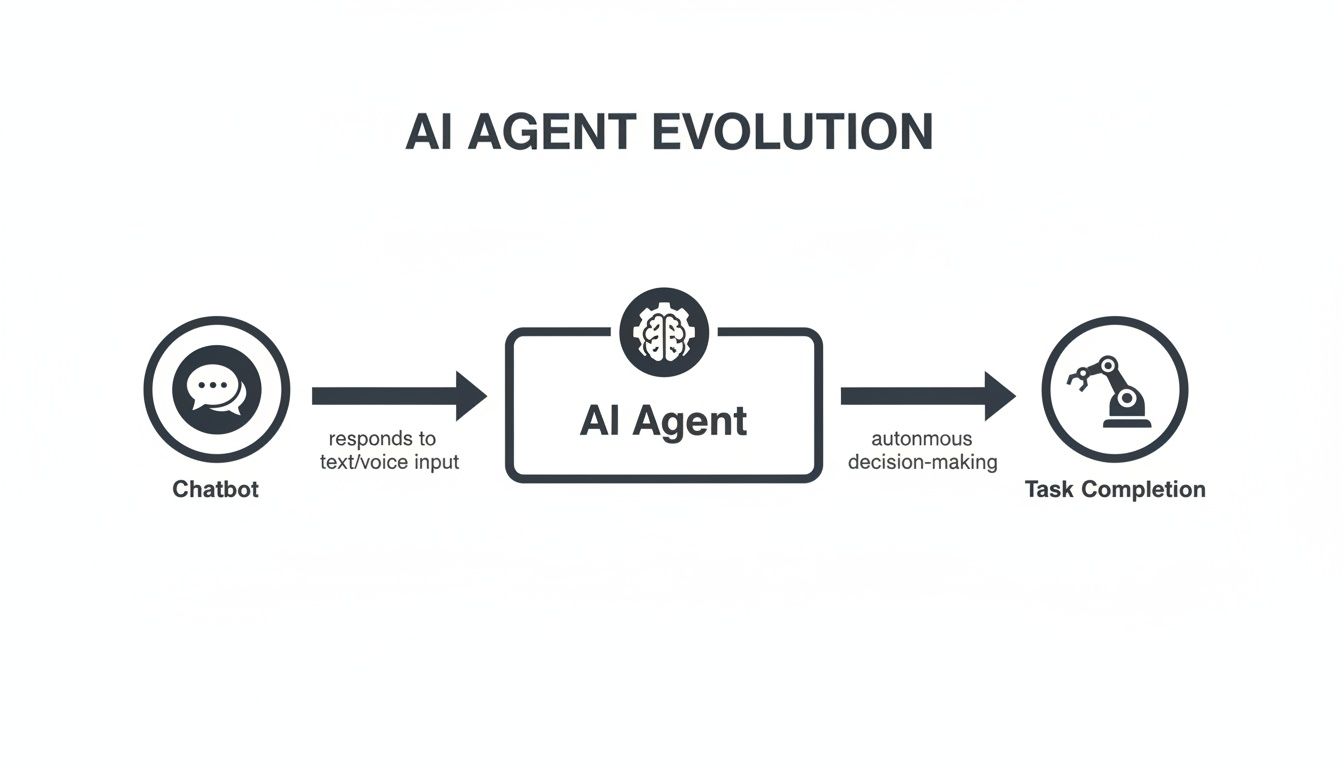
You can see the clear shift from basic input-and-response to a much smarter system that can handle tasks from start to finish.
Putting It All Together in a Loop
These three parts don’t just fire off once and call it a day. They run in a continuous cycle, which is what makes an AI agent so powerful. We call this the agentic loop.
The agent perceives its environment (Sensors), thinks about what to do (Brain), and then acts (Actuators). After it acts, it observes the results, and the whole cycle starts over again.
Imagine a sales agent tasked with outreach. First, its sensors might read a new lead’s LinkedIn profile. Its brain then analyzes that info to write a personalized connection request. Finally, its actuator sends the message through LinkedIn. The agent then waits and watches for a response, kicking off the loop again to decide on the next best move. It keeps learning and adapting until the job is done.
Practical AI Agent Use Cases for Modern Teams
The theory behind AI agents is interesting, but their real value pops when you see them solving actual business problems. Instead of talking in circles about abstract ideas, let's look at how real teams are using these autonomous systems to get more done, cut costs, and actually grow their business.
These aren't just fancy chatbots. We're talking about handing off entire workflows to a digital teammate, freeing up your people to focus on the strategic work that humans do best.
Supercharge Your Sales Pipeline
Sales teams are notorious for getting bogged down in repetitive but necessary tasks. An AI agent can step in and run the entire top-of-funnel process, acting like a sales development rep who never sleeps or needs a coffee break.
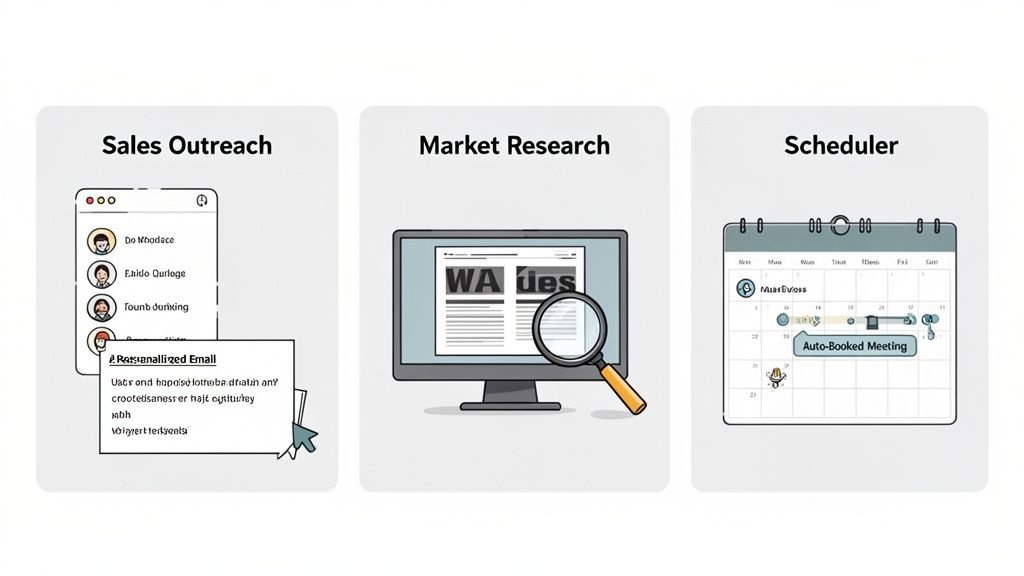
Picture a Sales Outreach Agent with one simple goal: book qualified meetings. Here’s how it gets it done:
Researches Prospects: It can scan LinkedIn profiles, company websites, and recent news articles to find personalized details about leads, going way beyond just a name and title.
Drafts and Sends Emails: Using what it learned, the agent writes genuinely personalized outreach emails that don't sound like they came from a template.
Manages Follow-Ups: It sends smart, timely follow-ups based on whether a prospect opened an email, clicked a link, or replied. No more spammy "just checking in" messages.
Schedules Meetings: The agent can even handle the back-and-forth of scheduling, syncing with the prospect’s and your sales rep's calendars to book a time automatically.
The result? Your sales team walks in to find their calendars already populated with promising meetings, all without lifting a finger on the cold outreach.
Dominate Your Market with Continuous Intelligence
In any competitive market, if you’re not paying attention, you’re falling behind. A Market Research Agent acts as your team’s dedicated intelligence analyst, working around the clock to make sure you never miss a beat.
This type of AI agent doesn't just fetch data; it synthesizes it into actionable intelligence. It connects the dots so your team doesn't have to.
You can give this agent a clear goal: deliver a daily competitive intelligence briefing. To pull this off, it constantly scans the digital world for you.
Key Functions:
Watches competitor websites for price drops or new product launches.
Keeps an eye on industry news and blogs to spot emerging trends.
Scans social media and forums to gauge shifts in what customers are saying.
Wraps everything up into a crisp, easy-to-read summary delivered right to your Slack or email every morning.
This alone can save product and marketing teams dozens of hours each week, ensuring no critical market shift ever catches you by surprise.
We're seeing a huge uptick in this kind of specialized agent. A PwC survey found that 35% of organizations already report widespread AI adoption. Looking ahead, Gartner predicts that by the end of 2026, a staggering 40% of enterprise applications will include a task-specific AI agent. That's a massive jump from less than 5% in 2025, and it signals a fundamental shift in how work gets done. You can read more about these top AI agent trends on USAII.org.
Key Considerations Before Building Your First AI Agent
It’s easy to get excited and dive headfirst into building an AI agent. But a bit of strategic thinking upfront can be the difference between a home run and a costly experiment that goes nowhere. A solid game plan is everything.
The most common mistake we see? Trying to boil the ocean. Instead of building an agent to "handle all customer service," start small. Really small. Think about a single, painful task. For example, create an agent that only answers questions about order status.
This laser-focus gets you a quick win, shows tangible value to your team, and builds the momentum you need for bigger projects down the road.
Once you have that crystal-clear goal, you can start mapping out what your agent actually needs to function.
Your Pre-Build Checklist
Before you write a line of code or even look at a platform, grab your team and hash out these questions. Seriously, don't skip this part.
What's the real problem? Get specific. Are you trying to cut down on manual data entry? Speed up how you qualify new leads? The more precise you are, the better.
Where does the data live? Your agent is only as good as the information it can access. List out every source it will need—your CRM, a product database, internal docs, even public websites.
How will it plug into our workflow? Figure out which tools the agent needs to talk to. Will it send notifications to a Slack channel? Update a lead's status in Hubspot? This is crucial. For a deeper look, check out our guide on how to integrate an AI agent with your CRM system.
Answering these questions first keeps your project grounded and stops that dreaded "scope creep" from derailing your efforts.
Platform vs. Custom Build
Alright, now for the big decision: do you use a pre-built AI agent platform, or do you build one from the ground up?
An off-the-shelf tool is like leasing a commercial kitchen—it’s fast and comes with standard equipment. A custom build is like designing your own kitchen from scratch—it’s tailored to your exact needs but requires more investment.
There’s no one-size-fits-all answer here. The right path depends entirely on how much control, scalability, and unique functionality you need.
It's a significant choice, but the payoff is clear. The global AI agents market is expected to rocket from $7.84 billion in 2025 to $52.62 billion by 2030. That's not just hype; it reflects real-world value. In fact, AI is a top-three strategic priority for 74% of global enterprises. You can find more stats on the future of AI agents on Salesmate.io.
A little planning now sets the stage for a successful launch and a tool that actually delivers.
Measuring Success and Mitigating Risks
Let's be clear: launching an AI agent isn't the finish line—it's the starting gun. If you just set it loose without a way to track its performance or a plan for when things go sideways, you're just automating in the dark. To get real value, you have to measure what matters and keep a handle on the risks.
Success can't be a gut feeling. It has to be about hard numbers. You need to decide what a "win" looks like with specific KPIs before the agent even gets to work. This clarity is what helps you prove the ROI and make smart calls on what to automate next.
Defining Your Success Metrics
The right metrics always tie back to what the agent was built to do. Your goal is to draw a straight line from its actions to real business outcomes. Start with the basics: efficiency gains and quality improvements.
Here are a few metrics we always look at:
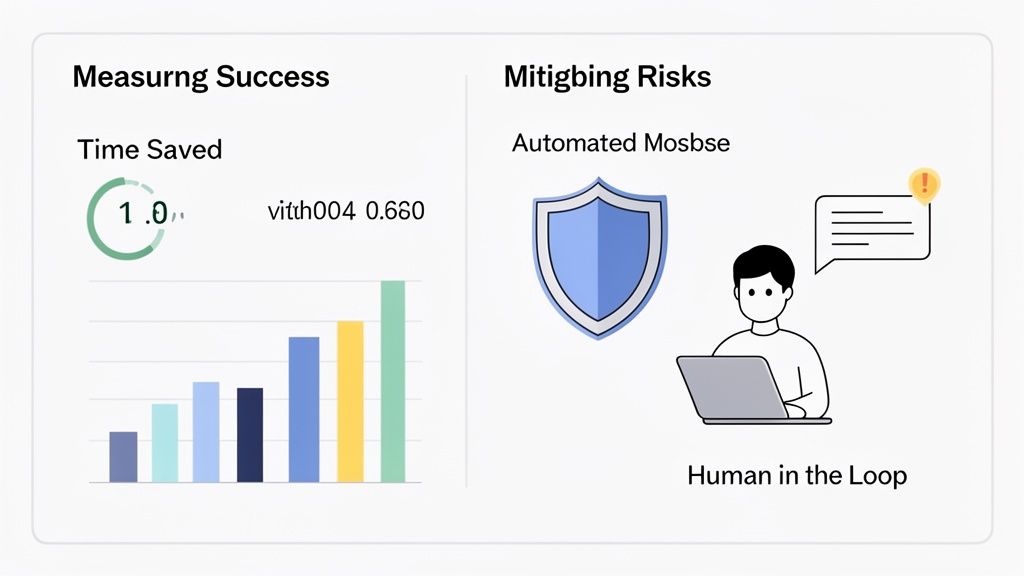
Time Saved: This one’s easy to get and incredibly powerful. Calculate the hours your team gets back every week. If an agent takes over a task that used to eat up 10 hours of someone's time, that’s a direct win.
Error Rate Reduction: Look at how many fewer mistakes are being made. An agent handling data entry might cut errors by over 95%, which has a huge downstream effect on data quality.
Operational Cost Savings: Track the real dollars saved. This could be from reduced labor costs, getting rid of a software license, or just making a process leaner.
Task Completion Speed: How much faster is the work getting done? An agent might qualify a sales lead in seconds, while a human could take minutes or even hours.
When you track these things, your AI agent stops being a cool tech project and becomes a measurable business asset. The conversation shifts from "what can it do?" to "look what it's done for us."
Managing Risks Responsibly
Giving an agent autonomy is a big deal. A rogue agent could do a lot of damage, from sending bizarre, off-brand messages to mishandling customer data. You absolutely have to build in some guardrails.
The best way we've found to do this is with a human-in-the-loop (HITL) system. This approach lets the agent run on its own for the simple, repetitive stuff but requires a person to sign off on the important decisions. For example, the agent can draft all your outreach emails, but a human has to hit "send."
This gives you a safety net. It keeps you in control, protects your brand, and prevents costly mistakes. You get all the power of automation without giving up governance.
How We Build Your Custom AI Agent
Taking an idea and turning it into a real, working tool takes a no-nonsense, practical approach. We’re not fans of building enormous, complicated systems that take forever to see the light of day. Our entire process is built for speed and impact, all aimed at getting a functional AI agent working for you as fast as possible.
Our partnership kicks off with a discovery phase. The goal here is simple: find the one automation opportunity that will make the biggest difference in your business, right now. We dig in with you to find a workflow that’s repetitive, eats up a ton of time, and gives you a clear win once it’s automated. This laser focus makes sure your very first agent is a success story.
Once we’ve locked in on that goal, we jump straight into a rapid build cycle.
Our Collaborative Build Process
We build your agent using a really simple and open model. Think of us as an extension of your team—you’re a partner at every single step and can see exactly what we’re doing and why. Our whole method is based on a few key ideas that keep us aligned and get the job done.
Shared Workspace: We set up a collaborative Notion board that becomes our single source of truth. You can see every task, track our progress, and find all the project documents in one spot. No secrets, no confusion.
Constant Communication: You get a dedicated Slack channel to connect our teams. It’s perfect for quick questions and daily updates without clogging up your calendar with unnecessary meetings.
Full Ownership: When we’re done, it’s all yours. You get complete ownership of the solution we build. It’s your tool, designed to solve your problems, with absolutely no vendor lock-in.
This approach ensures we’re not just building something cool; we’re building a tool that delivers real results, whether that’s saving your team hours of work or cutting down on operational costs. For teams that want to get their hands dirty, checking out a no-code AI agent builder can be a fantastic way to start experimenting.
Our goal is to deliver a functional solution that proves its ROI from day one. We start small, validate the impact, and then build on that success.
We pair this practical development process with our deep knowledge of workflow design. To get a better sense of how we can reshape your operations, find out more about what an AI automation agency can bring to your business.
Still Have Questions About AI Agents?
Let’s wrap things up by answering some of the most common questions we hear from teams thinking about building their first AI agent. Getting straight answers to these practical concerns is often the key to moving from "what if" to a real, working plan.
These are the things people usually ask after they've grasped the basics—the nitty-gritty of budget, security, and how this all fits into the tools they already use.
How Much Does It Cost to Build a Custom AI Agent?
Honestly, it really depends on what you need the agent to do. A simple agent built for a single, focused task—say, automatically tagging and routing new support tickets—can be a pretty modest investment. But if you're looking at a more sophisticated agent that has to juggle data from multiple systems and make complex decisions on its own, that's going to require more resources.
Our philosophy is to start with a Minimum Viable Agent. This gets you tangible value right away, proves the ROI, and helps build a solid business case before you dive into a bigger project.
This way, you start seeing a return on your investment early, without having to commit to a huge upfront cost.
What’s the Difference Between an AI Agent and RPA?
Think of Robotic Process Automation (RPA) as a really smart macro. It’s fantastic at mimicking human clicks and keystrokes to power through repetitive, rule-based tasks. If you have a process that follows the exact same steps every single time, RPA is a solid choice.
An AI agent, on the other hand, is a genuine problem-solver. It can handle messy, unstructured information (like the free-form text in a customer email), adjust its approach based on what it learns, and make its own decisions to reach a goal. That ability to think and adapt makes it way more flexible and powerful for workflows that are constantly changing.
How Can I Make Sure an AI Agent Is Secure?
Security isn't an afterthought; it's priority number one whenever you introduce a new tool. We stick to non-negotiable best practices, which always include:
Strict Access Controls: The agent only gets permission to see and touch the specific data and systems it absolutely needs to do its job. Nothing more.
Secure API Usage: Any connection to your other software is locked down with proper authentication and encryption.
Robust Logging: We keep a detailed audit trail of every single action the agent takes. This gives you full transparency and makes it easy to review what happened and when.
And for any high-stakes tasks, we always build in a “human-in-the-loop” checkpoint. This gives you the final say on critical decisions, so you get all the benefits of automation without ever giving up control.
Ready to turn your most repetitive workflows into a real strategic advantage? Shalev Agency specializes in designing and building custom AI agents that deliver measurable results and give your team their time back. Get in touch to scope your first high-impact automation project.