Unlock growth with AI automation. This guide explains how to implement AI workflows to save time, increase conversions, and scale your operations.
Jan 11, 2026
So, what exactly is AI automation? Think of it as the next evolution of getting things done. It takes standard automation tools and infuses them with artificial intelligence, creating systems that can actually learn, adapt, and make smart decisions on their own.
We're moving beyond just automating simple, repetitive tasks. AI automation is all about tackling complex, dynamic work, and it's completely changing how businesses, especially startups and nimble teams, operate and grow.
What Is AI Automation and Why Does It Matter Now?
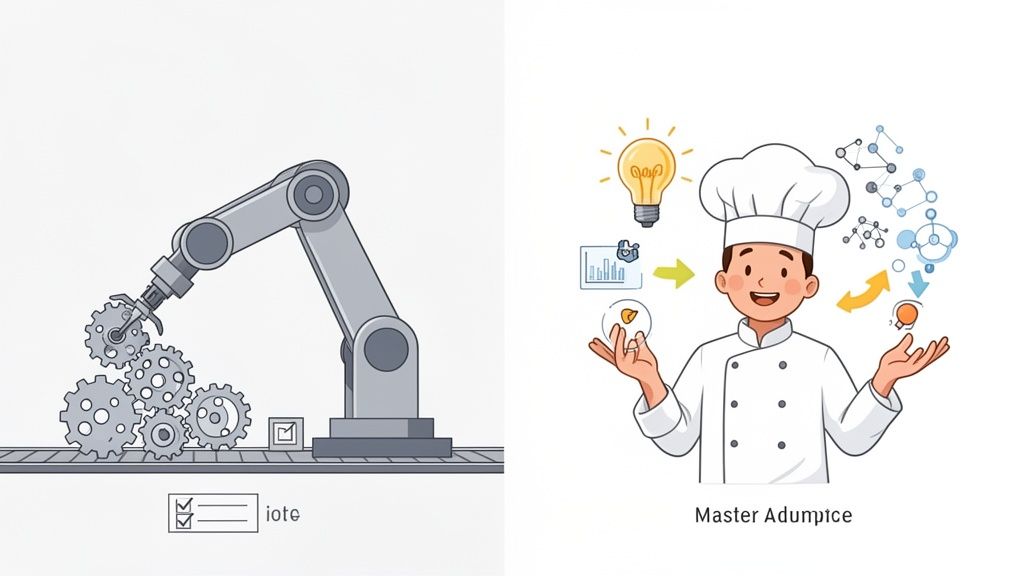
Let's use an analogy. Picture a classic factory assembly line. Traditional automation is the robotic arm that does the exact same thing thousands of times a day. It’s incredibly precise, but it can't think for itself. If a part comes down the line that's slightly different, the robot is stumped.
Now, imagine a master chef running a bustling kitchen. The chef doesn't just blindly follow one recipe. They adapt to the ingredients on hand, improvise when something goes wrong, and get a little better with every dish they make. That’s the heart of AI automation.
Beyond Rigid Rules
Unlike older systems that need every single step spelled out, AI-powered tools can analyze data, spot patterns, and make predictions to handle situations they haven't seen before. This intelligence is the key difference.
Here's how that plays out in the real world:
Traditional Automation: This is all about "if-this-then-that." For instance, if an email subject line contains the word "invoice," then it gets moved to the accounting folder. Simple and effective, but very limited.
AI Automation: This is about understanding context. An AI system can read the entire email, figure out who sent it, pull the due date and total amount from the attached invoice PDF, and then create a task for your finance team—all without needing a specific rule for every possible invoice format.
This is a massive advantage for startups and growing businesses trying to keep up with bigger competitors. It lets you operate with a level of efficiency that frees up your team's time and money, so you can pour those resources back into what matters most: growth. To see how this builds on foundational concepts, check out the fundamentals of workflow automation.
AI automation is about building systems that think, learn, and adapt to drive real business results. It’s the difference between doing tasks faster and doing them smarter.
A Quick Look at the Two Approaches
To make it even clearer, let's break down the core differences between old-school automation and the new AI-powered approach.
Traditional Automation vs AI Automation at a Glance
Aspect | Traditional Automation (Rule-Based) | AI Automation (Intelligent) |
|---|---|---|
Logic | Follows predefined "if-this-then-that" rules. | Uses algorithms to learn from data and make predictions. |
Data Handling | Works with structured data in a predictable format. | Can process unstructured data like emails, images, and text. |
Adaptability | Rigid. Fails when encountering unexpected variations. | Flexible. Adapts to new information and improves over time. |
Decision Making | Cannot make decisions; only follows commands. | Makes autonomous, data-driven decisions within set parameters. |
Example | Auto-replying to an email with a generic message. | Analyzing customer support tickets to route them by sentiment and urgency. |
As you can see, the leap is significant. One is about following a script, while the other is about understanding the whole play.
The Economic and Competitive Edge
The numbers behind this shift are hard to ignore. PwC estimates that AI will add a staggering $15.7 trillion to the global economy by 2030, with a huge $6.6 trillion of that coming directly from productivity gains. This growth is driven by intelligent systems that learn as they go, making our tools and workflows smarter and more scalable.
For founders, marketers, and operations leaders, this isn't just a statistic—it's a signal of a major change in how work is done. Startups can now set up sophisticated systems for things like lead qualification, customer support, and project management that used to be out of reach without a massive budget. For instance, understanding how document automation is transforming paperwork-heavy industries shows just one area where AI is making a huge impact.
Ultimately, adopting AI automation isn't just a nice-to-have anymore. It's becoming a critical strategy for survival and growth.
The Real Business Value of Implementing AI Automation
Okay, so we know what AI automation is. But the real question is, what can it actually do for your business? The value isn't found in the technology itself, but in the real-world results it delivers. It's about fundamentally changing how you use your most valuable assets: time, money, and talent.
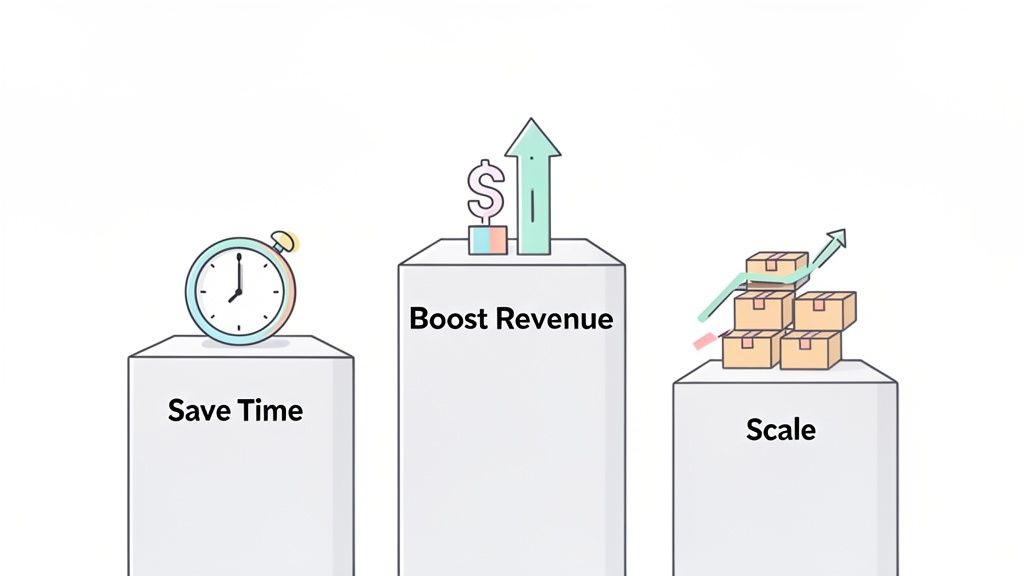
When you look at the return on investment (ROI), it really boils down to three main benefits. These aren't just buzzwords; they’re tangible advantages that growing businesses can see in their day-to-day work and, most importantly, on their bottom line.
Dramatically Reduce Costs and Save Time
At its core, AI automation is about getting back your team's time. It zeroes in on the repetitive, manual tasks that eat up hours and invite human error. Think of it as giving every employee a super-efficient assistant who works 24/7 and never needs a coffee break.
For a startup, this is a total game-changer. Imagine a customer support team drowning in tickets. An AI system can instantly sort these requests, tagging them by urgency, identifying keywords, and sending them to the right person. This one piece of automation can easily save hundreds of hours a month, freeing up your team to solve the complex problems that truly need a human touch.
By automating routine processes, businesses can redirect their team's focus from low-value, repetitive work to high-impact, strategic initiatives that drive growth.
The financial impact is just as clear. When you cut down the manual effort needed for things like data entry, invoice processing, or generating weekly reports, you directly lower your operational costs. This isn't about replacing people; it's about empowering them to do more without having to double your headcount.
Boost Revenue and Conversion Rates
Beyond saving money, AI automation is a powerful tool for actually making money. It injects a layer of intelligence into your sales and marketing, helping you make smarter, faster decisions that lead directly to more sales.
Take lead qualification, for example. A marketing team can use AI to score incoming leads based on dozens of signals—from their activity on your website to their company size. The system can instantly pinpoint the leads most likely to become customers and hand them off to the sales team with a neat summary of why they're a great fit. Your reps end up spending their time on promising prospects, which naturally increases close rates.
AI also lets you personalize customer experiences at a scale that's simply impossible for humans.
Dynamic Website Content: AI can change the headlines and calls-to-action on your site based on who is visiting, making the experience more relevant for every single person.
Personalized Email Campaigns: Instead of sending out generic email blasts, AI can create and send targeted messages based on what each user has actually done or shown interest in.
These smart touchpoints create a more engaging customer journey, which translates directly to higher conversion rates and more valuable long-term customers.
Enable Rapid and Sustainable Scalability
For any growing business, scaling is the name of the game. The hard part is growing revenue without letting your costs and operational headaches spiral out of control. AI automation is what makes this kind of sustainable growth possible.
When you build automated workflows and internal tools, you create a system that can handle a huge increase in volume without breaking a sweat. An AI-powered onboarding flow can welcome ten new customers just as easily as it can welcome a thousand. An automated financial process can handle a hundred transactions as smoothly as it can handle ten thousand.
This capability is quickly becoming a major competitive edge. Recent McKinsey reports show that AI adoption has hit 72% among businesses, with leaders counting on it to significantly boost team productivity. In North America, nearly two-thirds of companies are now focusing on AI automation as a primary engine for growth, a trend detailed in this report on AI stats for business. The message is clear: building an automated core isn't just about being more efficient today—it's about future-proofing your business for tomorrow.
High-Impact AI Automation Use Cases for Startups
Theory is great, but seeing AI automation in the wild is what really gets the gears turning. For a startup, where every hour and every dollar is precious, pointing this technology at the right problems can be the difference between hitting a wall and hitting warp speed. The trick is to spot the tasks that are repetitive, data-heavy, and absolutely essential to your business.
Let’s dive into some practical examples where AI can make a real difference across your teams. These aren't sci-fi concepts; they're automations you can build today to free up your people for the creative, strategic work that only humans can do.
Automating Marketing and Personalization
Marketing teams are usually drowning in a sea of tasks—running campaigns, crunching numbers, and trying to figure out what’s working. AI automation can be like a superpowered assistant, taking care of the grunt work and enabling a level of personalization that was impossible just a few years ago. It’s all about getting the right message to the right person at the right time, on autopilot.
Here are a couple of game-changing applications for marketing:
Hyper-Personalized Email Campaigns: Forget one-size-fits-all email blasts. An AI can watch how a user behaves on your site, look at what they’ve bought before, and see which emails they’ve opened. With that info, it can craft and send incredibly relevant messages automatically. Imagine a potential customer looks at a product page, and moments later, a perfectly timed email with related suggestions lands in their inbox. That’s how you boost conversions.
Dynamic Website Content Generation: Picture your website’s headlines, images, and buttons changing on the fly to match who's visiting. AI can analyze where a visitor came from, their industry, or even their location, and instantly tweak the content to resonate with them. This creates a personal touch that grabs attention and makes people feel understood, which is huge for engagement.
Supercharging Sales and Lead Qualification
A salesperson's most valuable asset is their time. But so much of it gets eaten up by admin work—qualifying leads, booking meetings, and manually updating the CRM. AI automation can clear the decks, letting your sales reps do what they do best: build relationships and close deals.
The goal is simple: let AI handle the repetitive sales tasks so your team can spend more time selling. This shift alone can have a massive impact on your bottom line.
A classic example is an AI agent that handles new leads from your website. Someone fills out your contact form, and instead of waiting for a human, the AI instantly starts a natural chat conversation. It can ask a few qualifying questions, figure out if they’re a good fit, and even check your team's calendars to book a demo on the spot. If that sounds good, a great first step is learning how to integrate an AI agent with your CRM system to create that seamless flow.
Streamlining Operations and Internal Workflows
A well-oiled operational machine is the engine of any startup. As you grow, manual processes for things like invoicing, expense reports, and getting new hires set up start to creak and groan. AI automation smooths out these internal bumps, creating scalable workflows that save a ton of time and cut down on costly mistakes.
Think about what you could do with these operational automations:
Automated Invoice Processing: An AI can be trained to "read" invoices that arrive by email. It pulls out the important details—vendor, due date, amount—and pops them straight into your accounting software. It can even flag anything that looks off for a human to double-check.
Intelligent Employee Onboarding: When a new person joins, it kicks off a long checklist of tasks. An AI-driven workflow can handle it all: automatically set up their software accounts, send them the right training docs, and schedule their intro meetings. This ensures everyone gets a smooth, consistent start.
Enhancing Product Development Cycles
Finally, AI automation can dramatically speed up how you build your product by taking over the heavy lifting of analyzing user feedback and technical data. Product managers and engineers spend ages digging through bug reports, feature requests, and interview notes just to spot trends and decide what to build next.
An AI tool can do this in a fraction of the time. It can scan thousands of comments from support tickets, app store reviews, and social media. Using natural language processing, it can sort the feedback into categories like "bug" or "feature idea," gauge the sentiment, and serve up a prioritized summary for the product team. This helps them make smarter, data-backed decisions on their roadmap, and fast.
Your Roadmap for Implementing AI Automation
Getting started with AI automation can feel like a massive undertaking. With so many options, it's easy to get stuck in "analysis paralysis" and end up doing nothing at all. The secret is to think small, prove the value, and then build on that momentum.
This roadmap isn't a rigid checklist. Think of it more as a flexible guide to help you get from a great idea to a working automation that actually adds value, without needing a huge budget or months of development.
Phase 1: Identify and Prioritize Opportunities
Before you write a single line of code or build a workflow, you have to figure out where to focus. The goal isn't just to automate for the sake of it—it's to automate the right things. The low-hanging fruit is almost always tasks that are high-volume, repetitive, and follow a clear set of rules.
Get your team in a room (or on a call) and ask some straightforward questions:
What are the tasks that eat up the most manual hours every single week?
Where do we constantly see work getting stuck or slowed down?
Which of our processes are most likely to suffer from simple human error?
Once you have a list, score each idea on two simple criteria: impact (how much time, money, or frustration it would save) and effort (how hard it would be to actually build). Your very first project should be a clear winner: high-impact, low-effort.
Phase 2: Prepare Your Data and Systems
AI automation is completely dependent on data. If you want to build an AI to qualify new leads, but your CRM is a total mess, the project is doomed from the start. Getting your foundational systems in order is a non-negotiable step.
This really comes down to two things:
Data Quality: Your data has to be clean, consistent, and easy to access. This might mean doing a one-time scrub of your customer database or, just as importantly, setting clear rules for how data gets entered from now on.
System Integration: Your tools need to talk to each other. Check that your key software—your CRM, email platform, project management tool—have APIs that let other applications connect to them and exchange information.
A successful AI automation project is built on a foundation of clean data and connected systems. Skipping this step is like trying to build a house on sand—it will eventually fall apart.
Phase 3: Start With a Minimum Viable Product
With a priority project chosen and your systems prepped, it's time to build. But resist the urge to create the perfect, all-singing, all-dancing solution right away. Instead, focus on a Minimum Viable Product (MVP). An MVP is the most basic version of your automation that can still deliver real value.
For instance, if your goal is to automate lead qualification, the MVP isn't a complex AI-powered chatbot. It might be as simple as a workflow that automatically pulls in company data for new leads and tags them with a "qualification score" right inside your CRM.
This flowchart illustrates how high-impact use cases—perfect for an MVP approach—can flow across different parts of the business.
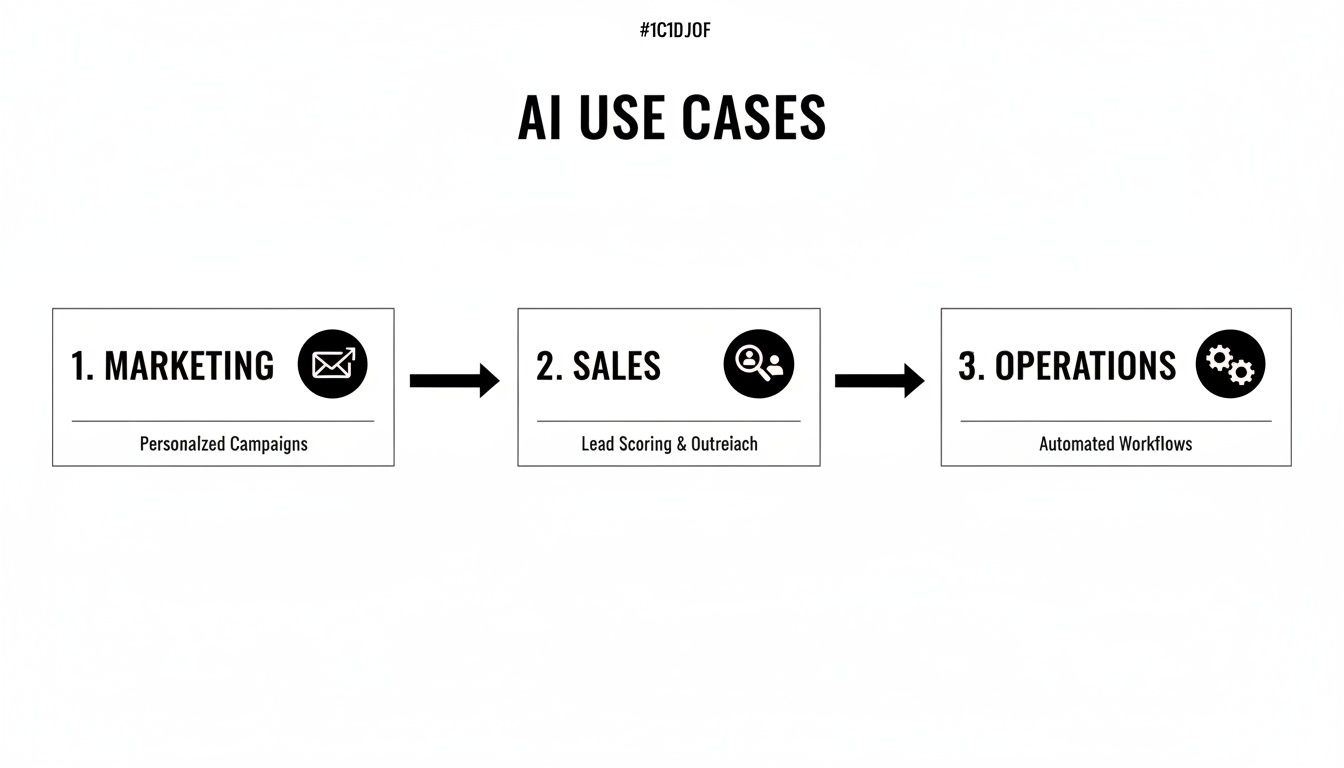
This shows how you can connect marketing, sales, and operations to create a single, efficient system.
The MVP approach lets you test your assumptions, prove the ROI, and get real feedback before you sink more time and money into it. It’s all about scoring a quick win to build confidence for bigger projects down the road. If you need a hand turning that idea into a reality, working with a team that provides dedicated ai automation agency services can help you get there much faster.
Phase 4: Measure, Iterate, and Scale
Okay, your first automation is live—nice work! But you're not done yet. The last phase is a continuous cycle of measuring what’s happening, learning from it, and making things better.
Before you even launch, define what success looks like. Are you trying to cut the time spent on a task by 50%? Increase qualified leads by 20%? Or maybe just get the error rate on data entry down to zero?
Track those key metrics like a hawk. Watch how your automation is performing and always be on the lookout for ways to improve it. Maybe the AI model needs more data to get smarter, or a step in the workflow could be tweaked for more efficiency. This constant refinement is how a simple MVP grows into an essential part of your business. Once it’s running smoothly, you can scale it up or move on to the next high-priority task on your list.
Staying Out of Trouble: Common Pitfalls and Smart Governance
Jumping into AI automation is exciting, but it's easy to get tripped up if you're not careful. Think of it like any powerful new tool in your workshop—how you use it matters just as much as what it can do. To get the most out of AI, you have to be just as aware of the potential snags as you are of the incredible upside.
One of the fastest ways to derail your efforts is by forgetting the people involved in this change. Another classic blunder is automating something just because you can, instead of focusing on tasks where it will actually make a difference. A little foresight goes a long way in making sure your AI projects are secure, sustainable, and genuinely valuable.
Don't Automate the Wrong Things
This is hands-down the most common trap. It's tempting to go after the most complex, high-profile task you can think of, but that's usually a fast track to headaches and wasted money. The best place to start with AI automation isn't with tasks that need a ton of creativity or complex human judgment.
Instead, hunt for processes that are:
Highly Repetitive: Think of the mind-numbing stuff your team does over and over again.
Data-Heavy: Anything that involves moving, sifting through, or making sense of large amounts of information.
Rule-Based: Processes that follow a pretty clear, predictable logic, even if the inputs change.
Trying to automate a creative brainstorming meeting? A terrible idea. But automating the grunt work of analyzing thousands of customer survey responses to fuel that meeting? That’s a perfect fit. Go for the clear, high-impact wins first to build some momentum.
Never Overlook Data Privacy and Security
AI runs on data. And with all that data comes a whole lot of responsibility. When you start connecting different apps and building automated workflows, you’re essentially creating new digital pipelines for information to flow through. If you don't secure those pipelines, you're not just making a tech mistake—you're taking a massive business risk that could destroy the trust you've built with your customers.
A single data breach can lead to a world of pain, from hefty fines to a brand reputation that takes years to rebuild. Data security can't be an afterthought; it has to be baked into your automation strategy from the very beginning.
Good governance isn't about creating red tape. It's about building guardrails so your team can move fast and innovate without breaking things.
The fix is to set up clear rules for handling data from the start. Know exactly who has access to what, make sure your data is encrypted (both when it's moving and when it's stored), and always keep regulations like GDPR and CCPA in mind.
A Simple Framework for Governance
You don't need a massive, hundred-page rulebook. A simple, practical framework is all it takes to give your team the clarity they need to build automations that are both effective and responsible. For any new automation idea, just make sure it can answer three basic questions.
What’s the point? Every automation needs a clear "why" that links directly to a business goal, whether that's saving 10 hours a week, cutting down on errors, or getting back to customers faster.
How are we keeping data safe? This is your quick check to ensure the project meets your security standards and respects everyone’s privacy.
When does a human need to take over? No automation is foolproof. You need a clear plan for when the AI gets stuck or sees something unusual, so a real person can step in and handle it.
Lastly, be transparent with your team. Position AI automation as a sidekick that frees them from tedious work, letting them focus on the more interesting, strategic parts of their jobs. This turns people from being skeptical of AI into being your biggest advocates for building a smarter, more efficient company.
How to Measure the Success of Your AI Automation
Getting an AI automation up and running is one thing, but proving it was worth the effort is a whole different ballgame. Success isn't just about the workflow doing its job without breaking; it's about showing exactly how it's making a real difference to the business. This is how you'll justify the time and money spent and get the green light to do more.
To measure success properly, you have to connect your automation projects to real-world results. Don't just stop at "task completed." Instead, focus on the numbers your leadership team actually cares about—whether that's saving money, making more money, or freeing up your team to do more important work.
Connecting Metrics to Business Goals
The clearest way to track return on investment is to link your metrics back to the specific problem your AI automation was built to fix. This approach helps you tell a powerful story with your data, painting a clear before-and-after picture of the impact.
The most successful AI automation strategies are those that are relentlessly measured against core business objectives. If you can't measure it, you can't improve it.
A simple framework is all you need to connect your high-level goals to concrete, trackable numbers. By setting these KPIs before you even start, you'll have a clear benchmark to prove the value your new systems are delivering.
Here’s a breakdown of the essential metrics to watch, organized by what you're trying to achieve.
Key Metrics for AI Automation ROI
This table summarizes how to connect your automation goals to tangible business outcomes, giving you a clear way to track your progress.
Business Goal | Primary Metric | Secondary Metric |
|---|---|---|
Efficiency Gains | Hours Saved Per Week | Reduction in Manual Errors |
Revenue Growth | Increase in Qualified Leads | Higher Customer Lifetime Value |
Cost Reduction | Lower Cost Per Acquisition | Reduced Operational Overhead |
Focusing on these metrics turns your automation projects from a technical task into a strategic win. When you consistently track this data, you can confidently show the value of your work, figure out what to improve, and build a solid case for future projects that will keep pushing the business forward.
Got Questions? Let's Talk AI Automation
Diving into AI automation can feel like a big step, and it's natural for questions to surface. Let's clear up a few of the most common ones we hear from teams just getting started.
How Much Technical Skill Do I Actually Need?
Honestly, probably less than you think. You don't need a team of data scientists to get started.
Many of the most powerful automations today can be built with no-code or low-code tools. Platforms like Zapier or Make let you connect the apps you already use and build smart workflows using simple, visual interfaces. No coding required.
The trick is to focus on the business problem first, not the technology. Once you know what you want to solve, you can find the right tool for the job. And if you hit a wall, you can always bring in an expert partner to handle the more complex stuff without hiring a full-time AI team.
Is This Going to Replace People on My Team?
This is a big one, but the goal is to augment your team, not replace them. Think about all the repetitive, mind-numbing tasks that eat up your team's day—data entry, report pulling, sorting emails. That's what AI is great at.
By handing that work over to an automated system, you free up your people to focus on what humans do best: strategic thinking, creative problem-solving, and building real relationships with customers. The aim is to make your team more effective and fulfilled, not smaller.
AI automation empowers your team to work smarter, not harder. It handles the tedious work so your people can focus on the tasks that truly drive growth and innovation.
What’s the Difference Between AI Automation and Robotic Process Automation (RPA)?
Good question. It helps to think of it like this:
Robotic Process Automation (RPA) is like a digital assistant that follows a very strict set of rules. It’s perfect for simple, repetitive tasks like copying data from a spreadsheet and pasting it into your CRM. If the rules don't change, it works perfectly.
AI automation is a huge step up. It adds a layer of intelligence. Instead of just following rules, it can understand context, handle messy or unstructured data, and even make decisions. So, while an RPA bot can move a file, an AI automation can actually read the file, understand its sentiment, and decide which department needs to see it. It's the difference between a follower and a thinker.
Ready to turn these ideas into reality? Shalev Agency is a design and development partner that builds high-quality internal tools, AI agents, and workflows that save time and drive measurable outcomes. Learn how we can help you implement AI automation.