
Learn how to increase lead generation with proven, actionable strategies. This guide covers website optimization, content marketing, and smart automation.
Jan 11, 2026
It’s tempting to dive headfirst into flashy tactics when you want to generate more leads. I've seen it a hundred times—teams launch ad campaigns or pump out blog posts without a real plan. But that's a recipe for wasted time and money.
The secret to a lead generation engine that actually works is starting with the fundamentals. You have to lay a strong foundation first by getting inside your customer's head and making sure you can track everything from the get-go. This is what separates the campaigns that scale from the ones that fizzle out.
Build a Strong Foundation for Lead Generation
Before you spend a single dollar on ads or an hour writing content, you need to know exactly who you're talking to. And I don't mean a vague, one-line persona. I mean a deeply understood Ideal Customer Profile (ICP).
What keeps them up at night? What words do they use to describe their biggest work problems? What other tools have they tried and hated? Knowing the answers to these questions is the difference between marketing that hits home and marketing that falls flat. The best source for this intel? Your existing customers.
Define Your Ideal Customer Profile
Your first step is to interview 5-10 of your absolute best customers. I’m talking about the ones who get the most value from what you do and are a pleasure to work with. Don't just email them a survey—get them on a video call and listen intently.
Ask questions that get them telling stories:
"Walk me through the moment you knew you had to find a better way to handle [the problem you solve]."
"What was the most frustrating part of your search for a solution?"
"You looked at a few other options. What made you ultimately choose us over them?"
These conversations are gold. You'll uncover the exact language your audience uses, their hidden objections, and the real outcomes they're chasing. This voice-of-customer data becomes the blueprint for every landing page, email, and ad you create.
Analyze the Competitive Landscape
Once you have a clear picture of your customer, it's time to see who else is vying for their attention. A competitive analysis isn't about blindly copying your rivals; it's about spotting opportunities and finding your unique angle.
Pick 3-5 of your direct competitors and dig into their lead generation strategy. What channels are they on? What kind of content do they produce? Are they pushing demos, free trials, or ebooks to capture leads? This homework helps you craft offers that stand out and avoid the crowded spaces.
A huge mistake I see startups make is trying to be everywhere at once. Instead, find one or two channels where your competitors are weak but your ideal customers are active. Own that space first, then expand.
Getting these basics right is non-negotiable. Implementing proven B2B lead generation best practices from the start ensures your strategy is built on solid ground, not guesswork. It's no secret that content is a major piece of this puzzle. In fact, companies that actively blog generate 13x more leads, and content marketing brings in 3x more leads for 62% less cost than old-school methods. With most B2B buyers doing 70% of their research before ever talking to a sales rep, your content is your first—and most important—handshake.
Set Up Your Tracking and Analytics
You can't improve what you don't measure. This isn't something you can put off until later; it needs to be in place from day one. At the bare minimum, get a tool like Google Analytics installed to see how people are finding and interacting with your site.
To avoid getting buried in data, just focus on these three metrics to start:
Lead Source: Where are people coming from? (Organic search, social media, etc.)
Conversion Rate: What percentage of visitors actually fill out your form?
Cost Per Lead (CPL): How much are you spending to get one new lead?
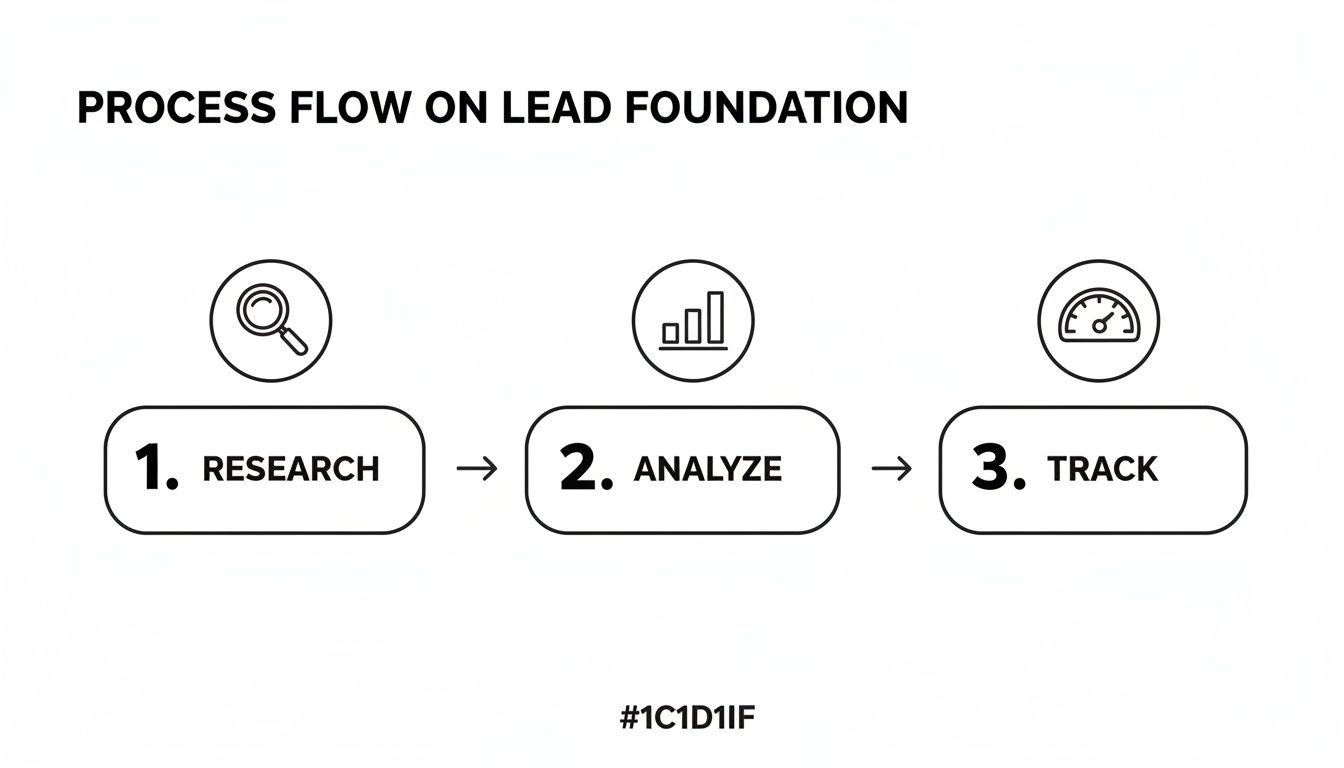
This simple three-step process—Research, Analyze, Track—is the bedrock of any successful lead generation program.
By putting in this foundational work, you move from just guessing what might work to building a predictable system for growth.
To keep yourself on track, use this quick checklist. It covers the essential building blocks you need in place before you start pouring resources into specific lead generation tactics.
Lead Generation Foundation Checklist
Foundation Area | Key Action | Why It Matters |
|---|---|---|
Ideal Customer Profile (ICP) | Conduct 5-10 live customer interviews. | Uncovers real pain points and language to create marketing that resonates. |
Competitive Analysis | Analyze the lead gen strategies of 3-5 top competitors. | Helps you find gaps in the market and create a unique value proposition. |
Tracking & Analytics | Set up Google Analytics with conversion tracking. | Provides the baseline data needed to measure performance and optimize efforts. |
Core Messaging | Document key value props and differentiators. | Ensures all your marketing materials are consistent and compelling. |
Running through this checklist confirms you’ve covered the basics. Once these pieces are in place, you'll be ready to launch and scale your efforts with confidence, knowing you're building on a rock-solid foundation.
Turn Your Website into a Conversion Engine
Your website can be your best salesperson, working around the clock to bring in new business. But for that to happen, it needs to be more than just a pretty digital brochure. A lot of companies treat their site like a passive portfolio, just hoping people will figure out what to do. That approach is a surefire way to bleed potential leads.
We need to shift that mindset. Your site should be an active, persuasive tool that guides visitors from "just browsing" to "I'm interested." This all starts with the pages that do the real heavy lifting: your landing pages.
Crafting High-Converting Landing Pages
A landing page has one job and one job only: get the visitor to take a specific action. That's it. Whether you want them to download a guide, sign up for a webinar, or book a demo, every single element—every word, image, and button—must support that single goal.
It all starts with the headline. This is your first and often only chance to grab someone's attention. If your headline doesn't connect immediately, they're gone. Forget being clever; be clear and compelling. Speak directly to their biggest pain point or the outcome they're dreaming of.
For instance, a headline like "Next-Generation CRM Software" is vague and falls flat. A much stronger approach would be "Stop Losing Sales Leads. The Simple CRM for Busy Teams." See the difference? The second one hits a nerve and offers an immediate solution.
Designing Forms People Actually Complete
The form is where the conversion actually happens, but it's also the biggest drop-off point. We’ve all been there—you land on a page, and you’re hit with a form that looks like a tax return. It’s an instant conversion killer.
The key is to make submitting information feel effortless. Ask for the absolute bare minimum you need to qualify and contact a new lead. For a top-of-funnel offer like an ebook, a name and email is usually all you need. You can always gather more info down the line.
Here are a few quick wins for your forms:
Keep it short: Stick to 3-4 fields max. Name, work email, and company name are good starting points.
Use smart fields: Tools like HubSpot can recognize returning visitors and pre-fill their info. It's a small touch that makes a big difference.
Explain the "why": If you absolutely must ask for a phone number, tell them why. A simple note like, "(For a quick setup call with our specialist)" can ease their hesitation.
Remember, every extra field you add is another reason for someone to leave. I've seen clients boost conversions by as much as 50% just by cutting their form fields from four to three.
Getting your forms and landing pages right is a huge part of a solid website design for conversion, and it's what turns a simple website into a real business asset.
The Psychology of Powerful Calls-to-Action
Your call-to-action (CTA) button is the final step. It needs to stand out visually and use language that motivates action. Generic phrases like "Submit" or "Click Here" are lazy and uninspiring. They don't tell the user what they’re actually getting.
Instead, your CTA text should be a clear, direct promise of value. This small tweak reinforces the benefit and makes clicking that button feel like a win for the user.
Vague CTA | Specific and Compelling CTA |
|---|---|
Download | Get My Free Marketing Plan |
Sign Up | Reserve My Webinar Seat |
Submit | Start My Free Trial |
Placement matters, too. Make sure your CTA is "above the fold" so visitors see it without scrolling. It's also a smart move to repeat it at the bottom of the page for those who like to read every last detail before committing.
Building Trust with Social Proof
People are naturally skeptical. Before they hand over their email address, they need to trust you. The fastest way to build that trust is with social proof. It’s proof from the real world that you deliver on your promises.
Sprinkle these elements throughout your landing pages:
Customer Testimonials: Short, punchy quotes are great. Add a headshot and company name to make them feel real.
Case Studies: For those who need more detail, link out to success stories that show tangible results and ROI.
Client Logos: If you've worked with recognizable companies, show them off. Their brand credibility instantly rubs off on you.
Trust Badges: Things like security certifications or industry awards can help put a visitor's mind at ease.
When you combine a powerful value proposition with a frictionless experience and undeniable social proof, any page on your site can become a lead-generating machine. This isn't just about making things look good; it's about building a predictable engine for growth.
Find and Engage Leads on the Right Channels
Getting traffic to your website is one thing. Attracting the right people—the ones who are actually a good fit for what you sell—is a whole different ballgame. It’s easy to get tricked into thinking you need to be everywhere at once, but that’s a surefire way to burn through your budget with little to show for it.
The real secret is to be surgical. You need to figure out where your ideal customers hang out online and then meet them there. It's not about chasing vanity metrics; it's about being intentional and focusing your energy where it will have the biggest impact.
Dominate Search Intent with SEO
When someone types a question into Google, they have a problem and they're actively looking for a solution. SEO is your chance to be that solution. For B2B lead generation, this means getting laser-focused on long-tail keywords—the longer, more specific phrases that signal someone is ready to buy.
Think about it. A search for "project management" is super broad; that person is probably just browsing. But a search for "project management software for small creative agencies"? That person has a specific need and is much further down the buying journey.
Your job is to unearth these hyper-specific phrases. Tools like Ahrefs or SEMrush are fantastic for seeing what your competitors rank for. You can even just use Google’s autocomplete suggestions to see what real people are searching for. Once you have your keywords, build high-value content—blog posts, guides, landing pages—that directly answers their query. You'll face less competition and attract much higher-quality traffic.
Educate and Capture with Content Marketing
Content marketing is the heart of inbound lead generation. The strategy is simple: offer real value upfront in exchange for a prospect’s attention and, eventually, their contact information. It’s not a hard sell; it’s about positioning yourself as a trusted advisor.
The most effective tools in your content arsenal are often "gated"—meaning someone needs to share their email to get access.
White Papers and Ebooks: These are perfect for tackling a complex industry problem, showing off your expertise, and presenting a detailed solution.
Webinars: A live or on-demand webinar lets you connect with your audience in a more personal way, answer questions on the fly, and show your product in action.
Templates and Checklists: Don't underestimate the power of practical, done-for-you resources. A simple "Go-to-Market Strategy Template" can become a lead-gen machine because it provides immediate, tangible value.
The best content isn't about your product's features; it's about your customer's problems. Focus on teaching them how to solve their challenges, and your product becomes the natural next step.
When you educate instead of just sell, you build trust. That trust makes the eventual sales conversation feel less like a pitch and more like a partnership.
Target Decision-Makers with Paid Channels
While SEO and content are long-term plays, sometimes you just need leads now. That's where paid channels shine, and for most B2B companies, LinkedIn Ads are a goldmine.
What makes LinkedIn so powerful is its targeting. You can zero in on users based on their exact job title, company size, industry, or even seniority level. Let's say you sell compliance software for CFOs in the fintech space. With LinkedIn, you can put your ad directly in front of only those people.
The trick to making paid ads work is a killer offer combined with a seamless landing page. A common mistake is just sending paid traffic to your homepage. Don't do it. Create a dedicated landing page that mirrors the message in your ad and has one, and only one, clear call to action.
Use Social Media for Direct Engagement
Beyond just running ads, social media is a fantastic tool for organic lead generation, especially on platforms like LinkedIn and X (formerly Twitter). The key here is to stop broadcasting and start engaging in actual conversations.
Jump into relevant industry groups on LinkedIn. Answer questions, share your perspective, and just be helpful. On X, follow key opinion leaders and add value to conversations using relevant hashtags. Your goal is simply to be visible and useful.
You can also use these platforms to capture leads more directly. For instance, run a poll on LinkedIn and then send a message to the people who respond. Or, share a free resource in your posts with a direct link to a download page. It’s a softer, more conversational approach that builds your pipeline over time by proving you're an expert who is also accessible.
Use Smart Automation to Nurture and Qualify Leads
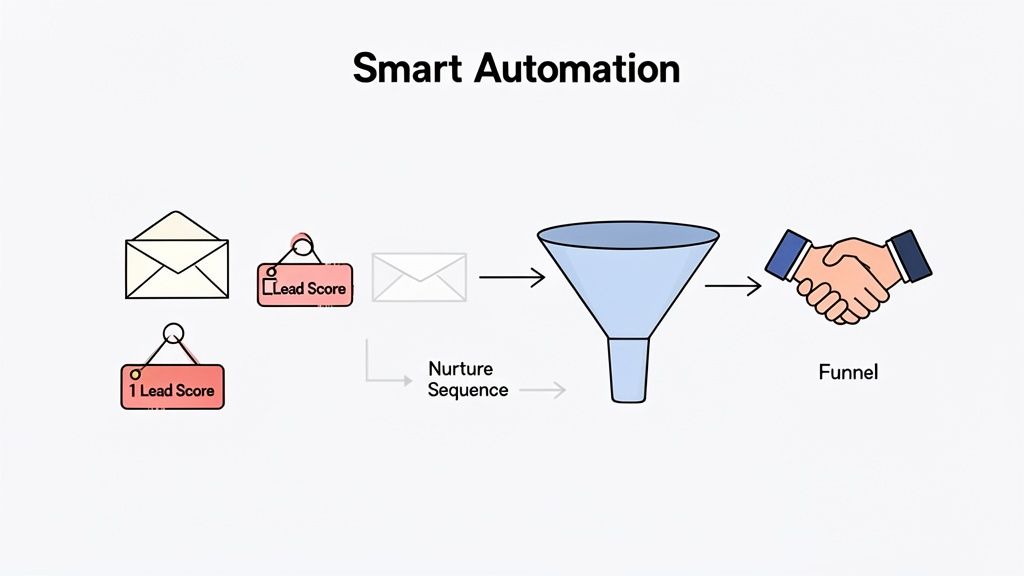
Getting a new lead is just the start of a conversation. If you grab their email and then go silent, you’ve ended it before it even had a chance to begin. The real work isn't just about getting more names into your funnel; it's about guiding the right people through it without burning out your team.
This is where automation becomes your secret weapon. You can build a system that methodically builds relationships and pinpoints your most promising leads, all while you sleep. Forget tedious manual follow-ups and endless guesswork. This is how you create a smart, consistent experience that turns curiosity into real interest.
Automate Your Lead Nurture Sequences
The moment someone downloads an ebook or fills out a contact form, an automated email sequence should kick in. No, this isn't about blasting them with sales pitches. It’s about continuing the conversation you just started by delivering more value, helping them solve their problems, and slowly building trust in your brand.
A well-crafted nurture sequence doesn't feel like a sales pitch; it feels like a helpful guide. Here’s how it usually plays out:
Instant Welcome: The first email needs to land in their inbox immediately. It delivers whatever they asked for (like the ebook link) and thanks them. This immediate follow-up feels professional and confirms you’ve received their request.
Acknowledge Their Problem: A few days later, follow up with an email that dives deeper into the pain point they're trying to solve. You could share a related blog post or a customer story that shows you really get it.
Introduce Your Solution: Now you can start to gently introduce your product as the answer to their problem. A short video demo or a compelling case study works wonders here. You’re showing, not just telling.
A Clear Next Step: Finally, you can wrap up the sequence with a more direct call-to-action, like an invitation to a webinar or a suggestion to book a quick, no-pressure chat.
This automated flow ensures every single lead gets a thoughtful, valuable experience, warming them up for a real sales conversation without you having to lift a finger. You can learn more about setting up these systems in our guide on AI and automation for businesses.
Set Up a Lead Scoring Model
Let's be honest: not all leads are created equal. Someone who downloaded a top-of-funnel checklist isn't in the same ballpark as the person who visited your pricing page three times and then requested a demo. A lead scoring model is how you automatically tell the difference.
It’s a simple system that assigns points to leads based on who they are and what they do on your site. The resulting score is a clear signal of how ready they are to talk to sales.
A good lead scoring system is the ultimate handshake between marketing and sales. It stops sales from wasting time on lukewarm leads and shows marketing which of their efforts are attracting the best prospects.
Here’s a simplified look at how you might set one up:
Action or Attribute | Points Assigned |
|---|---|
Job Title (Manager or above) | +15 |
Company Size (50+ employees) | +10 |
Downloaded a Case Study | +10 |
Visited Pricing Page | +20 |
Opened a Nurture Email | +3 |
Once a lead's score hits a certain number—let's say 50 points—the system automatically flags them as a Marketing Qualified Lead (MQL) and pings the sales team. That’s their cue to reach out.
This data-driven method helps your sales team stop chasing ghosts and focus their precious time on people who've shown they're actually interested. It's a massive boost for efficiency and conversion rates. When you combine automated nurturing with smart scoring, you’re not just capturing leads; you’re building a machine that turns them into revenue.
Measure What Matters and Test Everything
Trying to generate leads without tracking your results is like throwing darts in a dark room. You're putting in the effort, but you have no idea if you're even hitting the board, let alone the bullseye. Real, sustainable growth isn't about one-off wins; it’s about a constant cycle of measuring, learning, and improving.
This means you have to shift your team's mindset from just "doing marketing" to building a data-driven culture of experimentation. Every email, landing page, and ad campaign is a chance to learn something new about your audience.
Identify the KPIs That Truly Matter
It’s incredibly easy to get swamped by data. To stay focused, you need to zero in on the Key Performance Indicators (KPIs) that actually show you the health of your lead generation engine. Forget vanity metrics like social media likes—they don't pay the bills.
Instead, build a simple dashboard that tracks the numbers that directly impact your bottom line.
Cost Per Lead (CPL): This is your north star metric. It tells you exactly what it costs to acquire a single lead from each marketing channel.
Lead-to-Customer Conversion Rate: This is huge. It shows you what percentage of leads actually become paying customers. A ton of leads with a tiny conversion rate is a red flag that you're attracting the wrong people.
Channel Performance: Look at your lead sources individually. Is SEO bringing in higher-quality leads than your paid ads? Knowing this tells you where to double down and where to scale back.
Keeping an eye on these KPIs gives you an honest, clear picture of what's working. It’s the foundation for making smart decisions instead of just guessing.
Embrace A/B Testing as a Discipline
Once you have your tracking in place, you can start making systematic improvements. The best way to do this is with A/B testing, where you pit two versions of something against each other to see which one performs better. This isn't just for big-budget teams; it's a discipline anyone can adopt.
The key is to isolate one variable at a time. If you test five different things on a landing page at once, you’ll have no clue which change actually made the difference.
A classic mistake is calling a test too early. You need to wait for a statistically significant result, which just means you have enough data to be confident the outcome wasn't a fluke. Most A/B testing tools will tell you when you've hit that point.
Start with small tests that can have a big impact. For example, try testing your landing page headline. Version A might be "Project Management Software for Teams," while Version B is "Finally, an End to Missed Deadlines." Let the test run, see which one gets more sign-ups, and you have a winner.
This iterative process creates a powerful feedback loop. Every test—win or lose—teaches you something valuable about what makes your audience tick. If you're new to this, our guide on simple A/B testing for Framer breaks down the core principles, which apply to any platform.
Quick Ideas for Your First A/B Tests
Not sure where to begin? Here are a few straightforward but powerful tests you can run right away to start improving your conversion rates.
Element to Test | Example Variation A | Example Variation B |
|---|---|---|
Email Subject Line | "Your Weekly Marketing Tips" | "3 Tools That Saved Us 10 Hours This Week" |
CTA Button Color | Standard Blue | High-Contrast Orange |
Form Fields | Name, Email, Company, Phone | Just Name and Email |
Landing Page Image | Product Screenshot | Photo of a Happy Customer |
By consistently measuring performance and building a culture of testing, you turn lead generation from a guessing game into a predictable, scalable growth engine. Every result, good or bad, becomes fuel for the next improvement.
Answering Your Top Lead Generation Questions
Let's be honest, diving into lead generation can feel like a maze. You start pulling on one thread, and a dozen new questions pop up. As you work on your strategy, you’re probably wondering about timelines, common traps to avoid, and where to put your money.
I get it. I’ve been there. So, let's tackle some of the most common questions I hear from teams trying to build a pipeline they can actually count on. Getting these right from the start helps you set realistic goals and pour your energy into what truly works.
How Long Does It Actually Take to See Results?
This is the big one, and the honest answer is: it depends entirely on the channel you’re using. It's not a one-size-fits-all timeline, and knowing this upfront is crucial for managing expectations across your team.
Think of it like building a fire. Some methods give you a quick flame, while others build a slow, steady burn.
The Slow Burn (3-6+ months): SEO and content marketing are your long-term assets. These are incredibly powerful, but they take time to get going. You might be looking at several months before a new blog post starts ranking on Google and pulling in consistent organic traffic. The massive upside? Once that fire is lit, it provides a sustainable, low-cost source of leads that works for you 24/7.
The Quick Flame (Days to weeks): Paid channels like LinkedIn Ads or Google Ads can deliver leads almost instantly. You can launch a campaign in the morning and have new names in your CRM by the afternoon. The catch is that they require constant fuel—the second you stop spending, the leads dry up.
The smartest play is to do both. Use paid ads for those quick wins and predictable numbers while you build your long-term, organic engine in the background.
What's the Single Biggest Mistake People Make?
Easy. It's the obsession with the quantity of leads over their quality. I can't tell you how many teams I've seen pop the champagne over hitting a huge MQL number, only to realize that 95% of those leads were a terrible fit for their business.
All that does is clog your pipeline, burn out your sales team, and create a ton of friction between marketing and sales. It's a classic case of being busy, not productive.
A great lead generation program isn’t about getting the most leads; it's about getting the right leads. Focus everything on your Ideal Customer Profile (ICP). This will always lead to a healthier pipeline and a dramatically better lead-to-customer conversion rate.
You're far better off with ten highly qualified leads who are genuinely interested than a hundred who were never going to buy anyway.
Should I Go All-In on Inbound or Outbound?
The whole "inbound vs. outbound" debate feels a bit outdated because it presents a false choice. The best strategies I see today don't pick a side—they blend the two together.
Think of inbound marketing (powered by SEO and great content) as your foundation. It’s a long-term asset that draws people to you naturally, building trust and positioning you as an authority. It’s the bedrock of modern marketing.
Outbound efforts, like hyper-targeted ad campaigns or strategic outreach, are your accelerators. They let you jump straight to specific market segments, giving you a burst of speed and more predictable results for a new product launch or campaign.
My advice? Start by pouring a solid inbound foundation. Once that’s setting, layer in targeted outbound tactics to hit your growth goals much, much faster.
At Shalev Agency, we help growing teams turn these strategies into reality. We design and build conversion-focused websites and internal tools that streamline workflows and drive measurable outcomes. If you need a partner to help you ship faster and generate more qualified leads, let's talk.