A practical guide for startups on how to find, vet, and partner with the right digital marketing agency to fuel growth and achieve measurable results.
Jan 11, 2026
Before you even think about looking for a digital marketing agency, you have to figure out what winning actually looks like for your startup. This is all about looking inward and pinning down specific, measurable goals. Are you trying to generate more qualified leads? Improve your website's conversion rate? Or maybe build some real brand authority in a crowded market? Getting crystal clear on this stuff is the bedrock of finding a partner who's actually on the same page as you.
Defining Your Goals Before You Start Your Search
Walking into agency meetings without clear objectives is like setting sail without a map. Sure, you'll end up somewhere, but it probably won’t be where you wanted to go. The best agency partnerships I've ever seen started with the client doing a serious internal audit of their marketing and getting super specific about what they needed. This kind of self-assessment saves a ton of time and makes sure every dollar you spend is aimed at making a real impact.
For any startup trying to carve out a space online, it’s worth getting a handle on the basics of digital marketing for startups. This gives you the context to set goals that are both realistic and meaningful. Without it, you're just chasing vanity metrics instead of results that actually move the needle for your business.
Conducting a Practical Self-Audit
Start by taking an honest look at your current marketing channels. What’s working? Where are the obvious gaps? This isn't about pointing fingers at past efforts; it's about spotting opportunities for growth.
Get specific with these key areas:
Current Performance: What are your baseline numbers? Know your website traffic, lead gen stats, and customer acquisition cost. Having these figures on hand gives any potential agency a real starting point.
Resource Gaps: What skills is your team missing? Maybe you have a killer content writer but no one who understands SEO, or a solid product team with zero UX/UI design experience.
Competitive Landscape: Who are your main rivals, and what are they doing right? A quick analysis of their strategies can uncover market opportunities you might be missing.
This initial audit helps you shift from a vague wish like "we need more traffic" to a specific, actionable goal. It’s the difference between asking for a fast car and saying you need a vehicle that does 0-60 mph in under four seconds. One is a hope; the other is a benchmark.
A well-defined goal is the ultimate filter. It immediately weeds out agencies that aren't a good fit and attracts the ones who have a proven track record of solving the exact problems you have.
Differentiating Needs from Wants
Once you've audited where you are, it's time to prioritize. Not every marketing activity is created equal, especially when you're an early-stage startup watching every penny. You have to separate the absolute essentials from the "nice-to-haves."
An essential service is something that directly fuels your core business objectives. For an e-commerce startup, that’s improving the checkout conversion rate. For a B2B SaaS company, it's getting more demo requests. A "nice-to-have" might be a viral social media campaign—great for brand awareness, but it might not be the priority if it doesn't drive immediate sales. To see how this kind of clarity applies on the development side, check out our guide on product development for startups.
This whole process—auditing, defining, and prioritizing—is a non-negotiable first step. The graphic below breaks down this simple but powerful workflow.
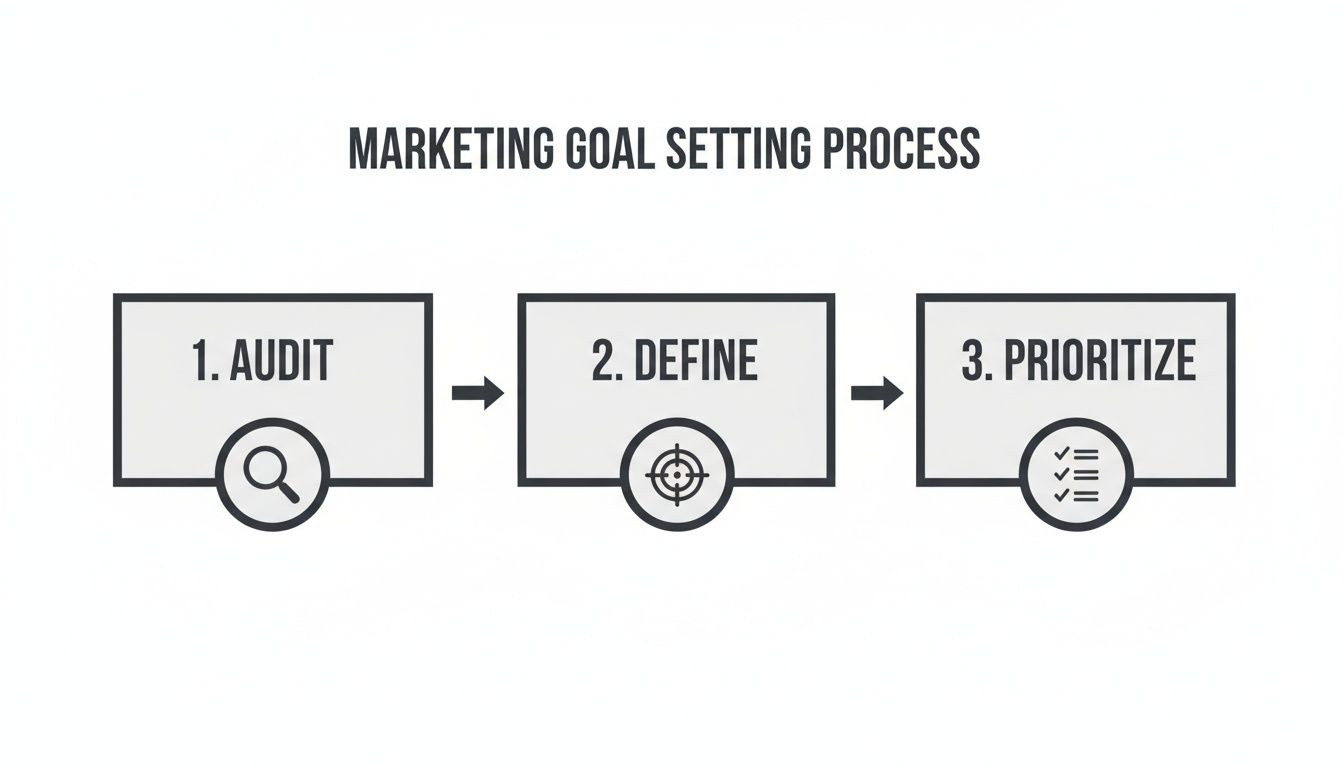
This just goes to show that a successful agency search starts with internal clarity, not with a bunch of outreach emails. Doing this foundational work first lets you write a much stronger brief, ask smarter questions during interviews, and ultimately find a partner who will feel like a true extension of your team and drive real results from day one.
How to Find and Vet Potential Agency Partners
Alright, you know what you need. Now comes the hard part: finding the right people to build it. This isn't just about Googling "best digital agency" and picking the one with the slickest website. You’re looking for a partner who has already solved the exact kind of problems you’re facing.
The real goal is to find an extension of your team, not just a hired gun. That means digging deeper than their sales pitch. You need to look at their actual work, talk to people they’ve worked with, and see if their process clicks with yours. A little extra diligence here can save you a world of headaches later.
Scrutinize Portfolios and Case Studies
An agency’s portfolio is their track record. Don't just get mesmerized by the pretty pictures. Dive straight into their case studies and look for work that feels familiar—similar industry, similar audience, similar growth challenges. A great-looking website is nice, but a great-looking website that actually doubled a client’s conversion rate is what matters.
As you review their work, ask yourself:
Is it relevant? Have they worked with other SaaS startups or B2C brands? An agency that already gets your world won't need a crash course on your business model.
Do they show their work? A good case study isn’t a sales page. It should clearly lay out the client's problem, the agency's strategy, and the results. If it’s all fluff about “synergy” and “engagement,” be wary.
Are the results real? Look for hard numbers. We’re talking about a 35% jump in qualified leads, a 50% drop in customer acquisition costs, or a 20% lift in user retention. Vague claims are a red flag.
This is how you separate the agencies that talk a big game from the ones that actually deliver. For a sense of what solid, results-driven case studies look like, you can browse through our agency's portfolio to see how we frame problems and solutions.
Read Between the Lines of Testimonials
Testimonials can be goldmines, but you have to know what you're looking for. A generic “they were great to work with” is nice, but it tells you almost nothing.
What you really want is the specifics. A quote like, “their weekly async updates and shared Notion board kept our team perfectly in sync and eliminated needless meetings,” tells you a story about their process and communication. It gives you a feel for what it’s actually like to be their client.
Look for clues about their communication style, responsiveness, and how they handle feedback or unexpected problems. Details like these paint a much clearer picture than a five-star rating ever could.
An often-overlooked but critical factor is cultural fit. An agency can have all the skills in the world, but if their communication style clashes with your team's, the partnership is destined for friction.
Assess Technical and Cultural Alignment
This is about more than just marketing chops. How an agency operates is just as important as what they produce. If their workflow is a total mismatch for your team’s, you’re signing up for constant friction and delays.
Think about their day-to-day process:
Communication Tools: Does your team live on Slack? If an agency only does scheduled calls and email, that’s a potential bottleneck.
Project Management: How do they track progress? Whether it's Notion, Asana, or Jira, you need to know their system can play nicely with yours.
Design and Dev Philosophy: Are they agile and iterative, or do they prefer a rigid, waterfall approach? As a startup, you almost always want a partner who can move and adapt quickly.
Ultimately, vetting is a two-step process. First, confirm they have the raw talent and proven experience to get the job done. Second, make sure they’ll be a cultural and operational fit. Find an agency that nails both, and you've found a partner who can actually help you grow.
Decoding Agency Pricing Models and Services
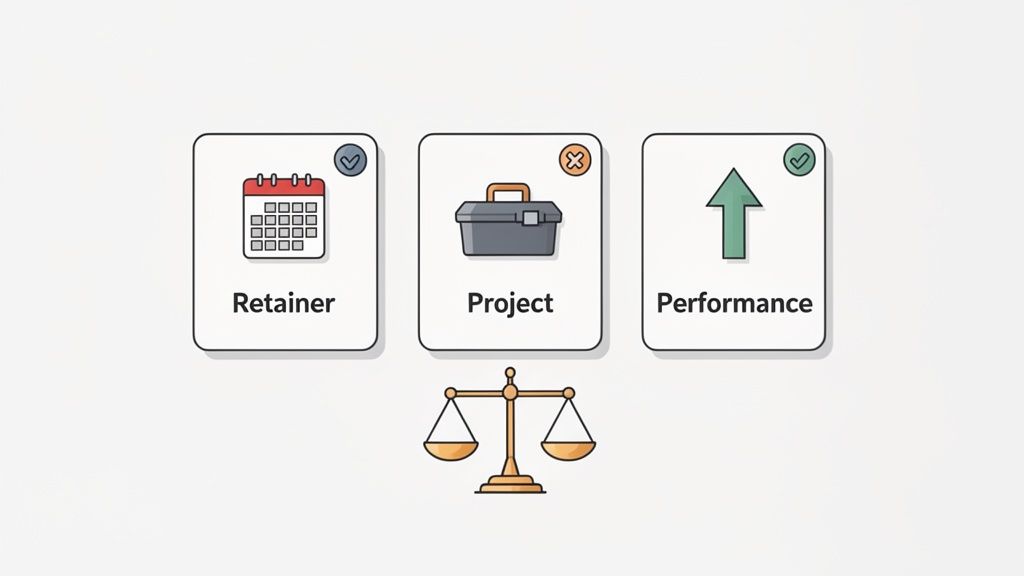
The moment you start looking at agency proposals, you're hit with a wall of jargon. "Retainer," "fixed-scope," "performance-based"—each term represents a totally different way of working together, and it has massive implications for your budget, workflow, and results.
Getting this right isn't just about finding the cheapest option. It’s about finding a model that gets the agency as invested in your success as you are. Pick the wrong one, and you could end up with a partnership that feels like you're constantly pulling in opposite directions.
The Predictability of Monthly Retainers
A monthly retainer is pretty straightforward: you pay a fixed fee every month for a dedicated block of time or a set of ongoing services. Think of it as having an expert marketing team on call, without the overhead of full-time hires.
This model is the bread and butter for long-haul efforts where consistency is everything. It works especially well for:
Search Engine Optimization (SEO): You can't just "do SEO" once. It's a slow and steady race, and a retainer ensures someone is always pushing you forward.
Content Marketing: Keeping a blog, newsletter, or social media channels alive with quality content requires a constant, dedicated effort.
Ongoing Website Maintenance: For all the little things that keep your site secure, fast, and up-to-date.
The biggest win here is predictability. Your costs are fixed, making it a breeze to budget for. It also lets the agency really get to know your business, becoming a true partner that can spot opportunities you might miss. This long-term relationship is where the magic happens.
There's a good reason retainer agencies tend to hold onto clients. The average annual churn rate for these firms is just 18%, leading to a client lifespan of around 56 months. That stability creates space for the kind of deep, strategic work that one-off projects can’t touch. You can dig into more data on agency churn rates to see why this is such a big deal.
The Clarity of Project-Based Fees
A project-based (or fixed-scope) model is the opposite of a retainer. Here, you pay a single fee for a very specific deliverable with a clear beginning and end. It’s perfect for those one-and-done initiatives.
Startups often lean on this model for things like:
A complete website redesign.
Building out a brand identity and messaging guide.
Launching a targeted ad campaign for a new feature.
The main appeal is total clarity. You know exactly what you’re getting and precisely how much it will cost before a single line of code is written. No surprise invoices. The downside? It’s rigid. If you want to add or change something mid-project—what we call "scope creep"—get ready for a new contract and a bigger bill.
A fixed-scope project is like hiring someone to build a house from a blueprint. It's efficient and predictable, but if you suddenly decide you want a third bathroom, it's going to complicate things fast.
The Incentive of Performance-Based Models
This is the "put your money where your mouth is" model. The agency’s pay is tied directly to the results they deliver. This could be a percentage of your ad spend, a flat fee for every lead they generate, or even a cut of the revenue they help bring in.
While it’s less common for pure design and development, you’ll see it all the time in paid advertising or affiliate marketing. It creates an incredibly powerful alignment—the agency only wins when you win.
But it’s not without its pitfalls. You need rock-solid tracking to attribute results correctly, and both sides have to agree on what a "win" actually looks like. It can also tempt an agency to chase short-term metrics at the expense of your long-term brand health. For a startup, the low upfront risk is tempting, but you have to be absolutely sure the KPIs you set are the ones that truly matter.
Comparing Common Agency Pricing Models
Every pricing structure is built for a different kind of job. The right digital marketing agency for you will offer a model that aligns with your startup's immediate needs and future ambitions. This table breaks down the key differences to help you decide.
Pricing Model | Best For | Pros | Cons |
|---|---|---|---|
Retainer | Long-term, ongoing work like SEO, content marketing, and site maintenance. | Predictable costs, deep partnership, proactive and strategic work. | Can feel expensive if the scope isn't fully utilized; requires a longer commitment. |
Project-Based | One-off, well-defined projects like a website build or brand guide. | Clear deliverables and fixed cost, less upfront commitment, easy to budget. | Inflexible, scope creep can lead to surprise costs, less focus on long-term strategy. |
Performance-Based | Results-driven campaigns like PPC or lead generation. | Low upfront risk, strong incentive alignment, focus on measurable ROI. | Hard to set up and track, can encourage short-term thinking, less common for creative work. |
Ultimately, understanding these options helps you look beyond the price tag. You're not just buying a service; you're choosing a partner and a way of working together. Make sure it’s a fit.
Asking the Right Questions in the Interview
Okay, you’ve sifted through the portfolios and have a shortlist. This next part is where the rubber meets the road: the interview. This is your chance to get past the slick case studies and see how an agency really thinks.
A generic list of questions won't get you very far. You need to ask things that make them think on their feet and reveal how they handle pressure. Are they a genuine partner, or just another vendor waiting for a check? Let's find out.
How Do They Approach a Problem?
First, you need to understand how they think, not just what they've done in the past. Your goal is to see their process for tackling a new challenge, especially one that looks a lot like yours. Vague, cookie-cutter answers are a huge red flag here. You're hunting for specifics.
Try starting the conversation with questions like these:
"Tell me about a time a campaign totally missed the mark. What went wrong, how did you figure it out, and what did you do to turn it around?" This question is great because it tests their honesty about failures and shows you their real-world problem-solving skills.
"Let's say our main goal is [your specific goal]. What does your 90-day game plan look like? What are the first few metrics you'd obsess over?" This immediately tests if they can translate your business needs into an actual marketing plan.
"For a startup like us, how do you balance the need for quick wins with building a solid long-term strategy?" This tells you if they get the unique pressures of a startup and can juggle both tactical and strategic thinking.
A team that’s a real contender will respond with a clear framework. They'll ask you clarifying questions and probably bring up similar situations they’ve navigated before. They won’t just hand you a pre-baked solution.
What’s It Actually Like to Work with Them?
Now it’s time to get into the nitty-gritty of the day-to-day. A mismatch in communication or project management styles can kill a partnership, no matter how talented the agency is. You're looking for transparency and a process that won't clash with how your team operates.
Get practical with your questions:
How are we going to see progress, and how often will we hear from you?
Who is our go-to person on your team?
What tools do you live in for project management and day-to-day chats?
The best agency relationships are built on clear, steady communication. If they're fuzzy on how they report progress or handle feedback, you might find yourself in the dark right when it matters most.
Are They Keeping Up with Technology?
Marketing changes fast, driven by a constant stream of new tools and tech. You need an agency that’s on top of these shifts and using them to get better, faster results. These days, AI isn't just a buzzword; it's a fundamental part of the modern agency's toolkit.
You have to ask how they’re using these new tools. A massive 88% of marketers now use AI daily for everything from fine-tuning campaigns to finding the right audience. This has completely changed the speed at which agencies can deliver. If you want to dig deeper, you can learn more about the top trends shaping digital marketing agencies and see why this is so critical.
A great follow-up is, "Can you show me a specific example of how you used a new tool to get a client a better result?" This separates the agencies that are actually doing it from those who are just talking a good game.
Do They Get Startups?
Working with a startup isn't the same as working with a huge, established company. It’s a completely different ballgame. Startups need partners who are scrappy, agile, and totally comfortable with a bit of chaos. Your agency has to understand this world.
Ask them about it directly:
"What’s your experience with early-stage companies? How do you change your process for a team that has to move fast and pivot on a dime?"
"How do you handle it when our priorities suddenly change because of market feedback? Does that throw a wrench in your whole system?"
"Who's the smallest client you've worked with? We need to know we'll get the attention we need and won't be your lowest priority."
Their answers will reveal whether they see your startup's fast-paced nature as a problem to be managed or an exciting challenge to take on. You want the team that’s ready for the ride.
Setting Your New Agency Up for Success
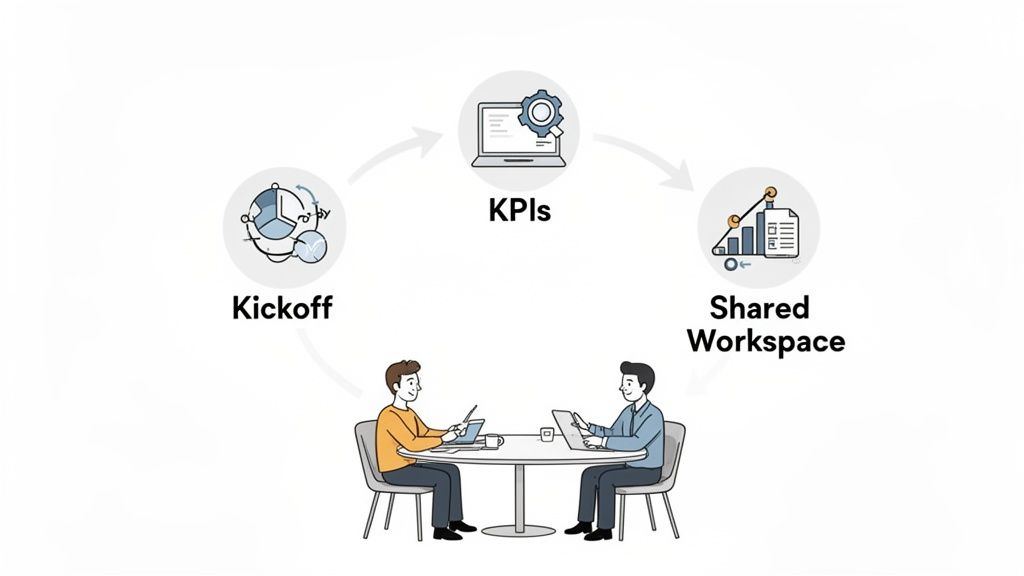
You’ve signed the contract and the first invoice is paid. It's tempting to breathe a sigh of relief and think the hard part is over, but this is where the real work begins. The first few weeks with your new agency will set the tone for the entire relationship.
A messy, disorganized start almost always leads to missed deadlines, misaligned expectations, and a ton of frustration down the road. But if you nail the onboarding, you’ll turn your new vendor into a genuine extension of your team, ready to hit the ground running. It’s the foundation you build everything else on.
The Kickoff Workshop Is Non-Negotiable
Your very first meeting needs to be a proper kickoff workshop. This isn't just a 30-minute hello; it's a deep-dive session to get both teams completely in sync. The whole point is to kill assumptions and build a shared vision for what you’re trying to accomplish together.
The agency should take the lead here, but you have to show up prepared. Make sure your key stakeholders are in the room and ready to dig into the details—your business goals, who your customers really are, and what you’ve tried in the past. It might feel like a big time investment upfront, but trust me, it saves countless hours of rework later.
This kickoff is also the perfect time to establish the project's true north: the Key Performance Indicators (KPIs) that will actually define success.
Defining and Tracking Clear KPIs
Vague goals get you vague results. It’s that simple. Before a single piece of creative is designed or a line of code is written, you must agree on specific, measurable KPIs that tie directly back to your business objectives.
Good KPIs look something like this:
For a Website Redesign: Boost the visitor-to-lead conversion rate by 25% within three months of launch.
For an SEO Campaign: Hit the top five search results for our target keywords and grow organic traffic by 40% in six months.
For a Product Launch: Generate 500 qualified leads from a new PPC campaign in the first quarter.
Your agency should be just as obsessed with these numbers as you are. They need to be able to tell you exactly how their work will move these needles and provide dead-simple, transparent reports showing progress.
Finding an agency that can do this is critical, especially now. The global digital marketing agency market, valued at USD 8.27 billion in 2026, is expected to explode to USD 27.57 billion by 2035, growing at a massive 14.32% annually. With so many options out there, a structured onboarding process is your best bet for making sure you picked a winner. Read the full research about the digital market's growth.
Establishing Communication and Workflow
Miscommunication is the silent killer of agency partnerships. The best way to prevent it is to set clear rules of engagement right from the start. This means deciding on the right tools and agreeing on expectations for things like response times and meeting schedules.
A solid communication plan should cover three key things:
Shared Workspace: Create a single source of truth for all project files, discussions, and updates. A shared Notion board or a dedicated Slack channel is perfect for keeping everything organized and easy to find.
Point of Contact: Designate one person on your side and one on their side as the official point of contact. This stops things from getting lost in endless email chains and ensures accountability.
Meeting Rhythm: Agree on a regular check-in schedule. A quick weekly sync call or even a detailed async update can keep everyone on the same page without bogging you down in meetings.
This structure might feel a bit rigid at first, but it quickly creates a predictable rhythm that lets everyone focus on doing their best work. For more on creating a smooth start, check out our guide on SaaS onboarding best practices—many of the same principles apply.
Still Have Questions? Let's Clear Things Up.
Even after you've done all the homework and sat through countless pitch meetings, some questions always linger. Deciding to bring on a digital marketing agency is a huge commitment for a startup, so it's completely normal to have a few last-minute hesitations. Let's tackle the most common ones I hear all the time.
My goal here is to give you the clarity and confidence to make the right call before you sign any contracts.
What’s This Going to Cost Me?
Ah, the million-dollar question. The honest-to-goodness answer is: it really, truly depends. An agency's price tag can swing dramatically based on their size, where they're based, and exactly what you're asking them to do. There’s no simple rate card.
For a small, one-off project—say, designing a new landing page—you might be looking at a few thousand dollars. But for a full-blown monthly partnership covering SEO, content creation, and design updates, you could see retainers anywhere from $2,500 to well over $25,000 a month. The trick is to shift your thinking from "cost" to "investment." What's the potential return?
How Long Until We Actually See Results?
This is where you need to be patient. How long it takes to see a real impact is completely tied to the marketing channels you're focusing on. Setting realistic expectations from the get-go is probably the most important thing you can do.
Paid Ads (PPC): You can get data and see leads trickling in almost immediately, often within the first couple of weeks, as the agency gets campaigns live and starts tweaking them.
SEO & Content: This is the long game. You’re often looking at 6-12 months of consistent work before you see a meaningful, lasting lift in organic traffic and search rankings.
Any agency worth its salt will be upfront about this. They should hand you a roadmap with clear milestones so you’re not left wondering what’s happening.
If an agency promises to get you the #1 spot on Google in 30 days, you should walk away. Fast. Real growth takes strategy and relentless execution. A good partner sets clear, achievable goals from day one.
Should We Go with a Niche Specialist or a Full-Service Agency?
This really boils down to two things: your most painful, immediate problem and who you already have on your team. A specialist agency brings an incredible depth of knowledge in one specific area, like conversion rate optimization for e-commerce or UX/UI for complex SaaS platforms. They are the masters of one craft.
On the other hand, a full-service agency offers a bit of everything—branding, web development, social media—all under one roof. For most early-stage startups, I find that hiring a specialist to solve a very specific, high-priority problem delivers a much bigger punch. As you scale and your needs get more complicated, that’s when a more integrated, full-service partner might start to make more sense.
How Do We Know if We're Getting Our Money's Worth?
Measuring the ROI of your agency partnership doesn't start with the first monthly report. It starts the moment you onboard them by setting crystal-clear KPIs that tie directly to your business goals.
Forget vanity metrics like website traffic. True ROI is measured by things that actually impact your bottom line:
Customer Acquisition Cost (CAC): Is it getting cheaper to win a new customer?
Customer Lifetime Value (LTV): Are you bringing in better customers who pay more over time?
Conversion Rates: Are more visitors turning into leads, trials, or paying customers?
Sales-Qualified Leads (SQLs): Are the leads coming in actually high-quality enough for your sales team to close?
Your agency should be sending you regular, easy-to-understand reports that connect what they do every day to these crucial numbers. That's how you know your investment is actually working.
Ready to stop searching and start building? At Shalev Agency, we partner with startups to turn ambitious ideas into high-converting websites and products that drive real results. Let's talk about what we can build together.